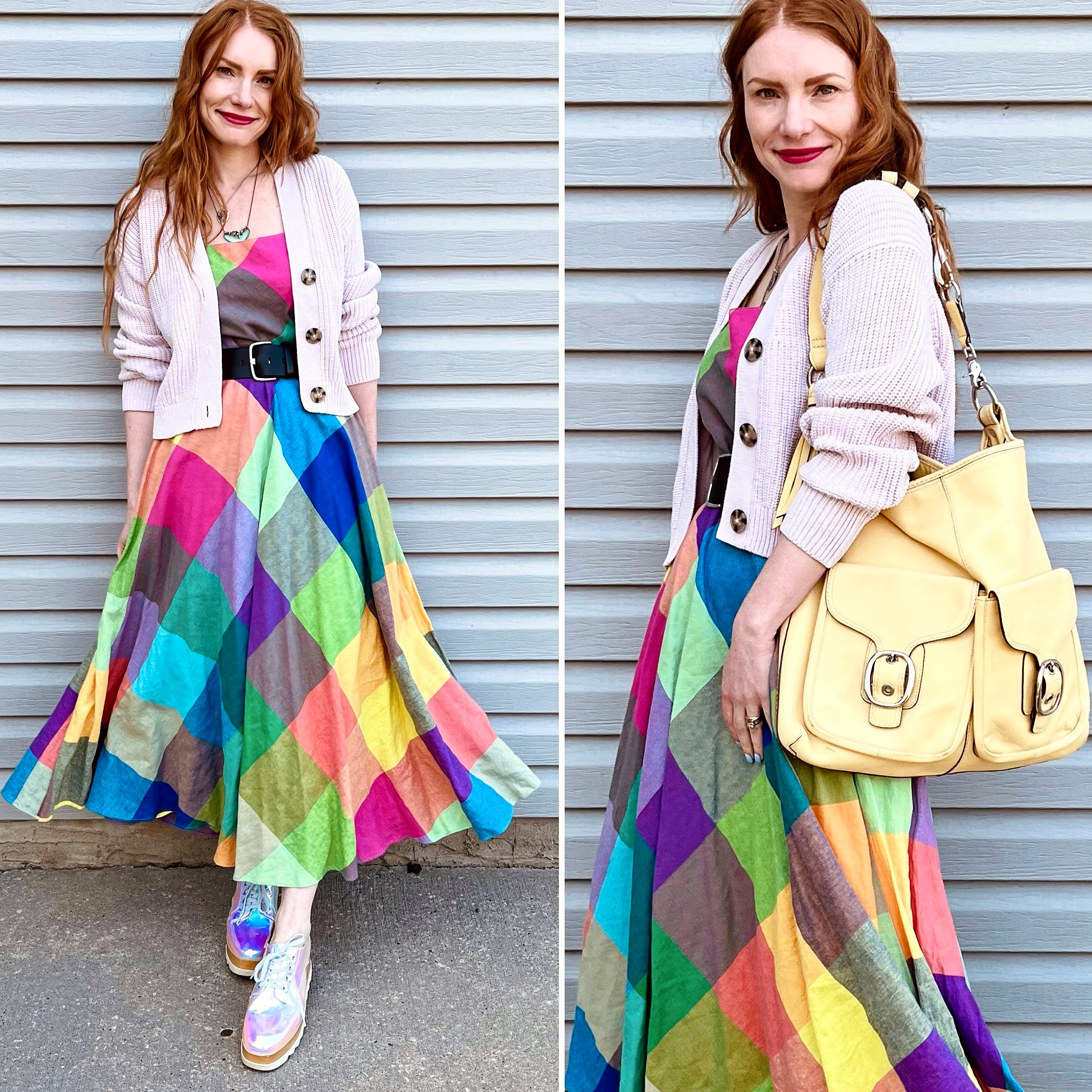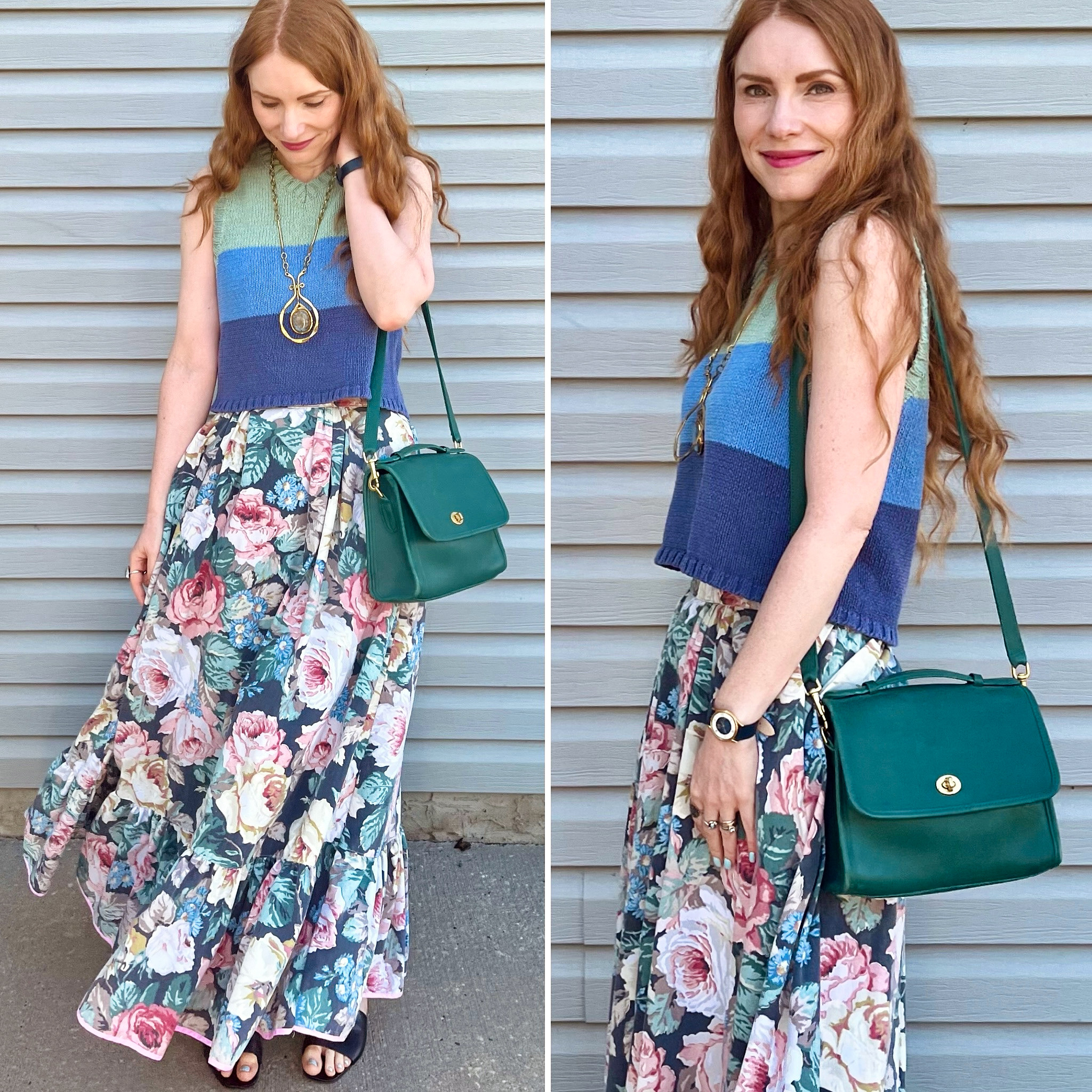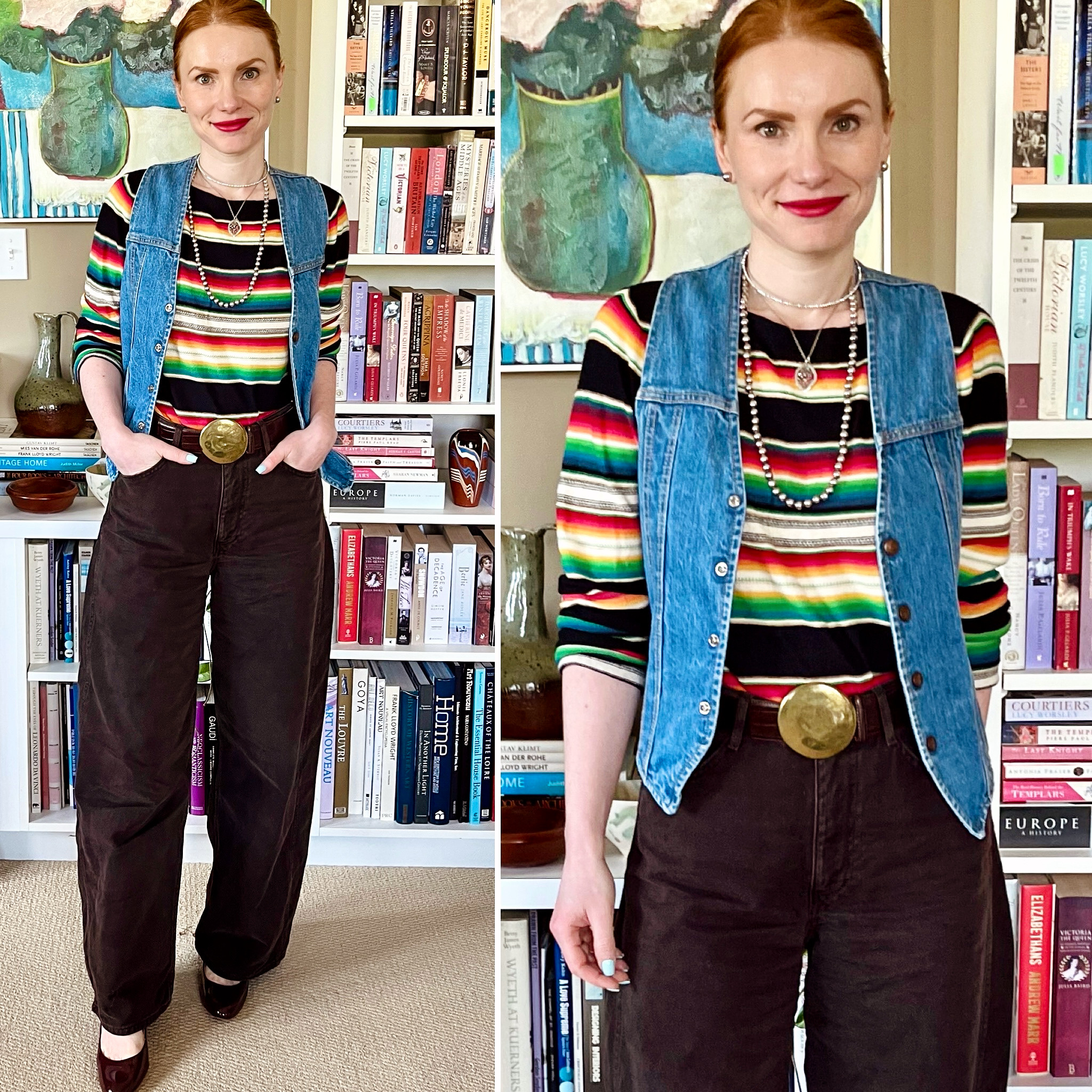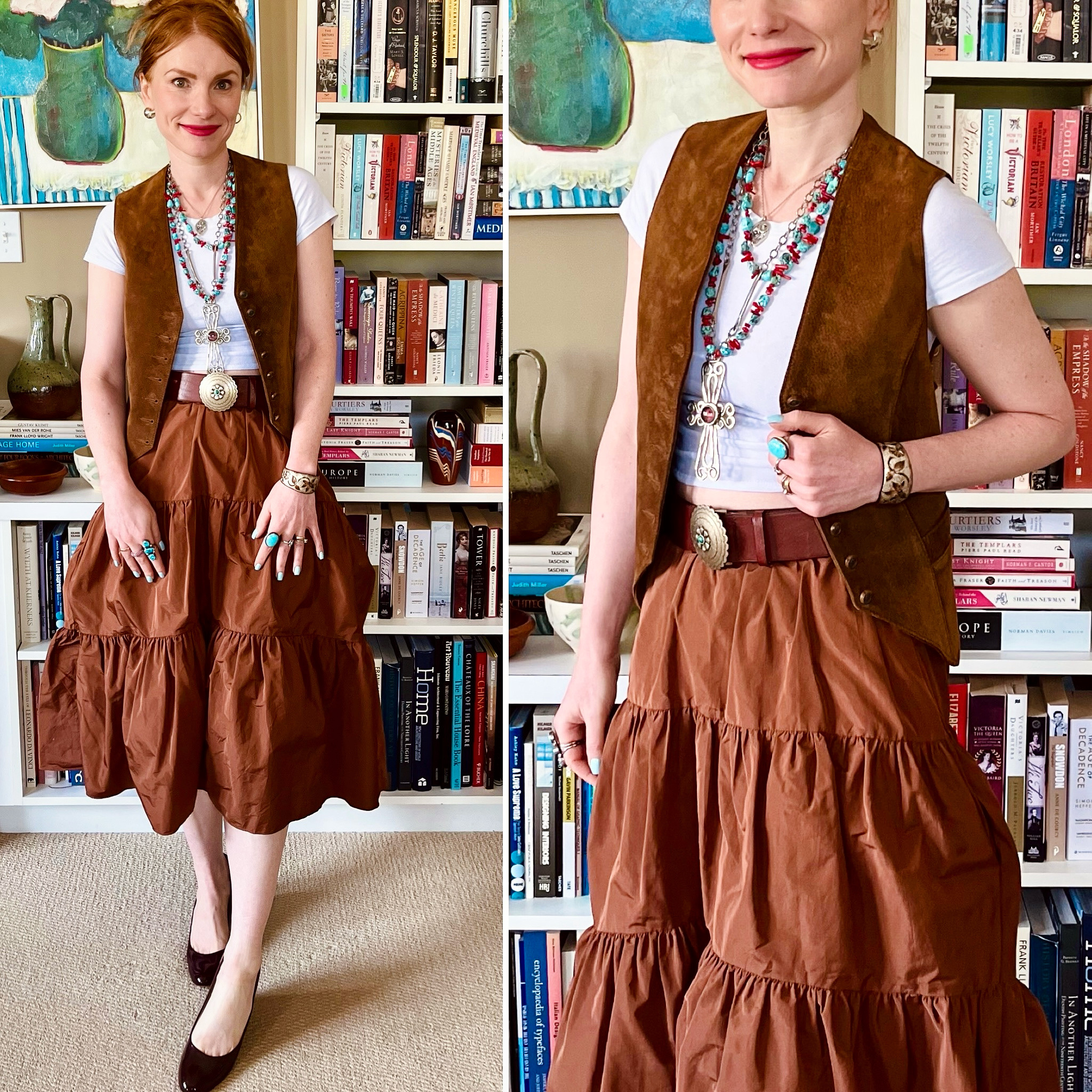
Tales of Thrift: On Wednesdays We Wear Whatever (pt. 1)

Editor’s note: hi, it’s me, I’m the editor. I’m adding this as a kind of introduction slash context for this new series, Tales of Thrift. The content of this series is adapted from the Memoir That Never Was, which I wrote last year. Its themes centered on identity-making and my relationship with secondhand stuff, but in writing it, I ended up synthesizing ideas that have been pivotal to my growth as a person since turning 40. Although I ultimately shelved my Memoir That Never Was indefinitely, I’ve decided that there are parts I would like to share here on the blog. It will get pretty personal/vulnerable at times, but I think the community we’ve created here is a wonderful (and safe) space, and I hope that these posts will inspire reflection and conversation. Cheers!

Have you ever looked at your overflowing closet and thought, “God, I have nothing to wear!” as you scrambled to pick something to wear to the job, appointment, or party you’re already 10 minutes late for? Isn’t that the worst? Nothing is more guaranteed to kill a good mood faster, or make you want to crawl back into bed and tell the world, “sorry, better luck tomorrow.” Or is that just me? Because I’ve been there, and sometimes it wasn’t just an ‘off’ day. Sometimes it was, like, an entire month. When that happens, I know it’s time for a check-in: something is rotten in the state of Denmark Adina, and I must find out what it is. Clothes are just clothes, except sometimes they aren’t.

Wait. Let me rephrase that. For some people, clothes are just clothes. Period. End of chapter. Just kidding – let’s continue. Since the invention of the loincloth, clothes have provided functional utility and, since we moved out of caves, social utility too. We wear clothes because they protect our bodies from the environment and because they tell other people who we are and what we’re doing. An office worker and a farmer wear different things for both of those reasons. And those reasons represent the sum total of what clothes do and mean for some people. Let’s call those people Functional Clothes Wearers. Think of Steve Jobs, the man who single-handedly spawned the “successful people wear uniforms” think-piece cottage industry. He famously wore the same thing every day, a black turtleneck and jeans. Maybe he did it because, as some people suggested, he wanted to create a personal brand that set him apart from other CEOs. Maybe he did it for the same reason Barack Obama told people he only wore gray or blue suits – to pare down decisions, eliminating the trivial (what to eat, what to wear) in order to focus on the critical (running a global empire, presumably). Either way, for Functional Clothes Wearers, function trumps form; to them, the fashion industry occupies the same mental space as the car industry does for me – I know it’s there but I never think about it until it’s time to buy a new car, at which point I pick whatever car-shaped object fits my driving needs and budget. Steve Jobs wore turtlenecks made by Issey Miyake rather than Walmart – I would too, if I had the money – but I don’t think he was a front-row regular at any fashion shows.

There is a second group of people, whom I am going to call Creative Clothes Wearers. I am not using the term “creative” as a descriptor of their style, but rather as a way to describe the way in which they relate to clothes. For this group, wearing clothes is a creative act – a means of self-expression, like writing or painting. Function matters, of course, but function can be served in different ways, and it is the choice of form that is important to Creative Clothes Wearers. For these folks, picking a suit is not a trivial decision to be automated in service of greater efficiency. It is an opportunity to communicate – not as a matter of necessity or convenience, but as art. For Creative Clothes Wearers, an outfit isn’t the email you write to your boss about the quaterly sales report; it’s the novel you write so the world can understand your point of view.

Functional Clothes Wearers and Creative Clothes Wearers are fundamentally different. Not better or worse, just different. Everyone falls somewhere along the spectrum between Functional Clothes Wearers and Creative Clothes Wearers. It doesn’t matter where you fall, but I think it’s helpful to know where you fall, because that determines how you can best maximize your happiness when it comes to fashion and clothes. If you’re closer to the Functional Clothes Wearer end of the spectrum, having to constantly pay attention to fashion trends, updating your closet every season, or even just thinking about personal style can feel bewildering, overwhelming and, ultimately, frustrating. It’s like being asked to write an essay on philosophy, when all you want to do is send a quick text message to your husband about picking up some milk on the way home. Functional Clothes Wearers want to look nice and feel good in their clothes as much as everyone else, but there is no particular joy in thinking about clothing a second longer than necessary to decide if something looks cute, feels comfortable, suits the climate and their boss’ expectations. If that sounds like you, here’s my unsolicited advice. You don’t need to pick three words to describe your style, hell, you don’t need to have a personal style. You can just wear clothes. Any clothes that you like, find comfortable, and consider appropriate to your situation. That’s it. Nobody is going to think less of you if you’re wearing a pair of jeans from 3 trend cycles ago, because people in general don’t think that much about what other people are wearing and also because most of them have no idea what a trend cycle is. You wanna know what I say when I see someone who is wearing skinny jeans in the year of our Lord 2025? Nothing. What someone else is wearing is none of my goddamn business as it has absolutely zero impact on my life. You wanna know what I – a self-professed Creative Clothes Wearer who spends an inordinate amount of time pondering the meaning of clothes – think when I see someone wearing skinny jeans? Assuming I have even noticed it – because, like most people, I’m probably otherwise occupied ruminating about what I’m wearing or, better yet, about what I’m having for lunch – this is what I think: here is a person who either really loves skinny jeans or doesn’t think about jeans very much at all. As is their prerogative.

Did you hear that? That was the sound of a value-neutral statement. Do you know why I’m wasting time pointing out something obvious like that? It’s not that I don’t trust your reading comprehension; I just feel that this is a point worth belaboring. There are some absolutes in life, but mostly there are choices that exist outside of an objective binary – good and bad. What makes a choice good or bad is a subjective valuation each of us brings to the question and, short of a situation where that choice directly impacts another person, the answers can never be categorically wrong. I think avocadoes are gross, but I don’t think it’s gross that my husband loves them. His love of avocadoes does not threaten my personal worldview; I don’t need to convince him that I’m right, that avocadoes are gross and that he should buy muscat grapes instead. (Although he should, because I adore them, and he should also let me eat all of them.) I’m using a dumb example here, but go into any comment section on any social media platform, and you will see a million of them.

“Cute dress! I would never wear that though – it’s so short.”

 “That paint colour makes the room look really dark – it would look so much better beige.”

“You’re putting up your Christmas tree in October? Wow, that’s so early!”

“You’re putting up your Christmas tree in December? My kids would never let me do that …”

The only rational and relatively polite response in each and every one of those cases is “OK, and?” Most social media comment sections are a waste of time because they’re taken up by people dumping out their insecurities, stream-of-consciousness style, in the pursuit of validation they will never get because why would anyone stop what they’re doing and go “wow, Random Person I’ve Never Met, you are SO right: my house should have been beige all along, what was I even thinking – of course there is only one right way to decorate and you nailed it!” To avoid inadvertently becoming one of those people, I have a very simple rule I use in deciding whether or not to post a comment on someone else’s social media content. It goes like this: am I writing an unqualified compliment? Hit send. Am I writing anything else? No, I am not. That’s it. I told you it was simple. I know what you might be thinking: some people post stuff asking for opinions – surely, then, it’s acceptable to give one. And I am not going to disagree with you, but I will gently point out that unless it’s a question posed in a friends group chat, it’s probably just a ploy to hit engagement metrics. Personally, I ain’t got time for that, but you do you.

But let’s hop off this tangent and return to fashion. You might think that because I’m a person who views clothing as a form of self-expression, I am constantly trying to “read” what other people are saying with their outfits. I do … and I don’t. In depends on the person. It’s quite easy to spot someone who is trying to express something through their clothing versus someone who is simply wearing clothes. Even Functional Clothes Wearers can recognize it, though they may not always be able to put their finger on why. It’s what we are referring to when we say that a person has “style”. Personal style is like a signal that says “subtext here, read at your own leisure”. You may or may not have the time and inclination to do it. But the invitation is there. On the other hand, if there is no subtext – if someone is just wearing clothes and going about their day – there is nothing to ponder. Sometimes clothes are just clothes.

This is a good time to bring up an important distinction. Style isn’t the same thing as an iconic look. Marilyn Monroe and Steve Jobs both had iconic looks, a visual identity that was instantly recognizable and never changing. As Philip Mann writes of Hollywood stars, “the secret is to project an innate personality through an identifiable style and to stick to it for evermore.”[2] As with any archetypes, there is only so much you can parse in an iconic look. It is, inherently, a finite and supra-personal text. Iconic looks represent an act of invention, not an act of expression. Personal style is the opposite. It is rarely static, because people are not static; what they have to say, and how they want to say it, changes as they change. I am not necessarily talking about radical transformations, although they can happen– sometimes, punks do grow up to become middle-managers – but the small, sometimes infinitesimal shifts that shape the course of our lives.

To be continued … [next week]


[1] But since we’re on the topic, my opinion is that anyone who makes a snide comment about another person’s clothes is an asshole with an inferiority complex. I was that asshole once, and therapy-ing the shit out of my inferiority complex magically cured me of the inability to mind my own business.

[2] Philip Mann, The Dandy At Dusk: Taste and Melancholy in the Twentieth Century, 2017, p. 221
Friday Feels #6

What is time? No, seriously, guys. How is it the middle of July already? My birthday’s in 2 weeks? What?!? I feel like I’m on a rollercoaster ride that’s going so fast, I don’t even have time to yell “let me off”. I guess that’s one way to go with the flow, hah.

It wasn’t a particularly busy week but it was also not not busy, if you know what I mean. I spent a good chunk of it working on my eleventy thousand edit of A Party to Murder, this time with the goal of getting the word count down from 115,000 to 95,000 words. I did it … just. Had to sacrifice some bits of my B-plot, but hopefully this strengthens my story overall. And I’ve learned my lesson; in the future, under-writing my first draft is the way to go. For me, it’s much easier to add wordcount during editing than it is to cut it.

Somehow, I was able to do a few fun things too. I’m currently trying to source comps for my current WIP (which I will need when I go to query) so I’m adding lots of books to my TBR list. This week, I read Alex Pavesi’s The Eighth Detective. Really enjoyed it, though it turned out not to be a good comp for my book. I picked it up because I saw it being compared to Stuart Turton’s Seven Deaths of Evelyn Hardcastle, but I actually found it more similar to something like Anthony Horowitz’s Mayflower Murders series. A mystery within a mystery with a writer/editor who is also a sort of amateur sleuth. Fun and twisty.

Last weekend, I picked up some books at the thrifts, including the companion illustrated “guide” to the show Victoria. Flipping through it made me feel nostalgic, so I ended up re-watching Season 1. I remember being obsessed with it when it first aired. I kinda blew my own mind when I realized that was in 2016. Coulda sworn it was only 5-6 years ago. Sigh. It was interesting to see it again, 9 years later. Weirdly, I was Team Melbourne back in the day, and now I found myself leaning Team Albert. I’d forgotten how cute Tom Hughes is. Anyhoo. I’m now locked in to watch Seasons 2 and 3, which I never saw the first time around. The show’s historicity is pretty typical of the genre, but it mostly works for me. It’s definitely entertainment first, history second, but it’s not total fantasy either.

I’m super pumped for the weekend. It’s my son’s birthday on Sunday; he’s turning 14. Seriously, what is time? He’s already had his birthday party, so the celebration this weekend will be super chill. On Saturday, we’re doing a day trip to Ponoka for their town-wide garage sale. We went a couple of years ago, and the whole fam had a blast, so we’re very excited to do it again. Hopefully, the weather cooperates because it’s been getting preeeetty smoky here this week.

Have a great weekend!

Tales of Thrift: The Golden Era

Editor’s note: hi, it’s me, I’m the editor. I’m adding this as a kind of introduction slash context for this new series, Tales of Thrift. The content of this series is adapted from the Memoir That Never Was, which I wrote last year. Its themes centered on identity-making and my relationship with secondhand stuff, but in writing it, I ended up synthesizing ideas that have been pivotal to my growth as a person since turning 40. Although I ultimately shelved my Memoir That Never Was indefinitely, I’ve decided that there are parts I would like to share here on the blog. It will get pretty personal/vulnerable at times, but I think the community we’ve created here is a wonderful (and safe) space, and I hope that these posts will inspire reflection and conversation. Cheers!

Once you get to a certain age, it becomes physically impossible not to start referring to specific times in the past as The Good Old Days. Sorry, I don’t make the rules. If you’re over 40 and this hasn’t happened to you, don’t be too smug; there will come a day, sooner or later, when you’ll wake up in the morning feeling like you’re coming off a three-day bender because you went to bed after 10:00PM, and the words “things used to be different back in the day” will escape your lips before you even realize what is happening. You will try, for a while, to keep those words to yourself – biting them back or muttering them under your breath – but it’s a losing fight. Those words will come out of your mouth eventually, and people around you will hear them and, congrats, you will officially become an Old Person at that moment. But listen! The truth is that thrifting really was different back in the day, and that day wasn’t all that long ago. I don’t know exactly when the Golden Era of Thrift started, but it was still in full swing by 2016 when I thrifted my first Burberry trench for $8 at Goodwill. For the next couple of years, it seemed impossible to walk into a thrift store and not come out with an armful of designer clothing. Yves Saint Laurent, Dries Van Noten, Etro, Marni, Christian Louboutin, Issey Miyake, Rick Owens, Valentino, Ferragamo, MaxMara, Jil Sander, Moschino, Alexander McQueen, Erdem … I can keep going, but you get the point. My closet got luxurified (not a word, go with it) practically overnight. And not a moment too soon, because the Golden Era ground to a halt by the end of the decade; 2019 was the last great year of thrift, not that I knew it at the time. If thrifting were the Roman Empire, we are now in the decline and fall phase, minus deranged emperors and barbarians at the gates. As Alanis might say: isn’t it ironic that, at the very same time, thrifting has never been more popular?

The first hint I had that things were a-changing came in early 2021 when I read Adam Minter’s Secondhand: Travels in the New Global Garage Sale. The book, which extensively documents various facets of the multi-billion global secondhand industry, makes the argument that thrift stores are facing a very real crisis thanks to a rising tide of unwanted secondhand – a crisis not of volume, but of quality. Simply put, thrift stores have no future if all they have to sell is crap. It doesn’t matter how cheap it is; nobody wants to buy crap. And I mean nobody. Historically, the Global South was the final destination of unsold secondhand goods originating from the affluent northern hemisphere, but as its populations become increasingly sophisticated players in the capitalist game, they are less willing to accept low quality secondhand goods, particularly at a time when their preference for and access to new goods is growing rapidly. Minter writes persuasively, backing up his argument with plenty of data, but as I read his book, my first instinct was to scoff. Just a few weeks prior, I had found a Gucci blouse, Alexander McQueen flats, and a Carven skirt at my favourite Value Village store in a single visit: what crisis of quality? Maybe one existed in the places Minter visited for his research; surely it did not exist everywhere. Not in Edmonton, anyway. Thrift stores were getting better here, not worse – even the pandemic had barely slowed things down.

Or so I thought.

What I didn’t know in 2021 was that I was witnessing the tail end of thrift’s glory days. Over the next couple of years, the reality began to sink in as the quality of thrift merchandise started to nose-dive. Minter was right. Thrift stores are facing an existential threat and it remains to be seen whether we – the global, collective “we” – will find a solution that allows them, along with the entire secondhand industry, to survive into the next century. One thing is for sure: the Golden Era of Thrift is over, for now at least. The reasons are probably too multifaceted and complex for someone like me to summarize without making a hash of it, but hey – when has that ever stopped me? Let’s give it the old college try.

The ramp-up in global mass production, from the 1980s onwards, made secondhand the multi-billion-dollar industry it is today and also sowed the seeds of its destruction. Mass production required mass consumption in order to be profitable, so consumers had to be encouraged and cajoled to buy, buy, buy – which they did, because capitalism is phenomenally good at selling things to people. All that mass consumption left people with more stuff than they could use or even fit inside their homes. The excess had to go somewhere; what didn’t go straight into landfills ended up in thrift stores – and antique malls, and flea markets, and eBay. The secondhand industry grew at a similar pace to the retail industry, which is to say exponentially over the last 40 years. What hasn’t grown at an equally impressive rate is people’s income. How can you keep selling more, and more, and more to people who have less, and less, and less to spend? You sell everything for cheaper. Nothing in life is free, though – especially not in a capitalist system – so cheaper prices mean lower quality. There are two corollaries of low quality which create a feedback loop for mass consumption. One, low quality functions as a kind of planned obsolescence; cheaply made goods tend to fall apart faster and need replacement sooner. Two, low quality together with low prices create a perception that goods are disposable and not worth the effort to care for and maintain over a long period of time. Fast fashion clothing is often discarded even before its low quality has rendered it unusable. Why take the time to properly launder a $15 shirt if you know it’s going to fall apart in a year anyway and meanwhile you can just buy another one for $10 – prices always being in a race to the bottom? The more we buy cheap things, the more we buy.

Clothing quality in particular has declined at an ever-faster rate since 2008. At that time, most mass-market clothing brands and retailers found it necessary to pivot to the fast fashion business model in order to remain profitable in the wake of the Global Financial Crisis. Once consumers grew used to cheap prices, there was no going back … nor any reason to. As it turned out, people didn’t seem to miss the higher quality of pre-fast fashion clothing – or, if they did, not enough to stop buying cheap clothes. Over time, this redefined consumer expectations. People forgot that cotton tees used to be thick enough to be opaque, or that pockets in women’s dresses hadn’t always been a luxury. Writing in 2012, Elizabeth L. Cline observed this phenomenon already in full swing. Speaking to a young designer, she was told:

“… something even more shocking: “There are very few high-quality garments being produced at all. A very, very, very small amount. So small that most people never even see it in their lifetimes. People are wearing rags, basically.” That is tragic, I thought, and the more I learned about the history of fashion, the more I was convinced she was right. Quality has been whittled away little by little, to the point where the average store-bought style is an extraordinarily thin and simple, albeit bedazzled and brightly colored, facsimile of a garment. Yet, I suspect few consumers born after 1980 have any idea what they’re missing.”[1]

I feel called out, Elizabeth! But anyway, there is now an entire new generation who joined the market after 2008 and has never known anything except fast fashion. It is no wonder that Gen Z has embraced the latest wave of fast fashion, as embodied by Shein, Temu and the like; if, to someone like me, Shein represents the nadir of the fashion industry as I know it, for this generation it is simply business as usual. And, no, it’s not a coincidence that I picked 2019 – which marked the beginning of Shein’s rise to global prominence – as the end of thrift’s Golden Era.

So, what exactly was that Golden Era? In my working hypothesis, it was a period defined by the confluence of several factors: the economic bull-run of the 2010s; rising levels of consumption fueled by declining prices and the growing popularity of online shopping; the juxtaposition of the everything-is-disposable mindset and increasing awareness of climate change issues; and changing demographics. Cheap credit made everything, including luxury goods, more accessible and, in turn, more disposable. People binged consumer goods and looked for ways to purge not only the excess but also their consciences. Baby boomers began retiring and downsizing their homes; the contents of those homes, accumulated over a lifetime (or even several generations), needed a place to go. Everything – the bad, the good, and, occasionally, the exceptional – found its way into thrift stores. There may have been other factors at play as well; I’m not an economist, ok? All I know is that, for a time, the decline in the quality of goods which found their way into thrift stores lagged behind the decline in quality of new retail goods, even as the volume of thrift donations surged. That lag was thrift’s Golden Era. Treasures were plentiful, and thrift prices were low precisely because treasures were plentiful. It couldn’t last forever, though for a while it seemed like it might. The supply of older, higher quality goods is ever dwindling, while the quality of new goods coming onto the market continues to decline. The pandemic wreaked havoc on everything, not least of all on people’s financial means, further shrinking the retail market for high-quality goods. What remains of those high-quality goods in circulation is increasingly being diverted away from thrift stores thanks to resale platforms like Poshmark, ThredUp, Depop, and eBay, which allow people to recoup a portion of their sunk costs. As the volume of goods being donated keeps rising and the quality keeps declining, thrift stores face a double whammy: they have fewer good items to sell to their customers, which means less revenue, and more crap to dispose of (often via landfill), which means higher operating costs. It is no wonder, then, that thrift prices keep creeping up; the thrift stores’ math ain’t mathing otherwise.

By the time the general public was starting to hear about thrift’s Golden Era, it was already nearly over. This isn’t just my pessimism talking; I have seen it with my own eyes. It’s as if, around 2021, someone turned the tap off; since then, designer stuff has all but disappeared, what mall brand items can be found are often in poor condition, and rack are overflowing with Shein clothing that makes Zara look like haute couture. And it’s not just clothing that’s going to the dogs. Other categories, like furniture and housewares, are suffering a similar fate. Turn over any random item in a thrift store and you’re more likely than not to find a sticker from HomeSense or, worse, Dollarama. To add insult to injury, that sticker is likely to display a price only marginally higher than what the one being charged by the thrift store. Forget trying to find a treasure; even bargains seem harder to get these days. Meanwhile, a whole new group of people, hyped on tales of the Golden Era, are joining the ranks of thrifters searching for those increasingly elusive treasures. I’ve often wondered how many of them feel disappointed by what they find (or don’t find) and end up deciding that thrifting is overrated. If TikTok is any measure, the answer would appear to be “not many”. In truth, that question is simply a projection of my own growing nostalgia, as an Old Person who remembers the way things used to be and aren’t anymore.

So, yeah: I know how lucky I’ve been in my thrifter’s journey. I was in the right place at the right time and built a life for myself that wouldn’t have been possible without thrifting – a life rich in beauty acquired without extraordinary wealth. The window of opportunity for others to do the same is closing. As Adam Minter prophesied, we are facing a crisis of quality, which does not belong to the secondhand industry, but to our culture as a whole. The way we consume and how we relate to the things we consume must change if we want to avoid that crisis becoming an irreversible disaster. Here are two cents and a sermon you can’t take to the bank: we should buy less and only buy what matters. We should buy things because we value them, not because they are cheap. We should honour that value in the way we handle those things while they are in our possession, and we should honour it when they pass out of our hands. This is not a modest proposal. For those of us stuck in the trenches of late-stage capitalism, it is a fucking massive ask. It’s asking for nothing short of a philosophical revolution. It’s scary and it’s hard and the alternative is unthinkable so here we are. We need thrifting to help us become revolutionaries. We need thrifting to have a future, but it’s up to us to write it.


[1] Elizabeth L. Cline, Over-Dresssed: The Shockingly High Cost of Cheap Fashion, 2012, p. 90