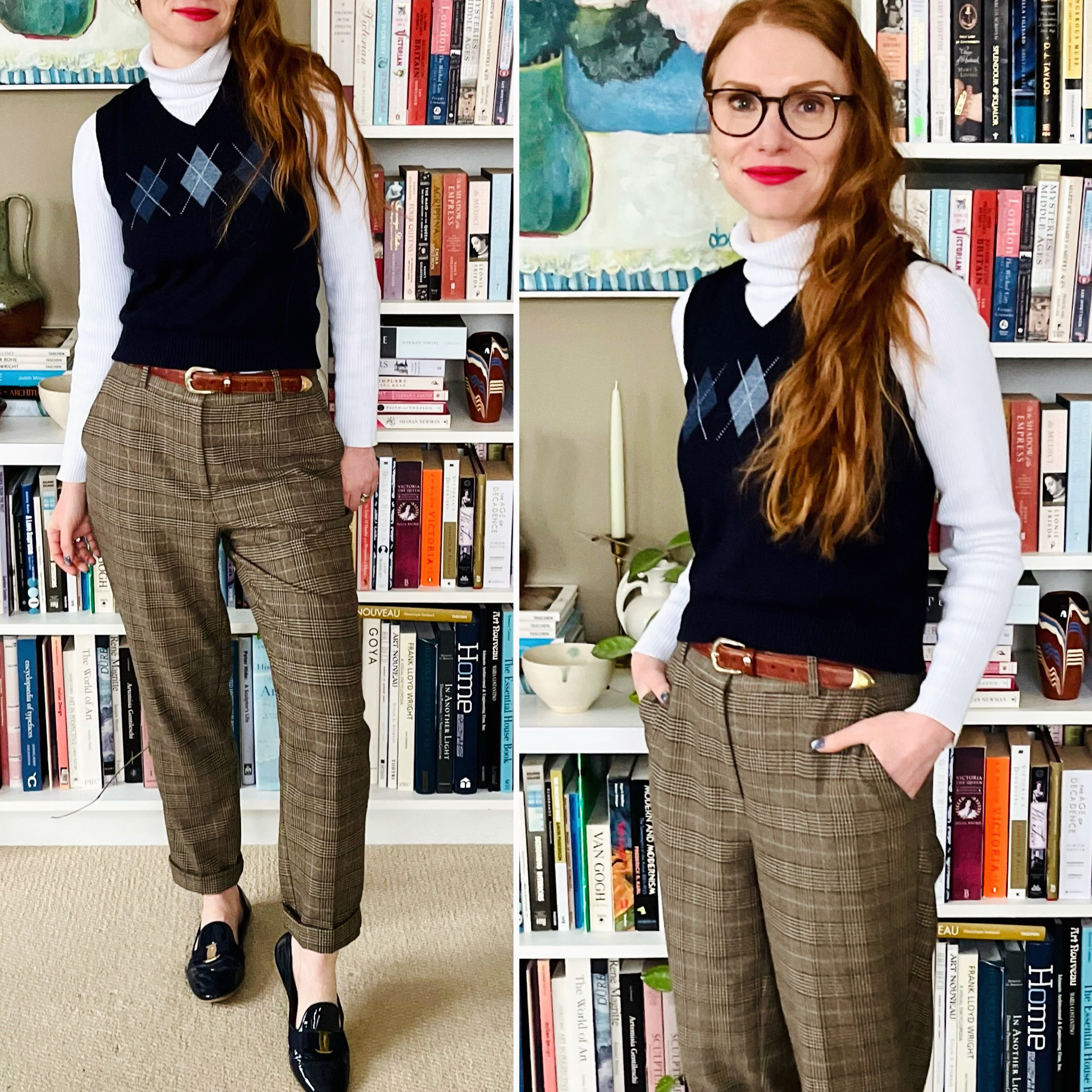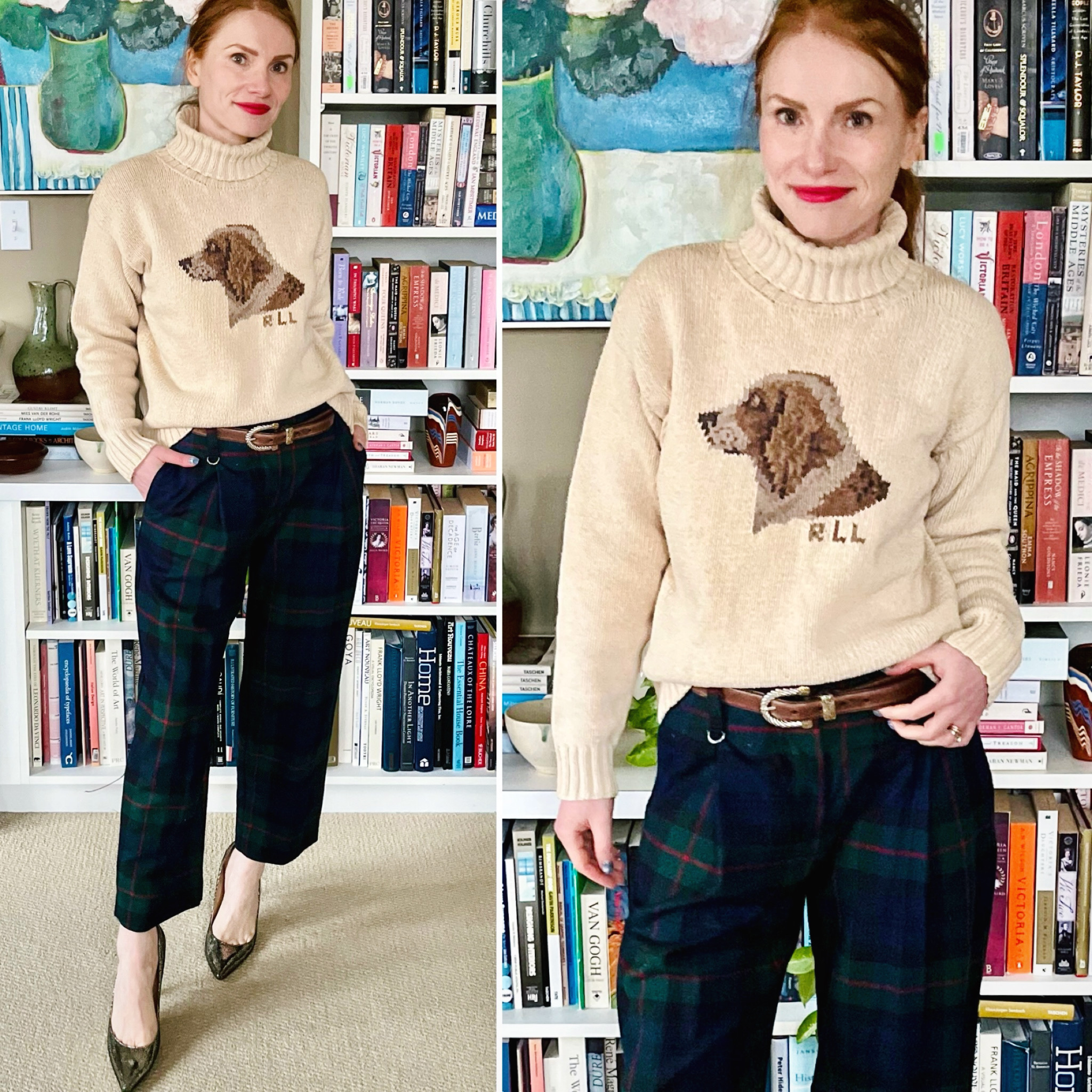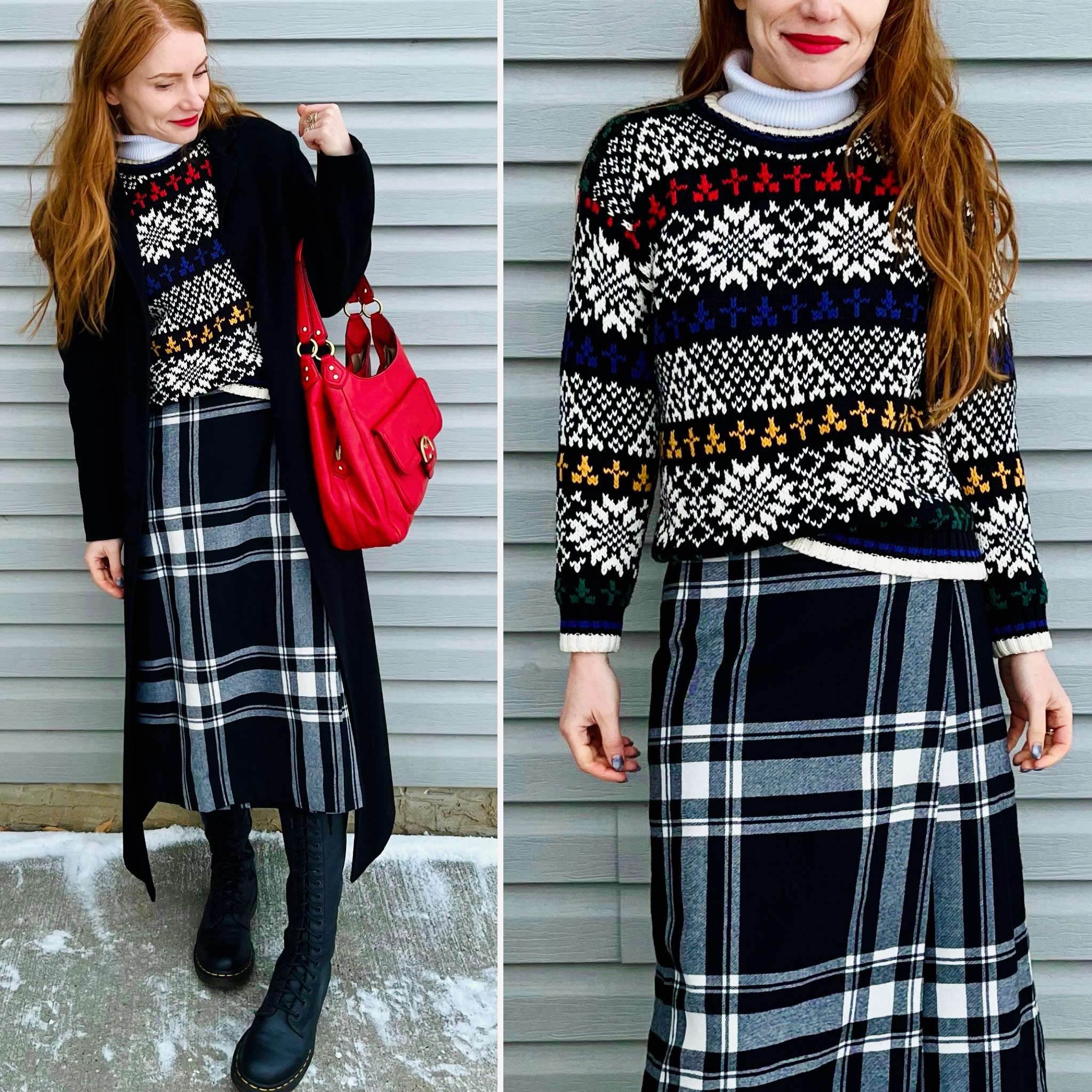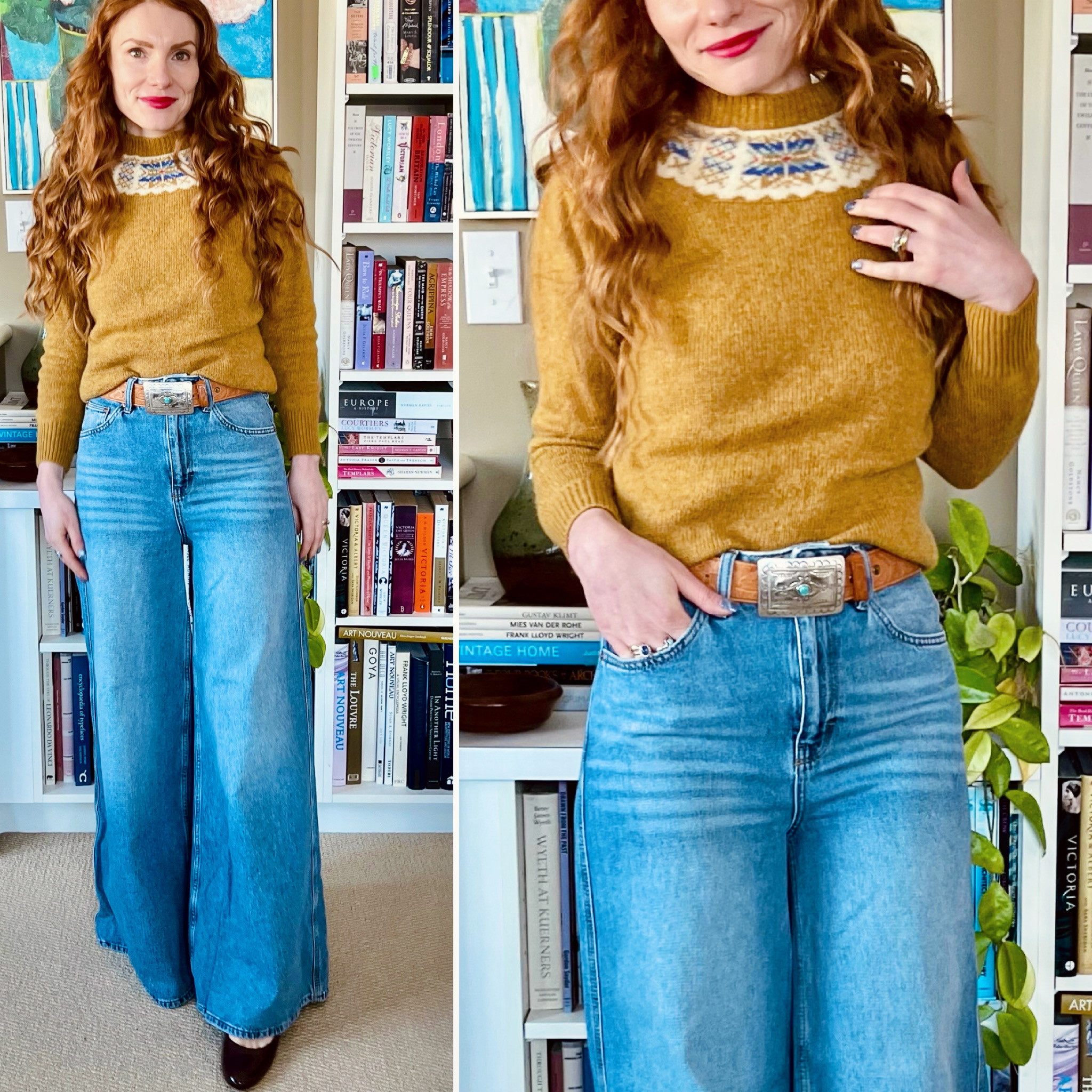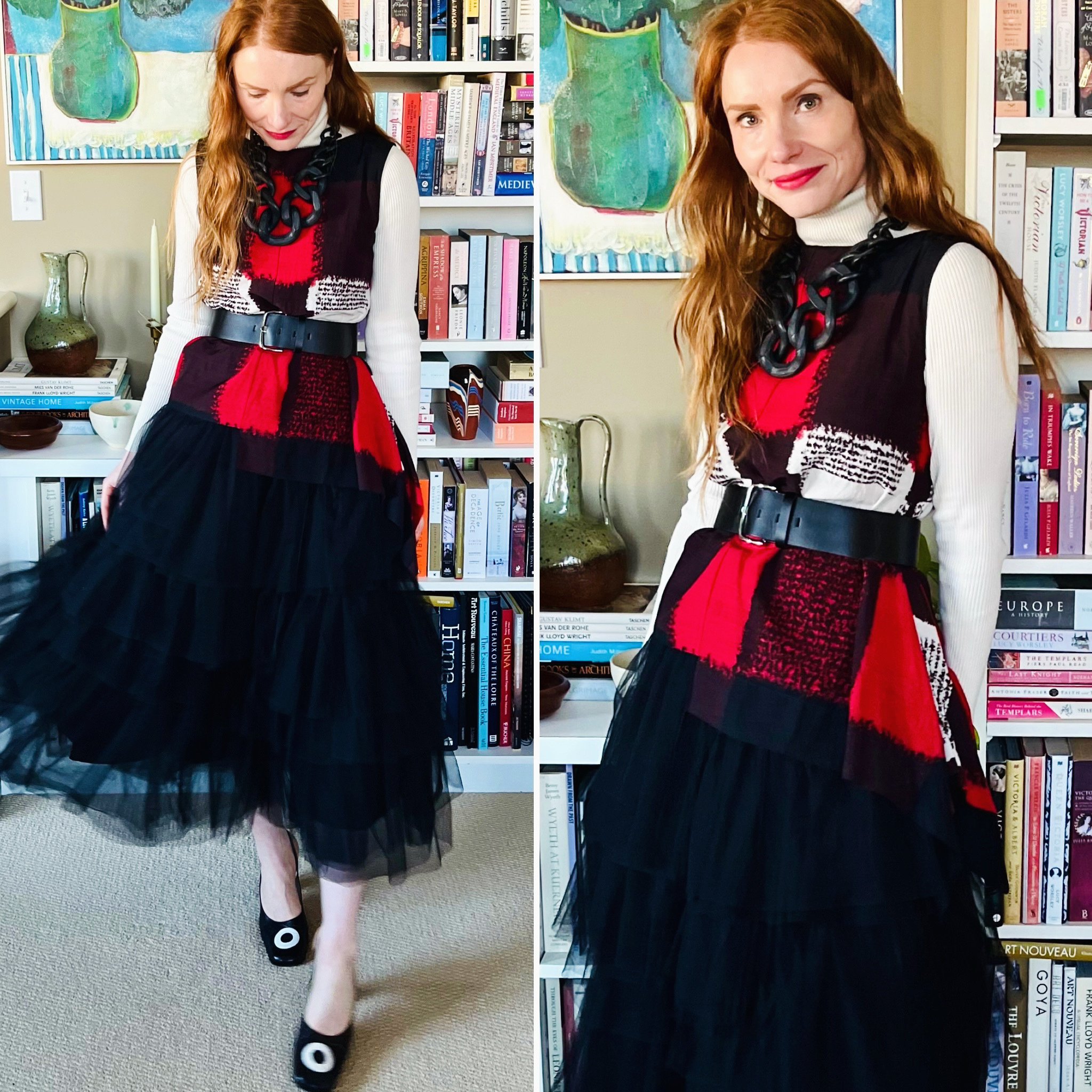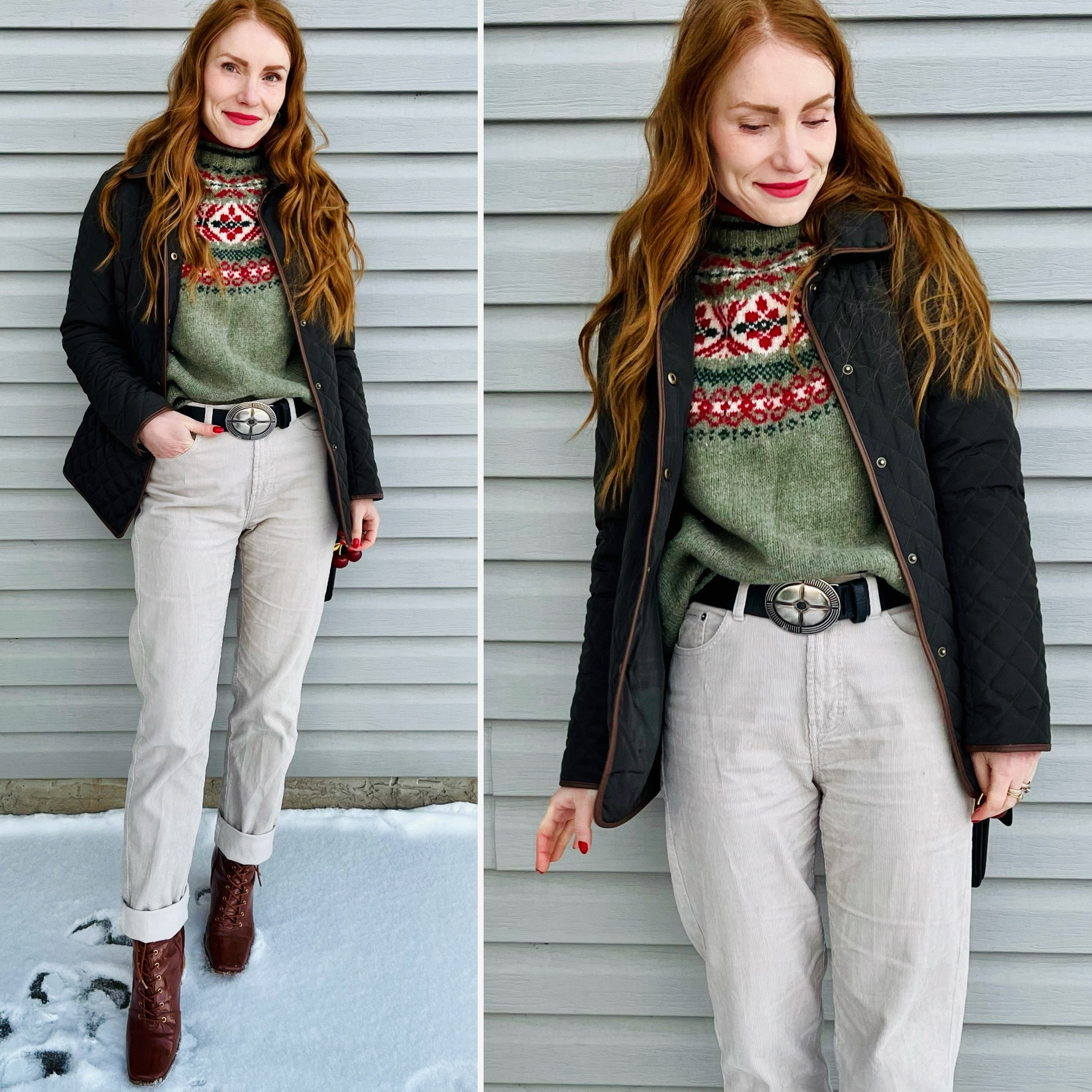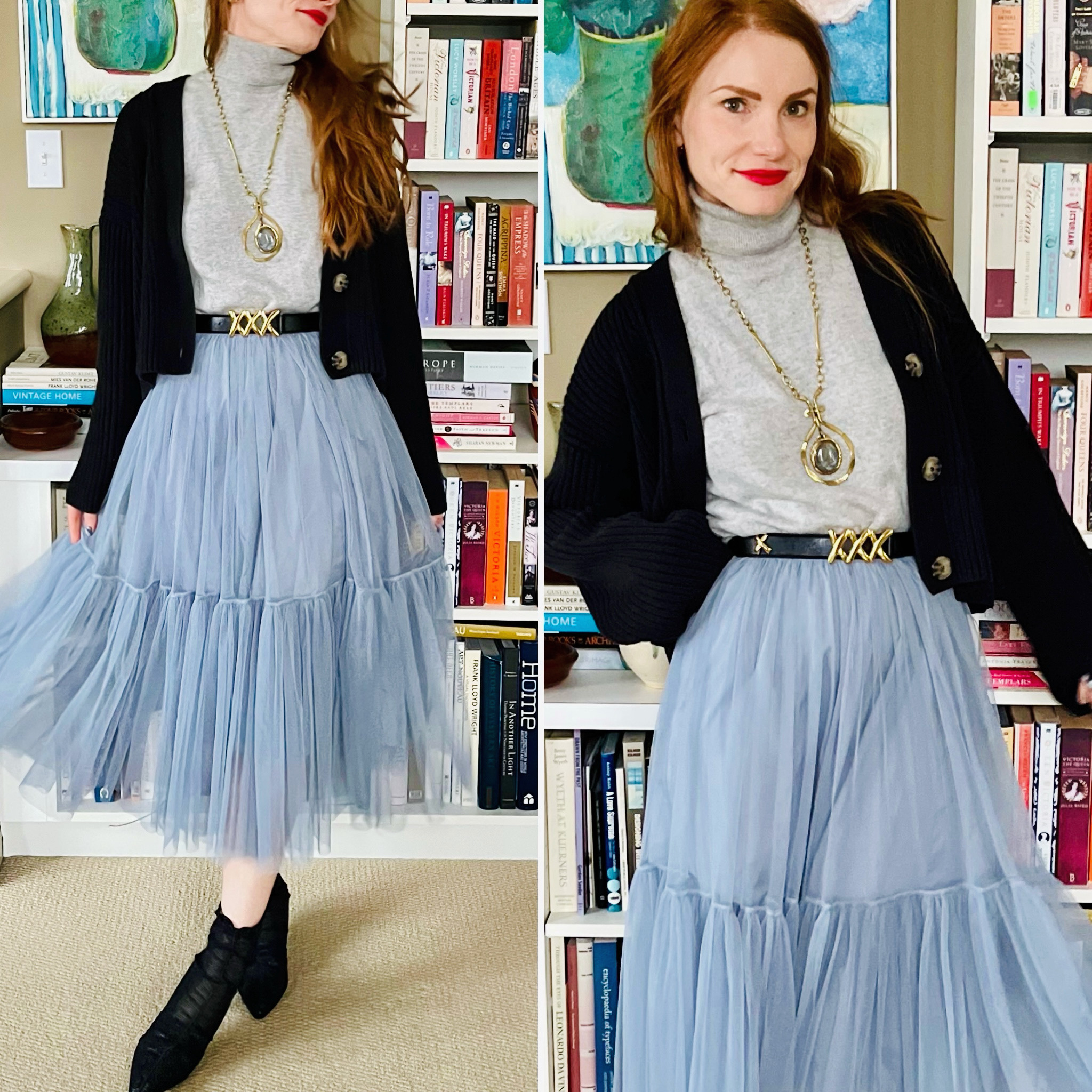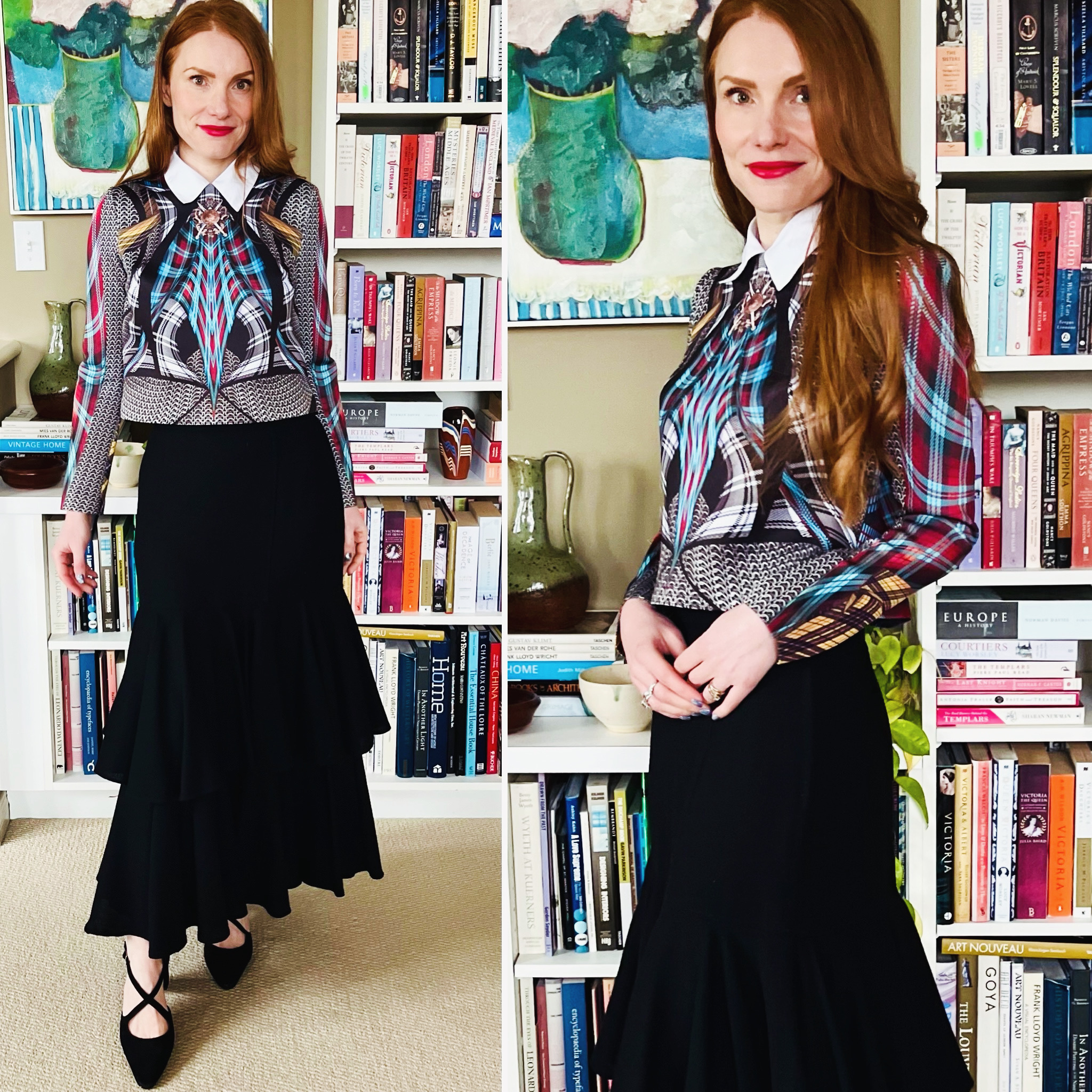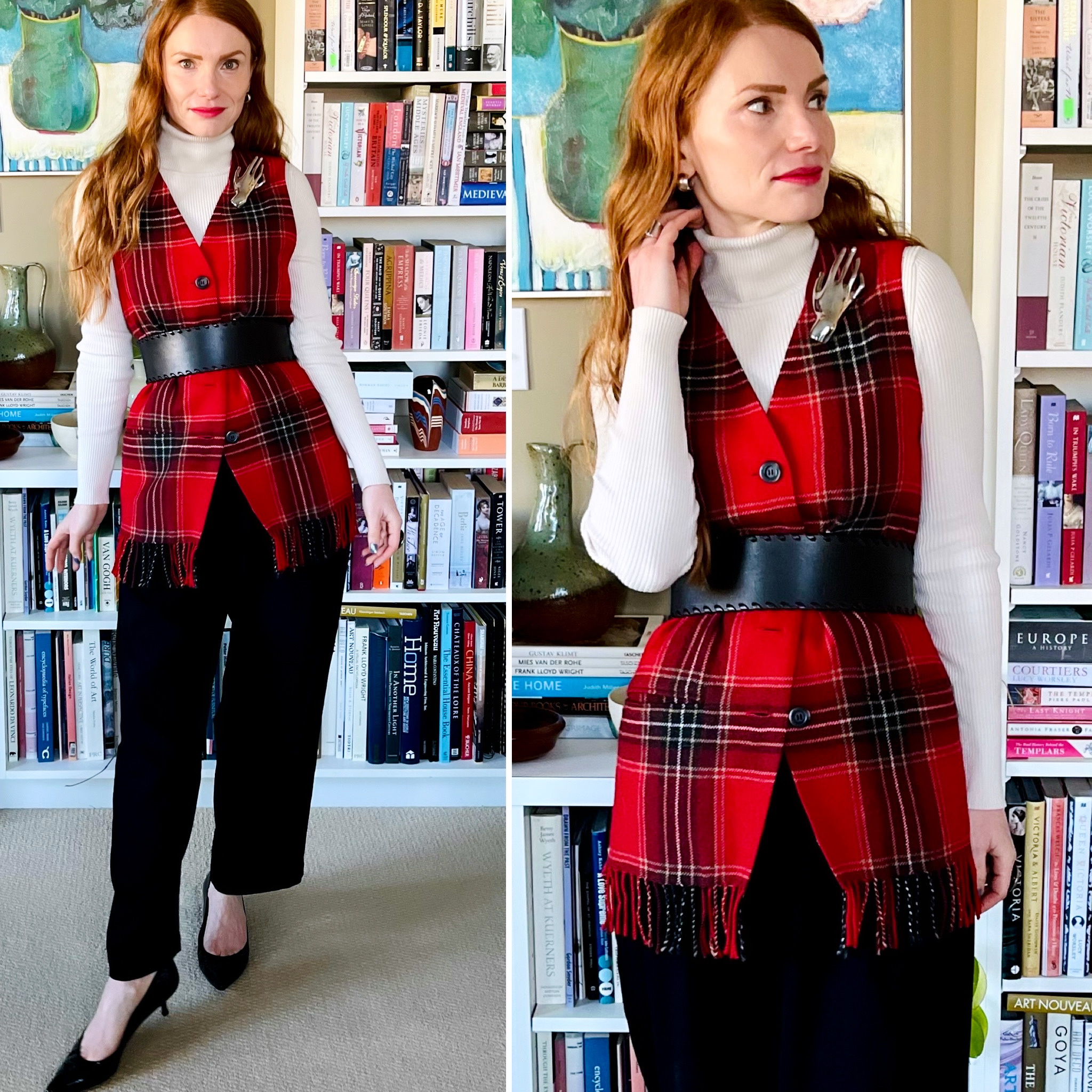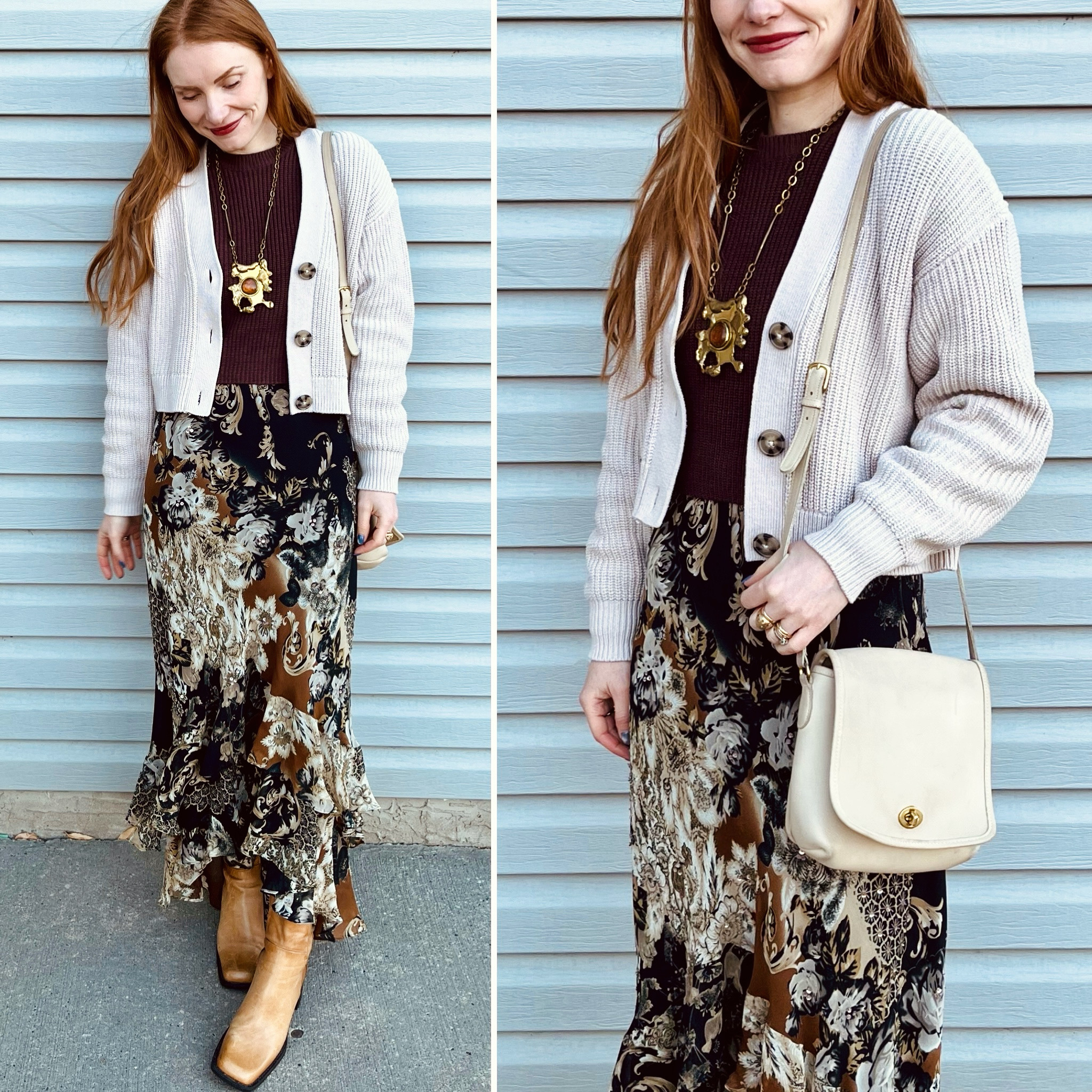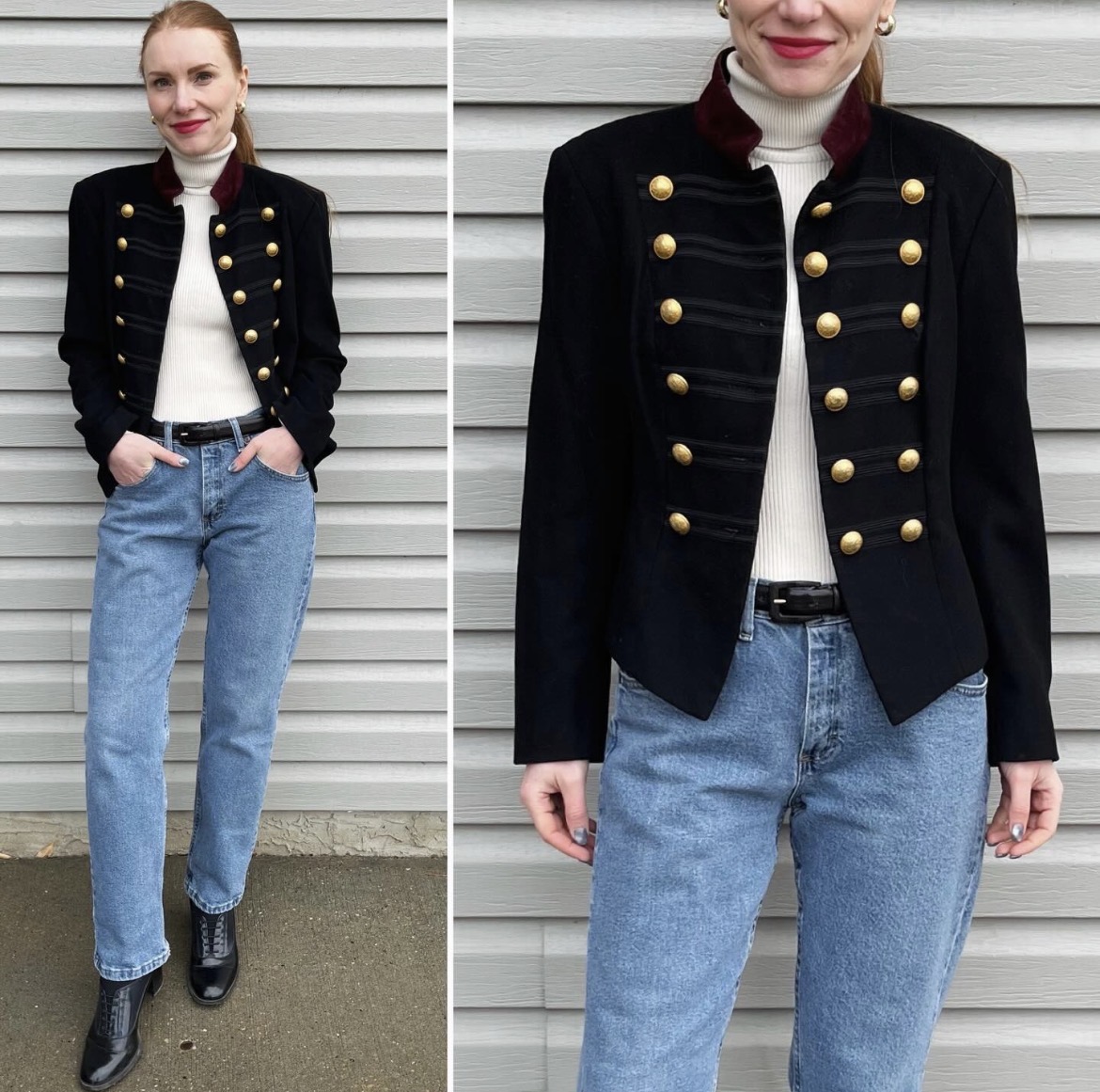
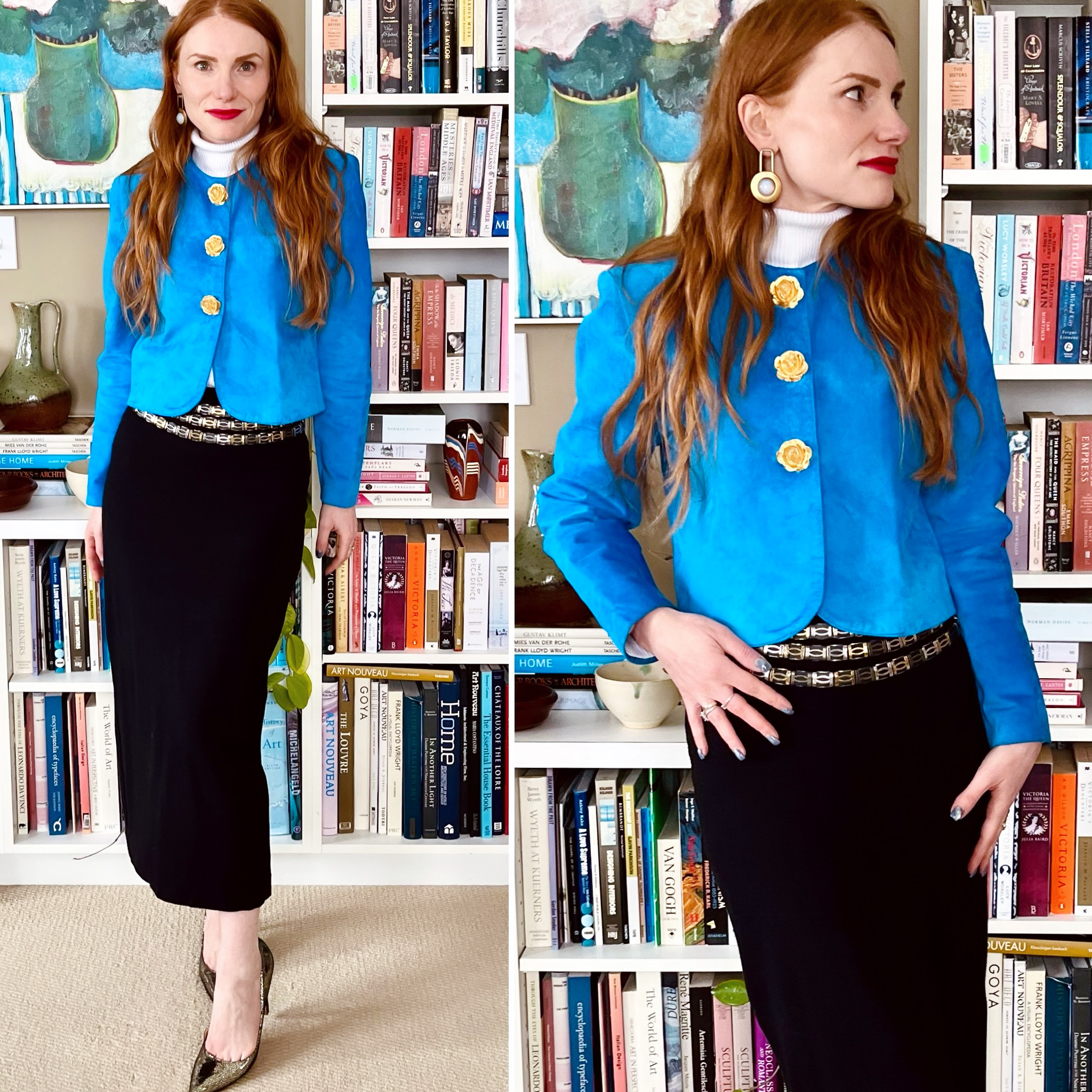
Tales of Thrift: Getting Philosophical (pt. 2)

Editor’s note: hi, it’s me, I’m the editor. The content of this series is adapted from the Memoir That Never Was, which I wrote last year. The themes centered on identity-making and my relationship with secondhand stuff), but in writing it, I ended up synthesizing ideas that have been pivotal to my growth as a person since turning 40. Although I decided to shelve my Memoir That Never Was indefinitely, I decided that there are parts of it I would like to share here on the blog. It will get pretty personal/vulnerable at times, but I think the community we’ve created here is a wonderful (and safe) space, and I hope that these posts will inspire reflection and conversation. Cheers!

I like to think of thrift stores as giant libraries – stay with me here. Libraries are famously full of books, and books are famously full of words. If fashion is a language, the clothes are words, and, well, you see where I am going with this. Go into any thrift store, and you are sure to find clothes from the last three or four decades – every trend, every colour, every style, sometimes in several iterations. Take puffy sleeves: people have been making them since practically the dawn of time, or at least the Middle Ages. There are all kinds of puffy sleeves out there, and you’re likely to find a generous sampling of them at the thrift store. Go and look. Even if you’ve never been to fashion school and don’t know the technical terminology to articulate how this puffy sleeve is different from that one, you will still be able to see the difference. Try them out and you’ll also see how they fit on your body – and if you like the way they fit on your body. Most important of all, how they make you feel. Do they make you feel like you? Make a note of that. You’ve found a tool – a word or a sentence, if you like – you can use to tell the world something about yourself.

That’s basically what I did, one thrift store visit at a time. Before I even realized what was happening, I found myself in possession of a whole vocabulary. To me, personal style is nothing more than the way in which I put those words and sentences together. I want to be very clear here: personal style is the process of creating an outfit; it is not the outfit. I’m not just splitting hairs. Writing is not the same thing as the book. These days, with AI, you can have a book without any writing. Personal style is also not an aesthetic. If we stick with the writing analogy, aesthetic is the genre. Think of it like this: Daphne du Maurier and Shirley Jackson both wrote gothic fiction, but their books would never be confused. Similarly, there are plenty of people who like the goth aesthetic, but they don’t all have the same personal style. Personal style is an individual perspective brought to life through clothes.

Thrift stores are like libraries in another way as well. For a relatively modest fee, you can “check out” an item – say, a puffy-sleeved top – to figure out if it has a place in your closet or not. If it does, you can keep it; if not, you can return it. You can keep it for a while and then return it. Either way, your “experiment” has cost the planet nothing. A new puffy-sleeved top did not have to be created for your use; the existing top can remain in circulation (and out of landfills) long after you part ways with it, assuming you take care of it while it’s yours. I think this is really important. As a Creative Clothes Wearer, I crave novelty and diversity – I want to be able to write with a complete dictionary at my disposal, so to speak – but those things come at a cost. Clothes require vast amounts of resources to produce; the more variety, the greater the volume. Creating a chartreuse puffy-sleeved top for every person on the planet is not sustainable and or even worthwhile because not every person on the planet will be interested in wearing a chartreuse puffy-sleeved top. Ideally, there would only be as many chartreuse puffy-sleeved tops in the world as there are people who love wearing them. The reality is that the fashion industry isn’t designed for that kind of math; if capitalism can sell 10 billion chartreuse puffy-sleeved tops to 8 billion people, it will gladly do so. What someone like me can do, in this situation, is to minimize the impact of my hobby by shopping secondhand for my hobby-related needs as much as possible. I make thrift stores my libraries, try to be a good steward of the clothing I take into my closet, and do everything I can to keep the circular economy going.

Which is a good thing because, like I said, it took me a few years of regular thrifting (and an embarrassing amount of clothes) before I got the hang of my personal style and how to use it. At the beginning, as many people do, I tried to use brands as a shortcut to personal style, thrifting every attractive designer item I could get my hands on. But, friends, there is no shortcut to personal style. If you wear head-to-toe designer – pick any designer of your choice here, go on, aim for the sky – you won’t be any closer to having personal style than if you bought an outfit at Zara. Your outfit will probably look better and feel nicer (assuming that designer isn’t skimping on fabrics and construction), but you’ll be wearing someone else’s point of view, not your own.

Getting your own point of view across sounds nice, but the how of it isn’t necessarily obvious. It wasn’t obvious to me, even after I spent a few years circling around the topic in my mind, trying different approaches. Because here’s the thing: there isn’t a single, universal way of approaching personal style. That is a deeply personal process. Every artist thinks about their creative process in their own way. I mean, you’ve got Method actors and actors who think Method acting is stupid; neither is right, neither is wrong. The key is finding what works for you, what feels most natural and instinctive and easy. Personal style isn’t effortless – because nothing intentional is created without effort – but it shouldn’t feel difficult.

I am going to tell you what works for me, but only as a point of reference among others. There are lots of them out there; hang out with other Creative Clothes Wearers for a hot minute, and you will be sure to come across dozens. Allison Bornstein’s “three-word method” is one example; it helps people figure out how they want to express themselves through their clothing by asking them to identify three adjectives which best signify their unique look. To illustrate the process, Bornstein often uses real-life models; for example, she identifies style icon Jane Birkin’s three words as “simple, casual, sexy” and Kim Kardashian’s as “exaggerated, fitted, and sculptural.” The “three-word method” is extremely popular, so I assume a lot of people find it helpful, but here’s the thing: I’ve tried this approach, and it didn’t work for me. And I’ll tell you why – not because I want to criticize Bornstein’s methods, but because I think it helps to illustrate why it may or may not work for you.

Remember how I said that I hate when people ask me to tell them about myself? How that makes me want to dig a hole in the space-time continuum so I can disappear from existence? If I can’t string together a simple elevator pitch, do you think I’m going to be able to pick just three words – THREE! – to capture everything I want to say about myself through my clothing? Hell, no. I don’t think about myself in terms of simple labels, and I don’t approach my creative process in a diagrammatical sort of way.

I had to go all the way back to the beginning to find my process. Books were my first love, writing my first creative experience. I am, first and foremost and above all, someone who loves stories. I mean, look, I’ve been using a language analogy for fashion this entire time; you shouldn’t be surprised when I tell you that that personal style, to me, is like writing a character – with clothes, instead of words. Well, several characters, to be precise. I call them avatars, because why not add one more “me” into the confusing mix. Don’t hate me yet, I will explain.

So, we have the self … which becomes identity when perceived in relationship with the world around it … which in turn is presented as persona to others. I find it helpful to visualize this as 3 concentric circles, with the self at the core and the persona in the outer ring. How do avatars fit into this picture? Add another circle. Avatars are an anthropomorphized embodiment of those facets of my persona that I want to express through the clothes I wear and how I wear them. Conceptualizing these facets as characters – rather than words or descriptors – makes it easier for me to visualize them, and thereby translate abstract ideas into concrete outfits.

If I ask you to think about your favourite literary heroine, chances are that you can summon a clear picture in your head. Maybe it’s based on a movie adaptation you saw; maybe it’s based solely on your imagination, conjured up as you were reading the story. In fact, you can probably imagine how that heroine might dress under different circumstances – say, going to the grocery store or going to the opera – even if you’ve never thought about it before. In mentally dressing this character, you are exercising your creativity. Now, layer on the fact that the character is someone you relate to; someone with whom you identify, whether a little bit or a lot, and there you have it: that character is an avatar through which you can express yourself, creatively, in clothing. Characters are multi-dimensional. Even if they are amenable to a one-word label, they do not collapse into one-dimensionality because we know that behind that label is a much richer text. We can call Jane Eyre a “governess”, but what she signifies is so much more – and the what is unique to each reader. If the what I associate with Jane Eyre represents a facet of myself, asking myself ‘what would a modern-day Jane Eyre wear on a cold Saturday afternoon in February to visit her best friend’ helps me to visualize how to express that what in my outfit choices.

Choosing avatars is a deeply personal and subjective process that, like everything else to do with personal style, is more art than science. Avatars don’t have to be literary characters or historical figures, but the more well-developed they are in your mind, the better they can serve you when you shop for clothing and create outfits. I can look at a piece of clothing and immediately know whether one (or more) of my avatars would wear it, much in the same way I know these things about my closest friends. An avatar should be more than simply a collection of descriptors, otherwise it’s just a more verbose version of the “three-word method”. I came up with my avatars by thinking about the different aspects of myself that I wanted to bring out in different parts of my life – at work, at play, in different social groups and settings – and then turning them into characters, each with its own a backstory and atmosphere. The first time I did this exercise, back in 2018, I came up with 4 avatars. I say the first time, because I have repeated the process several times since then. As we’ve already discussed, our personas are works in progress, continually evolving as we evolve and our circumstances – where, how and with whom they live – change. As reflections of parts of our persona, avatars will evolve too. I like to sit down and reflect on my avatars at least once a year; sometimes I do it every season, around the time when new runway collections come out, as part of an exercise in updating my inspiration reference points. It’s a way to check in with myself: are these characters still telling the story I want to tell, and if so, what new elements (trends, colour stories, proportions) can I add to my toolbox to tell that story? My avatars haven’t changed very drastically over the last 6 years, but there has been a slow, steady, organic evolution.

Identity is a funny business. So much has been written about it throughout history, but at the end of the day, each of us is left to figure it out on our own. Kierkegaard was probably right in thinking that “[t]o be entirely present to oneself is the highest thing and the highest task for the personal life” but that doesn’t make it an easy one. We can look in many directions for help in finding our answer to ‘who I am‘ – philosophy, religion, art, friends and family – but the answer can only be found looking inward. And that’s hard, because society wants us to do the opposite and is constantly working to make sure we conform to its desires. Introspection takes our attention away from where society likes it to be: on the ideas and objects it wants to sell us. Telling us that identity can be created through consumption kills two birds with one stone. It’s a shiny distraction, phony as a three-dollar bill. Consumption should be a function of identity, not its source, if we are to have a hope in capitalist hell of being happy. My clothes make me happy, but they couldn’t make me happy until I stopped looking for them to tell me who I ought to be, and started looking at them as a way I could tell other people who I am. You may not look at clothes the same way, and that’s okay. We all tell our stories in different ways. The story, and the telling of it, is ours alone. As for personal style, the taste which informs it:

“is not an arbitrary collection of likes and dislikes, but rather a rare form of intelligence: an intelligence that transcends knowledge of styles past and present. Gaining this intelligence is a perpetual process, which is part and parcel of the gaining of self-knowledge. But to have gained it, cela justifie une vie.”[10]

[8] Marx, p. 106-107

[9] Marx p. 107

[10] Phillip Mann, p. 336

Friday Feels #11

Got back into the regular (summer) swing of things with work and the kids’ last week of holidays, just in time for our routine to change again come next week. On one hand, I can’t believe it will be September already; on the other hand, May feels like a hazy memory. We had a relatively decent summer, weather-wise, and I think that’s made it feel long even as it seemed to breeze by. I am definitely excited about switching to my fall closet – hello, sweaters and layers! – but less excited about the prospect of the cold, dark days of winter beyond.

I am already starting to mentally prepare for ‘hibernation’ mode, which this year will (hopefully) involve writing my next book. For the last few weeks, I’ve struggled with writer’s block – not in writing, but in brainstorming my next story idea – and I was starting to worry about, what else, never being able to write anything again. It’s a rite of passage, right? Well, it sucks. Thankfully, it’s over … for now … I think. I have an idea and … I’m really excited about it? Honestly, it feels like a magic trick because less than a week ago I was convinced my brain was broken. Creativity is a weird, wonderful thing.

This week, I did something I haven’t done in a long time: took a bunch of things to get tailored. It started with a NWT J. Crew dress I thrifted. I LOVED it, but it was slightly big in the bust and gaping under the arms. In the past, I might have tried to make it work* but this time, I decided it was worth the time and money to get it to fit just right. It turned out to be a relatively inexpensive fix ($20), so I took the plunge and took in a couple of other dresses that had a similar issue, including my beloved rainbow dress. I mean, I’ve had that dress for years and adore it, so it’s worth the effort, right? Especially since I’ve found a seamstress in my neighbourhood whose work I trust.

* My reason was that, for many years, my style/closet was constantly evolving, and I couldn’t always be sure that any particular item would be a ‘forever’ piece worth the extra investment of tailoring. I would either not buy something that didn’t fit perfectly, or else buy it and just make it work as-is. Now that my style and closet have ‘settled’, I feel differently about spending money on fixing up core pieces.

My current shopping obsession is still jewelry. I’ve been browsing a lot on Poshmark, because thrift stores have been a bust lately, but haven’t bought anything yet. I’m trying to be very intentional and approach it more like “collecting” than “buying”. Mainly, I want to get pieces that I can pass down to my daughter. Lately, I’ve found myself going back again and again through the jewelry that I got from my mom and grandmothers, and (re)discovering pieces that perfectly suit my current tastes. Every time that happens, it feels like a gift from the women who shaped my life; a way to feel close to them again. I love the idea of making that possible, some day, for my own kids (and, maybe, grandkids).

Last weekend, I did a big edit of my jewelry collection – putting aside stuff that doesn’t suit me anymore, reorganizing the rest, and generally making more space (literally and figuratively) for the pieces I love. I need to be able to easily see and access my jewelry and clothes in order to wear them regularly. Out of sight, out of mind. (I recently read that object impermanence is an issue in ADHD and I was, like, ‘yeah, that tracks’. LOL!) I’m now gearing up to do the same thing with my clothes, which will be harder – I have way more emotional attachment to clothes – but I’m excited to start the new season with a ‘fresh’ slate.

Have a great weekend!

I Write Things: The Journey and the Destination

Yesterday marked 4 months since I embarked on the adventure known as Trying to Get a Traditional Publishing Deal. In the context of the industry, that’s barely a blip. To me, it seemed like one, very long fever dream. As a writer, I’ve aged, like, a decade. I made mistakes, learned stuff, got rejected, bounced back. Over and over. I wrote a LOT. [Since January, nearly 400,000 words. That’s 4 books’ worth.] I still do not have an agent, and I am about to start querying my second manuscript (which is actually my 4th book). Let’s recap!

Back in July, I decided that it was time to shelve A Party to Murder for the time being. It’s not that I think it’s a bad book; in fact, after the last round of revisions in July, I think it’s better than ever. The mistakes I made early on during the query journey came home to roost, though. The biggest one was querying too soon, and too widely. It meant that, with many agents, I didn’t end up putting my best foot forward vis-à-vis this book – and, in querying, you typically only get one shot. It sucks, but it is what it is, and I learned some valuable lessons from it. I am not sending A Party to Murder to the dustbin, though. I’m still hopeful that, down the line, I’ll get another chance to bring it out to the world – especially since I wrote 2 other books in that series (as interconnected standalone mysteries). It remains to be seen how and when.

My final (for now) stats for A Party to Murder are 70 queries sent, 2 full requests, one partial request, and 39 rejections. I think it’s safe to say the remaining outstanding queries are also rejections; it’s increasingly common, it seems, for agents not to respond (even with form rejections). In light of the effort and time I put into this book, the lessons I learned from querying it were not cheap ones … but that’s how it usually goes with writing. I feel much better prepared for my second attempt at querying, at least. In addition to being excited to try again, I also feel a kind of detached curiosity about how the process will go this time around, given that I’m much more savvy about the industry and its expectations, and that I’ll be working with a very different book.

I don’t want to give you the impression that I wrote this last book as a cynical exercise in pandering to the market … but I definitely approached it more strategically than my first. Since I didn’t get much agent feedback on A Party to Murder, I wasn’t able to get a clear sense of its marketability as a historical mystery, so when I decided it was time to pivot, I decided the safest bet would be to write something different. Mystery is the genre in which I feel most at home (when it comes to structure and plot beats), but I figured I would need to switch things up. So, instead of historical, I went with contemporary, and instead of a romance-forward plot, I went with a fantasy-forward one. The Mysterious Affair at Gaunt Hall is an adult, contemporary fantasy mystery set in a small English village hiding a big secret. My main inspirations were Stuart Turton’s The Seven Deaths of Evelyn Hardcastle and Angela Carter’s The Bloody Chamber. When I say ‘inspiration’, I’m using that term very loosely. Each one gave me a little nugget of an idea for what ended up being key parts of the premise of my book, but you’d be hard-pressed to find obvious similarities between these works and mine. I also took a much more considerable chunk of inspiration (slash actual plot) from a novella I wrote about ten years ago. I didn’t actually go back to re-read that earlier work, but it might be interesting to do so at some point and compare to see my evolution as a writer.

Here, for fun, is a short blurb for The Mysterious Affair at Gaunt Hall:

Thea Paget has a problem. She’s standing in a strange room with a dead body at her feet and the last 48 hours are a complete blank. The last thing she remembers is driving into the small village of Spalding Crow, following a mysterious summons from a man whose name may or may not be Mr. Noddy. With her academic and personal life in tatters thanks to a heartbreaking betrayal, Thea hasn’t got much to lose. Even so, a murder charge is something she’d rather avoid. Two people are dead – and one of them might not even be a garden variety human. Wolfram Breakspear, lately of Gaunt Hall, was the immortal creature responsible for Spalding Crow’s ancient curse. Allegedly.

Every 27 years, at the summer solstice, Spalding Crow must send a bride to Gaunt Hall or else face the wrath of its owner. Floods, earthquakes, and the threat of a motorway running straight through the village (among other terrible things) have kept the inhabitants of Spalding Crow in line for centuries. Now, one of them seems to have taken matters into his – or her – own hands. With the solstice just around the corner, and a new bride due to fulfill the covenant, the traditional engagement party at Gaunt Hall has become the scene of a double murder. But why would anyone want to kill the local antiques dealer? Is Breakspear really dead? And what’s going to happen once the clock strikes midnight on solstice day if the covenant isn’t fulfilled? To get herself out of Spalding Crow, Thea must first return to the crime scene and try to find the answers to these questions, along with her missing memories. She soon discovers that Gaunt Hall will not yield up its mysteries easily – especially not if Theo Devlin, Breakspear’s former personal secretary, has anything to do with it. Luckily, a magical talking mirror proves slightly more willing to help than the devilishly handsome Mr. Devlin. Offered an unorthodox means of investigation, Thea embarks on a race against time to unravel the truth and, very possibly, save Spalding Crow from utter destruction. But nothing at Gaunt Hall is as it seems, and Thea is about to find out that its secrets can change everything … including her life.

Let’s hope it’s a story that will catch an agent’s eye!

I’m doing a few things differently this time to increase my chances. First and most importantly, I stuck firmly to genre conventions on word count. The Mysterious Affair at Gaunt Hall is 80,000 words, which seems to be the sweet spot for debut novels. Hopefully, that means that agents won’t reject it outright based on length. Second, I plan to query in very small batches, spread out over a much longer period, starting with agents who have fast response rates. The goal is to test the strength of both my query package and my MS, and make adjustments as necessary. I don’t expect to get personalized responses, but form rejections can still be helpful in pinpointing what is and isn’t working. I am also going to get a professional editorial assessment (in addition to beta reader feedback) to help me with that. Ultimately, of course, the whole thing may come down to marketability, which is hard to predict these days. So, on one level, this whole thing is just a big roll of the dice.

Meanwhile, to keep moving forward, I really should be starting to think about my next book. Should … but haven’t. Or, rather, I have been thinking about it and not getting very far. I think there’s a bit of ‘quiet burnout’ happening (not weird, considering how hard I pushed myself for the last 6 months) along with the usual cocktail of impostor syndrome and “what’s the point when all I get is rejection” blues. I’ve been trying to go easy on myself this month, as summer is winding down, but I’m starting to feel the clock ticking. Come fall, I need to find the motivation to get myself back in the saddle. I keep thinking about the axiom that gets bandied about a lot in writer spaces, which is that most published authors sell their 4th or 6th or 9th book, rarely their first. If at first you don’t succeed, try and try and try again.