Month: June 2025

I Write Things: Oh, Query!

I promised you a post about querying and, whether you want it or not, you’re about to get it. If you want to follow along with my traditional publishing journey, you’ll want to read this; it will provide useful context for those of you who are not familiar with the process of trying to become a traditionally published author, as well as give you a glimpse into where I currently am in that process. Let’s dive in!

[Mandatory disclaimer: I am not a publishing industry expert, so what I share here is only what I’ve gleaned from the internet, as an outsider trying to navigate said industry. If you’re an aspiring writer yourself, don’t take anything I say as gospel, ok? There are lots of good resources out there to consult, but please be careful — there are also many terrible ones. Protect yourself and don’t get burned/taken for a ride by unscrupulous bad actors.]

OK, so you’ve written a book. Congrats! Now what?

This was me, back in April. I’d written the book, edited it, sought out and received beta reader feedback, edited some more, and felt ready to take the first step towards getting my book out into the world. Doing that via trad publishing (as opposed to self-publishing) has 3 main steps: 1) get a literary agent to represent your book, 2) sell your book to a publisher, and 3) have your book published.

There are five major publishing houses (conveniently called The Big 5), each with many imprints. Think of an imprint as a sub-brand. Imprints often specialize in specific genres, like fantasy, mystery, etc. Outside of the Big 5, there are a number of mid-size and indie publishers as well. They all publish “traditionally”, which is to say that they buy books from authors, polish them up, and sell them to the public. In this process, the publisher takes on all of the financial burden and risk; the author, once they get a contract, doesn’t have to pay for anything — not editing, not cover design, not marketing, nada. In exchange, they get (a) an advance, and (b) a (small) percentage of the sales proceeds from their books. That’s the main difference between trad publishing and self-publishing; in the latter case, the author pays for everything required to get the book ready for publication, but retains a greater portion of the sales proceeds. [Not all, because platforms that sell self-published books will always keep a percentage.]

The Big 5 publishers do not accept book submissions directly from authors. To have a chance of being published by a Big 5, you need a literary agent. The agent’s job is to sell your book to the publisher, and help you negotiate your contracts. Agents will also often help edit/polish up your book before it’s submitted to publishers. They take a cut of your earnings from the publisher, including any advance, but they only get paid if you end up selling your book. Getting agent representation does not automatically guarantee that you’ll sell your book; but you (generally) can’t sell your book without representation. Makes sense? Now, some smaller publishing companies do accept direct author submissions. Submitting to a publisher is not entirely dissimilar to submitting to an agent. Both require a query.

A query is basically a resume and cover letter for your book. Not for you as an author — that was a distinction I was fascinated to learn about. An agent is looking for a product to sell to publishers, not for a client (author). Over time, a relationship may develop where the agent will represent an author across many books, perhaps for their entire career, but this isn’t a given. [Authors can have several agents, even at the same time, for different books.] But, in the first instance, the agent is not “signing up an author” per se; they are signing up a product. This is important to understand. Agents offer to represent books they think they can sell, not authors whose talent they appreciate. As a writer, this is both discouraging (quality and marketability are two different things, and the publishing industry cares more about the latter, because it’s a business and capitalism sucks) and liberating (an agent rejecting your book isn’t rejecting you as an author).

Ok, back to the query. It’s a one-page letter whose purpose is to pitch your book to the agent and to convince them to agree to take it on. There’s a WHOLE science/art to query letters, which I won’t bore you with here. They’re surprisingly difficult to write (effective ones, anyway) and have to do a LOT of heavy lifting — basically, convincing an agent that your book is worth even looking at. In some cases, agents will only accept the query letter, and nothing else. Some agents will also ask for a short writing sample — anywhere from the first 10 pages to the first 2-3 chapters of your book. If the agent is hooked/intrigued by your query letter and/or the writing sample, they will ask for either a partial or full manuscript for review. If they like the manuscript, you’ll get an offer of agent representation.

And that’s step #1 in the trad publishing process.

This step can take months and sometimes years. Some authors are never able to get agent representation; some only get it on the 2nd or 3rd book they query — or the 5th or the 10th. Yes, some authors write half a dozen or more books before they write the one that ends up getting picked up by an agent. (And, remember, that’s only step 1.) It’s a hard slog and it can be intensely demoralizing. I’ve only been querying for about 7 weeks, and I can tell you: it’s not fun, not even a little bit. And it’s a TON of work. Thanks to platforms like QueryTracker, it’s relatively easy these days to find lists of agents who accept unsolicited queries, and to send them yours. But to have a decent shot at finding representation, you have to research agents and find the ones who specialize in your type of book. Remember, their job is to sell your book, which means being knowledgeable and enthusiastic about that genre/type of book; every agent will have his or her own niche, based on their personal interests as well as their connections within the publishing industry. Agents publish their manuscript “wishlists” (aka the types of books they’re looking to represent), and it takes time to trawl through those. Then you also have to tailor your query to each agent’s interests. Well, you get the idea … it takes time and effort.

Seven weeks in, I’ve sent 50 queries. It might sound like a lot, but it’s not. Querying is a numbers game as much as anything. You only need one person to say “yes” but it’s like finding a needle in a haystack; to increase your chances, you have to ask a lot of people. I’ve heard of people sending hundreds of queries. I don’t think I’ll be able to do that. Based on my specific genre, there just aren’t that many agents who would be a good fit. My goal is to try to get as close to 100 as I can before the end of the year. If nothing comes out of that, I’ll start considering other options. Out of those 50 queries, I’ve received 8 rejections — all of them form rejections. I also received two full submission requests and one partial submission request.

A submission request is a major win at this stage of the game. It means the agent is intrigued enough to want to devote time to reading your entire manuscript (or a portion of it). It’s not a guarantee that they will love it, of course. But it’s a necessary preliminary step. From the stats I’ve seen, most agents have a submission request rate of less than 10%. That is to say, for every 10 queries they receive, they will ask to see 1 manuscript — at most. I think that gives you a good sense of how difficult it is to “break into” trad publishing.

As I mentioned last week, my first full submission request eventually resulted in a rejection, as did the partial. I’m now waiting to hear back on the second full submission request, along with the rest of my queries. Many agents never send a written rejection for queries, so sometimes you’re waiting for … nothing. Like I said, it gets pretty demoralizing. Rejection isn’t fun for most people, but it’s especially not fun for people with ADHD, who experience something called rejection sensitive dysphoria.

[What ADHD giveth to a writer — aka, the hyperfixation that makes it possible to write 80,000 in a month — ADHD taketh away — aka, the complete emotional meltdown triggered by RSD that makes it feel impossible to follow through getting a book into the world.]

To keep myself occupied, I’ve been writing. In fact, I finished the first drafts of my next 2 books. Before you think “wow, that’s impressive”, please note that both of these are very much WIPs and still require months of work. They also represent a gamble on my part; while each book is a standalone, all 3 are part of the same “universe” and are interconnected via several (secondary) characters. The gamble is the fact that, if I can’t get my first book picked up, it will be bad news for the other two. One, because they’re in the same genre, style, and vibe; if the first book isn’t deemed marketable enough, my chances of successfully pitching the others will be slim. Two, because I will have to rewrite chunks of the subsequent books to eliminate certain references to the first book and add bits of extra backstory for a couple of recurring characters. Time will tell. Now, I could be spending my time writing different books to increase my chances of selling those down the line, but I don’t want to do that. Yet. At the end of the day, I started writing because I wanted to amuse and entertain myself, and that means writing Golden Era-style romance mystery books … for now, anyway. One or two other ideas may or may not be percolating, but I’m deliberately keeping them on the backburner for now.

Well, that’s the query process in a nutshell.

Next week’s post is going to be a little surprise, but in my next writing update, I’ll talk a little bit more about my actual book — and, of course, bring you up to speed on my publishing journey šŸ™‚

Friday Wrap-Up #1

It was a Dickens of a week.

(It was the best of times, it was the worst of times…)

Let’s begin with the worst because why not get it out of the way first? About 3 weeks ago, the most exciting thing to ever happen to me as a writer, umm, happened. I received my first full manuscript submission request. I have a post coming up next week that explains in more detail the query process and why a submission request is Kind of a Biggish Deal, but for now I’ll simply say that it represented my first opportunity to put my entire book in front of a literary agent. And it was an agent at a very well-established firm. I was thrilled!

And then a bunch of stuff happened (more on that next week) and I realized that I kinda, maybe made a very rookie ā€˜newbie writer’ mistake and, long story short, I finally got a response on my submission and the agent passed. Having gone through a rollercoaster of emotions over the previous 3 weeks, I had more or less resigned myself to that outcome, but it still stung. This actually happened last Friday, and I took the weekend to wallow.

I’ve learned that, for me, that’s an important part of the whole trying-to-get-published process. Rejection and ADHD don’t go well together, and pursuing traditional publishing is a rejection buffet for writers, so it takes a LOT of mental and emotional energy for me to push through and keep going. Spending a day (or two or three) being in my sad feelings about a rejection has been more helpful for me than trying to ignore or supress those feelings. I’ve been querying my book for 7 weeks now, and day by day it’s becoming a little bit easier to handle generic rejections; the downtime is decreasing. This was a more painful rejection than most, though, so I decided I deserved a little treat to take some of the sting out.

Little treats are also an important part of the process. Sometimes it’s ordering my fave grocery store cake, sometimes it’s a pedicure, sometimes it’s buying a book. This time, the little treat was a bit of a splurge. Ahem. I did something I’ve never done before: buy a piece of clothing from Anthropologie at regular full price. Whut?!? Yes. Yes, I did. I bought something at retail … not even on sale. It was a dress I had been eyeing for a few months, after seeing it pop up in my Insta feed, and something that fits me to a T, and is both versatile and easy to wear. You’ll see it next week, and then you’ll understand what I mean when I say that it was made for me.

Ok, now for the good times part of the post. There’s actually quite a few things to report. First, and in keeping with the theme, I’m happy to say that I received my second full manuscript submission request. Yay! I am keeping my expectations manageable, and my fingers crossed.

Last Friday, I met up with one of my thrifting buddies and we made a wonderful day of it – thrifting, lunching, catching up. So good for the soul – and I found some cute things too. Lately, I’ve been mostly buying housewares and accessories, not so much clothing. In the wake of the clothing swap, I did another closet edit and removed a couple of dozen pieces … and I still have a full closet. Clearly, I don’t need more clothes. I’m planning to write down some thoughts on closet editing soon, so stay tuned for that.

On Saturday, I went to the mall with my SIL (where I bought my dress) and we had a fun time pretending we were teenagers again. No, but seriously: why does it look like 1999 up in there? I’m not complaining, but it’s … disorienting.

Speaking of the 90s, this week I read Girl on Girl: How Pop Culture Turned a Generation of Women Against Themselves by Sophie Gilbert and it was SO GOOD!! Guys! If, like me, you came of age in the 90s and early 00s, and you’re interested in female-centric cultural commentary, you have to check out this book. I heard about it from Anne Helen Petersen’s podcast, Culture Study, who had the author as a guest on a recent episode. Give that a listen, it was also excellent, and it made me immediately go and order the book. 10/10

That’s a wrap for this week. Have an amazing weekend!

I Swap Clothes: 2025 Edition

My annual clothing swap is one of the highlights of my social calendar and the official start of the summer season. This year was no exception, on either score. A fun time was had by all, on a gorgeous afternoon in my blooming garden. It was, in fact, a scorcher of a day; luckily, I’d put up the canopy again this year – not aesthetic, but very handy for extra shade. After 18 years, I’ve got the whole programming down to a science. The actual event, on the other hand, is always a delightful surprise.

Every year, the guest list is slightly different and so, of course, are the things we swap. This year, there were 11 of us – including one ā€œswap newbieā€ and my daughter. My daughter started hanging out with us at swap a couple of years ago, but this was the first time she was a full participant in every sense; she brought her own things to swap and everything. As a sidebar, while I don’t include kids’ clothing specifically in my swaps, I always encourage my guests to pick up things for their (older) kids, if they see something they think might work. My daughter turns 12 this year, which might seem a bit young to participate in an adult clothing swap, but the reality is that she’s already 5’4 and wears the same shoe size as me; she fits right in, no pun intended. I can’t express how happy it makes me to see her embrace the secondhand ethos – thrifting with me, doing clothing swaps, etc. For her, this is simply ā€˜normal’ life, much as going to the mall was ā€˜normal’ for me when I was growing up. I don’t think I need to explain why I think this is a Very Cool Thing. I’m not the type of parent who pats herself on the back very often – the proof of whether I’m doing a good job is still years away, and it’ll be my kids who decide the final verdict – but this is one instance where I feel like I do deserve one.

(Further sidebar, but I also love to see my daughter confidently explore her personal style – without the hangups I had at her age – and I think that has a lot to do with her exposure to thrifting. I’ve always believed that shopping secondhand pushes/helps people to develop their own ā€œeyeā€ / point of view, rather than follow what others dictate is cool, interesting, etc.)

Ok, back to the swap. This year, I had about 5 bags of clothing and accessories to contribute to the swap. Going forward, I think I will have less. A couple of (interconnected) reasons for that: (1) my shopping has slowed down a lot; and (2) I’m buying with a narrower focus and doing less experimenting. This is a good thing, and an extension of my having reached a place where I’m happy/confident/comfortable in my own style. It will mean that I have less to contribute to future swaps, but that’s ok; I know that there will always be more than enough. Case in point: this year, even though I ended up picking up more pieces than I expected or intended, and even though everyone else took lots as well, we still had several bags’ worth of leftovers to be donated.

Let me digress again. Clothing swaps involve a tricky balance. You want to have enough supply so everyone can find something they love (and fit). Style being subjective, this means that for someone to end up with 3 pieces, you might need 10 pieces for them to choose from. Those are not exact numbers, by the way. But you get my point. It’s why I don’t limit the number of items people can bring to my swap; better to have extra, than not enough. It’s also why I save a lot of my unwanted clothing over the course of the year to bring to the swap so that, regardless of what others contribute, there is a good ā€œbaselineā€ of options. Obviously, I can’t do that in an extended size range, but I try my best. It’s something I might not be able to do in the future … but we will figure it out.

I came away from the swap with about 2 (very full) bags of stuff, for both me and my daughter. Here’s what I picked up:

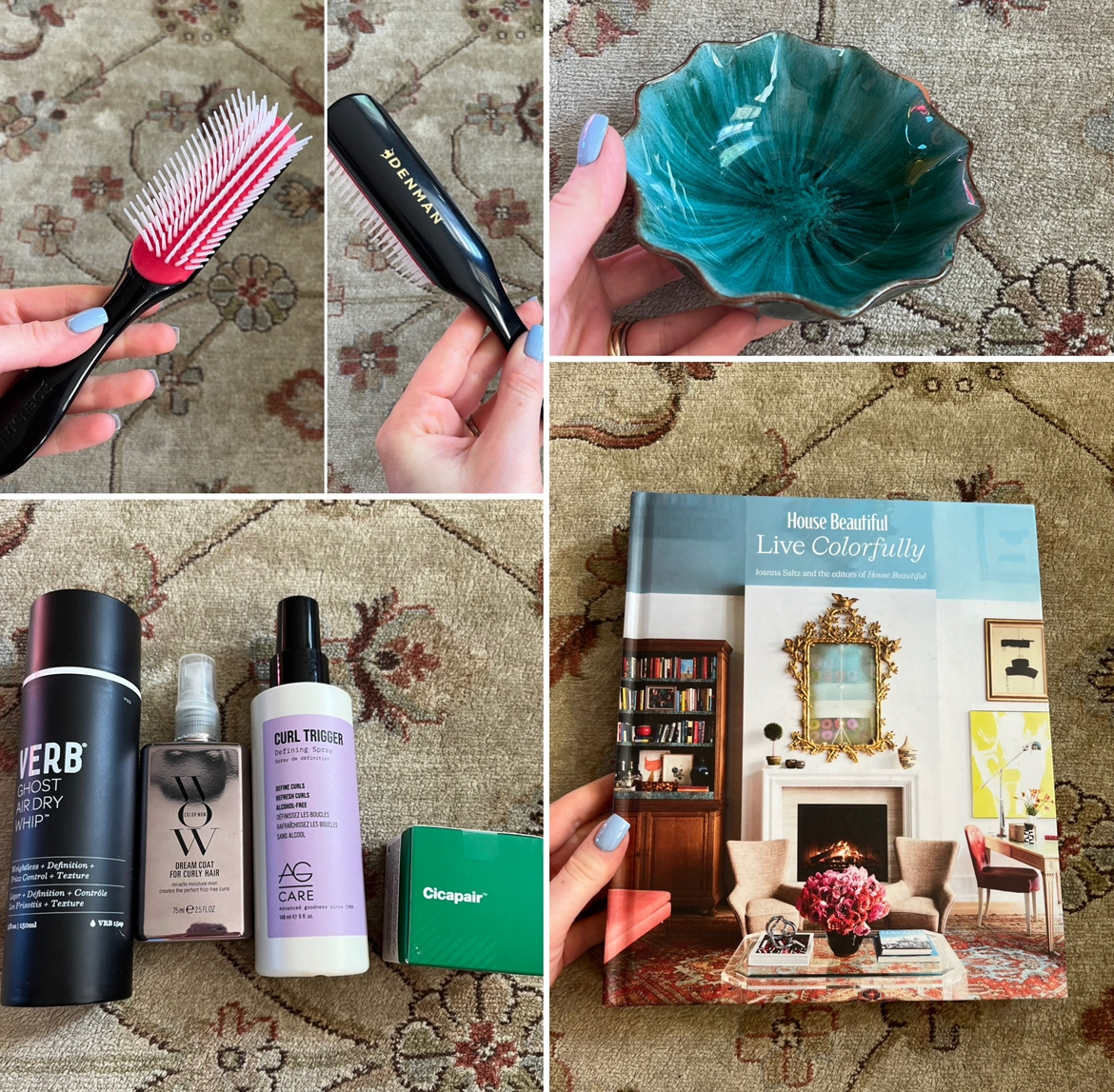
I love picking up miscellaneous items because they can be just as fun, not to mention functional, as clothes. To wit, this year I got: skincare and hair products for curly/wavy hair (including a cool hairbrush). I’ve been on a journey to find my perfect wavy hair routine, and getting products for free is extremely convenient for that. I also got a trinket dish … and dontcha know, I collect Blue Mountain pottery. The book was for my husband, so he wouldn’t feel left out, LOL!

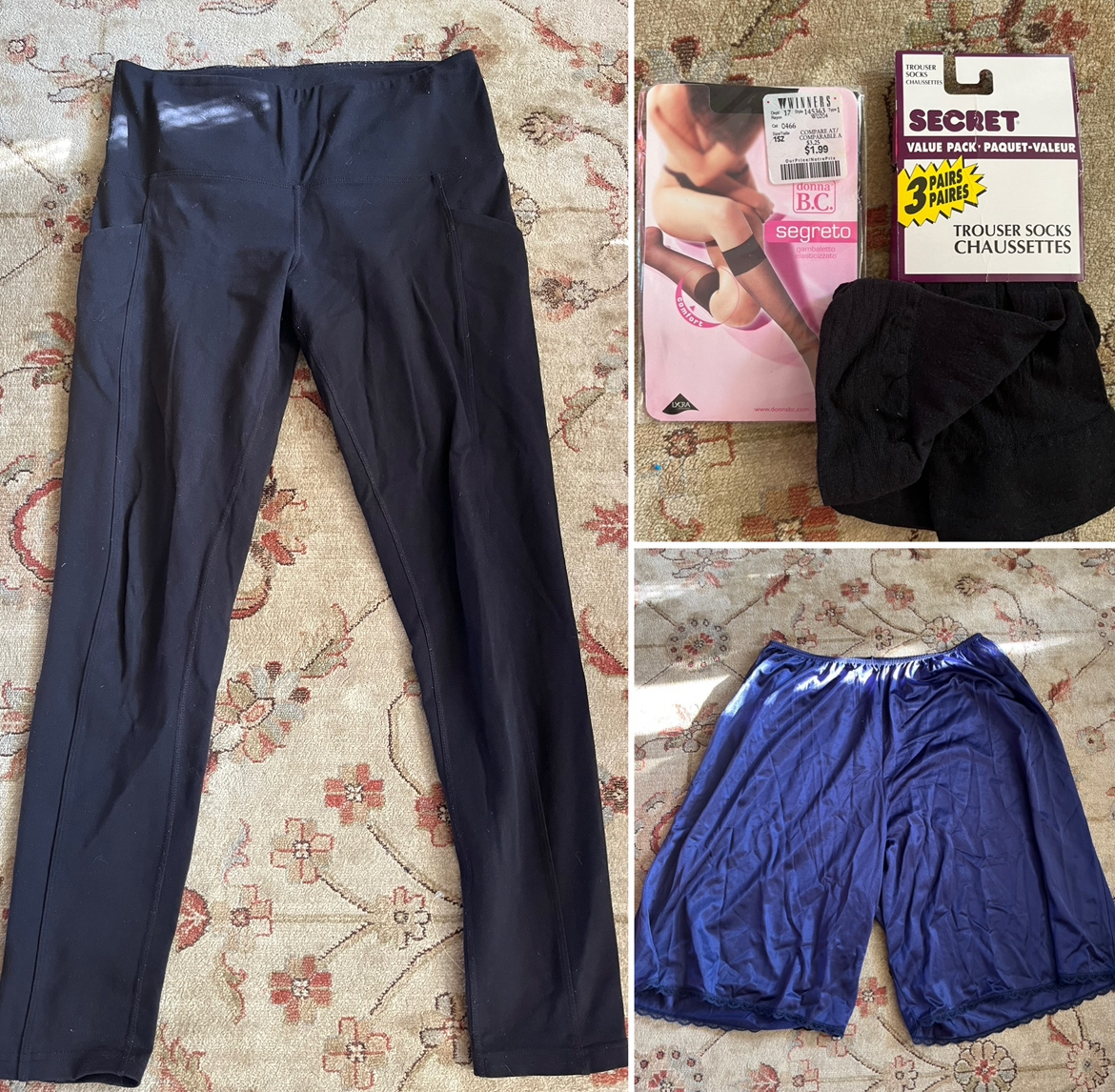
I also love picking up functional items, like: workout leggings (with pockets, which are a must for me), vintage bloomers (to wear under skirts), and socks.

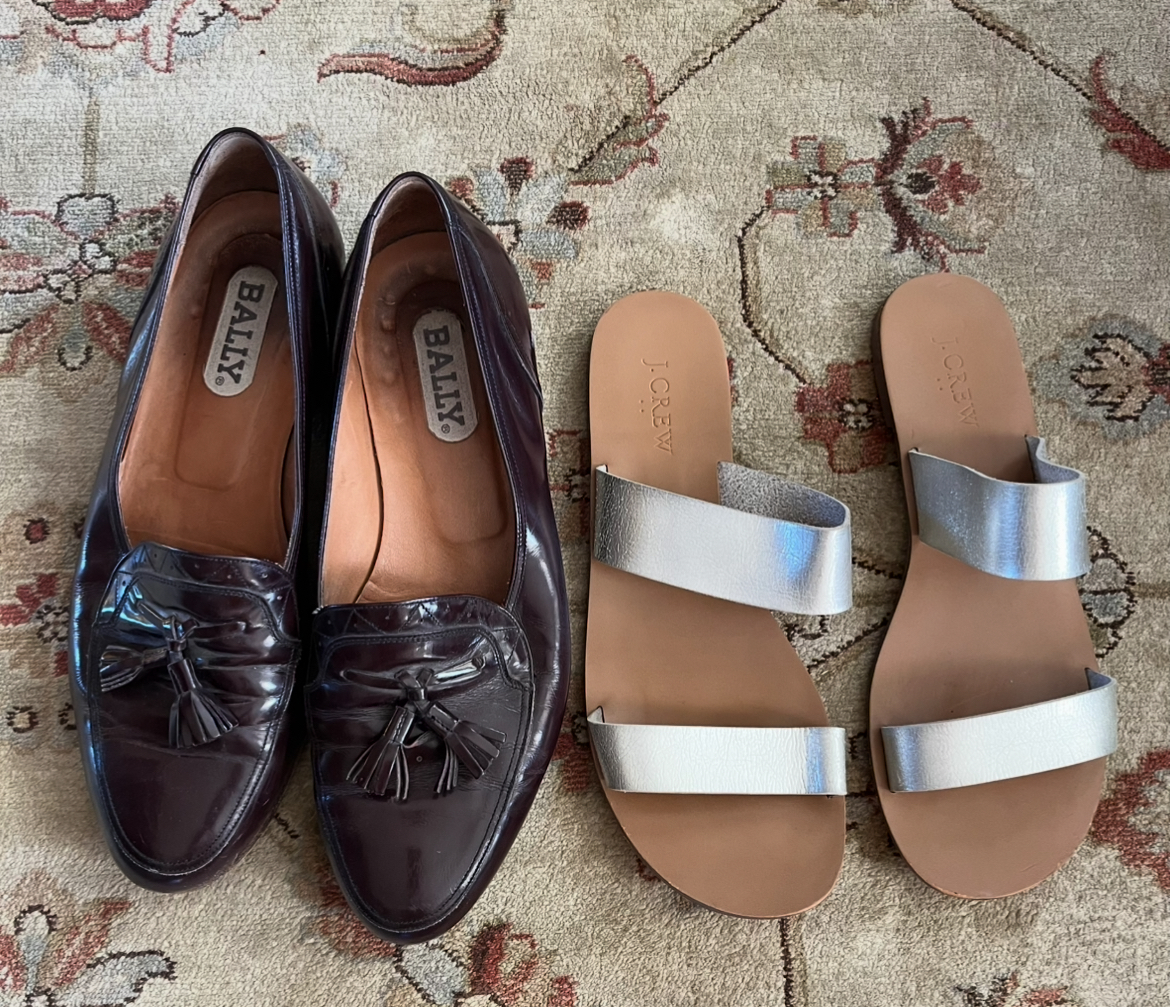
Got two pairs of shoes. I’m obsessed with the loafers. I have been wanting a brown pair of loafers for ages – score! The J. Crew sandals were also a score for me; I’ve had the black version for 6+ years now, and still wear them non-stop every summer. It’s my fave style of sandals. It goes with everything. This silver pair is brand new.

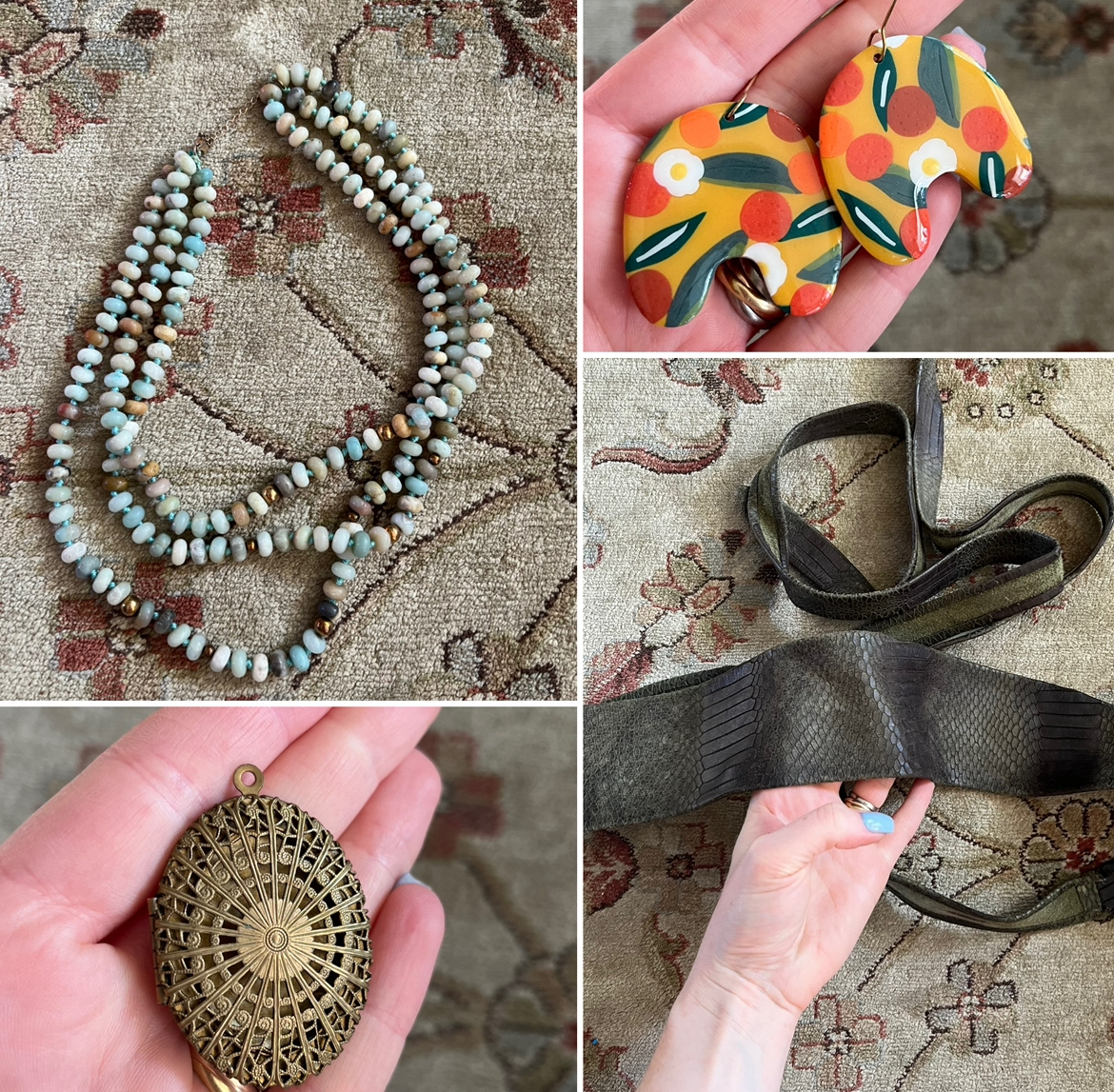
Got some fun accessories: amazonite necklace, cute polymer clay earrings, a sweet locket, and a leather wrap belt.

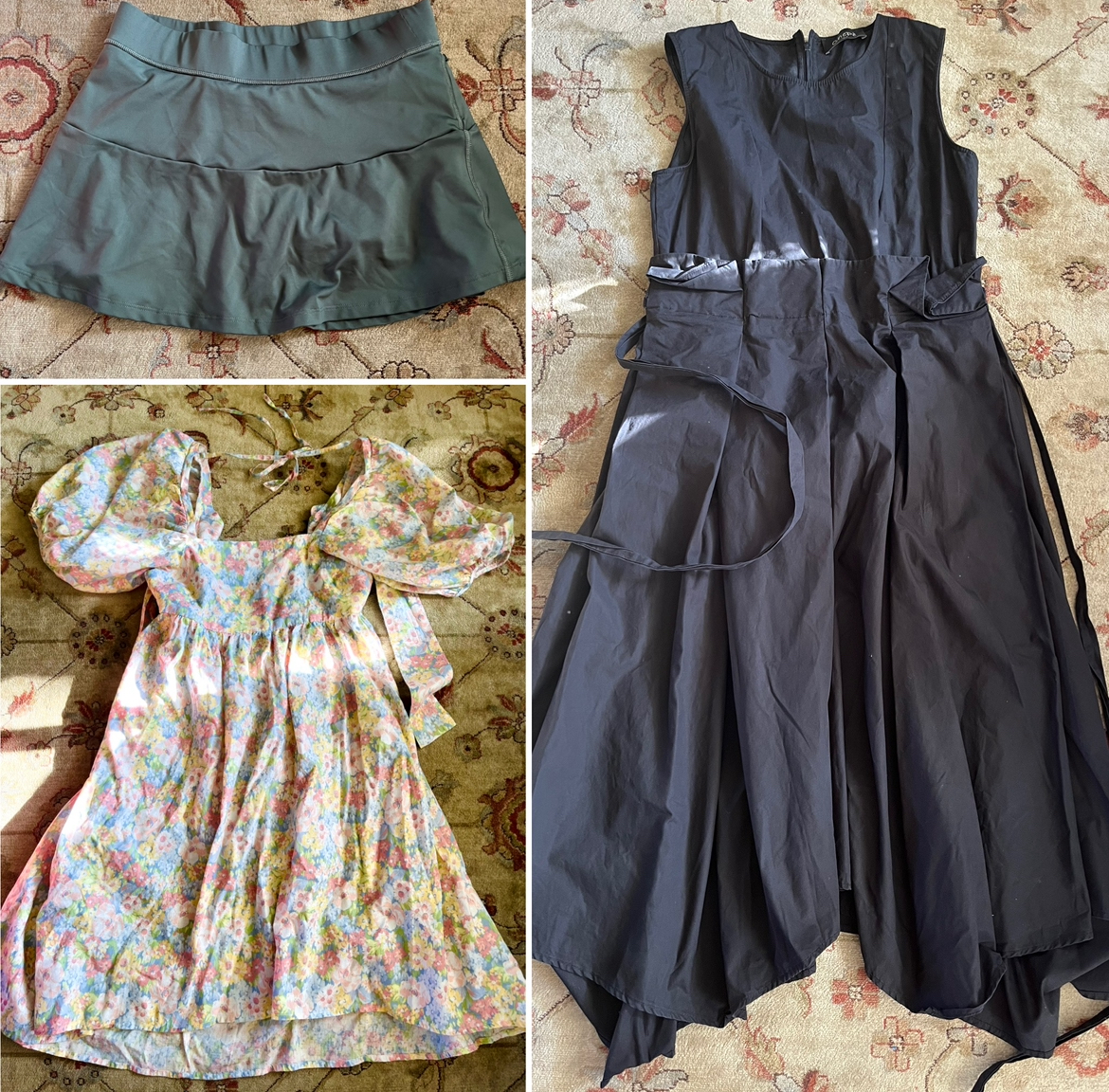
These are the pieces my daughter chose for herself. She was very discriminating in her picks, and I love that for her. These are items that suit her style really well.

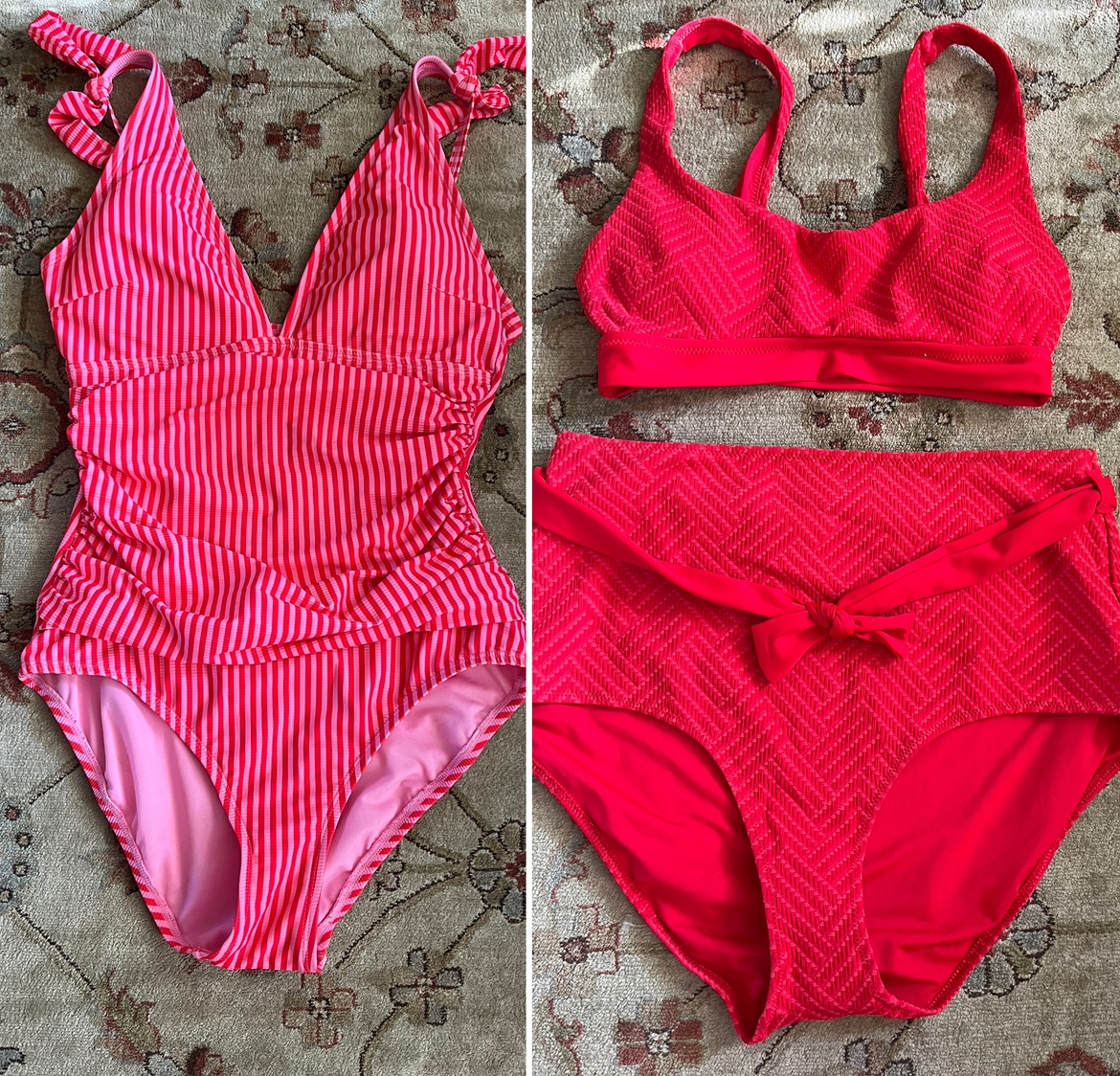
I got 2 swimsuits. I don’t swim often, but I still end up needing a swimsuit a few times a year. I hate buying new ones, so it’s handy to have a few options on hand. These were both brand new.

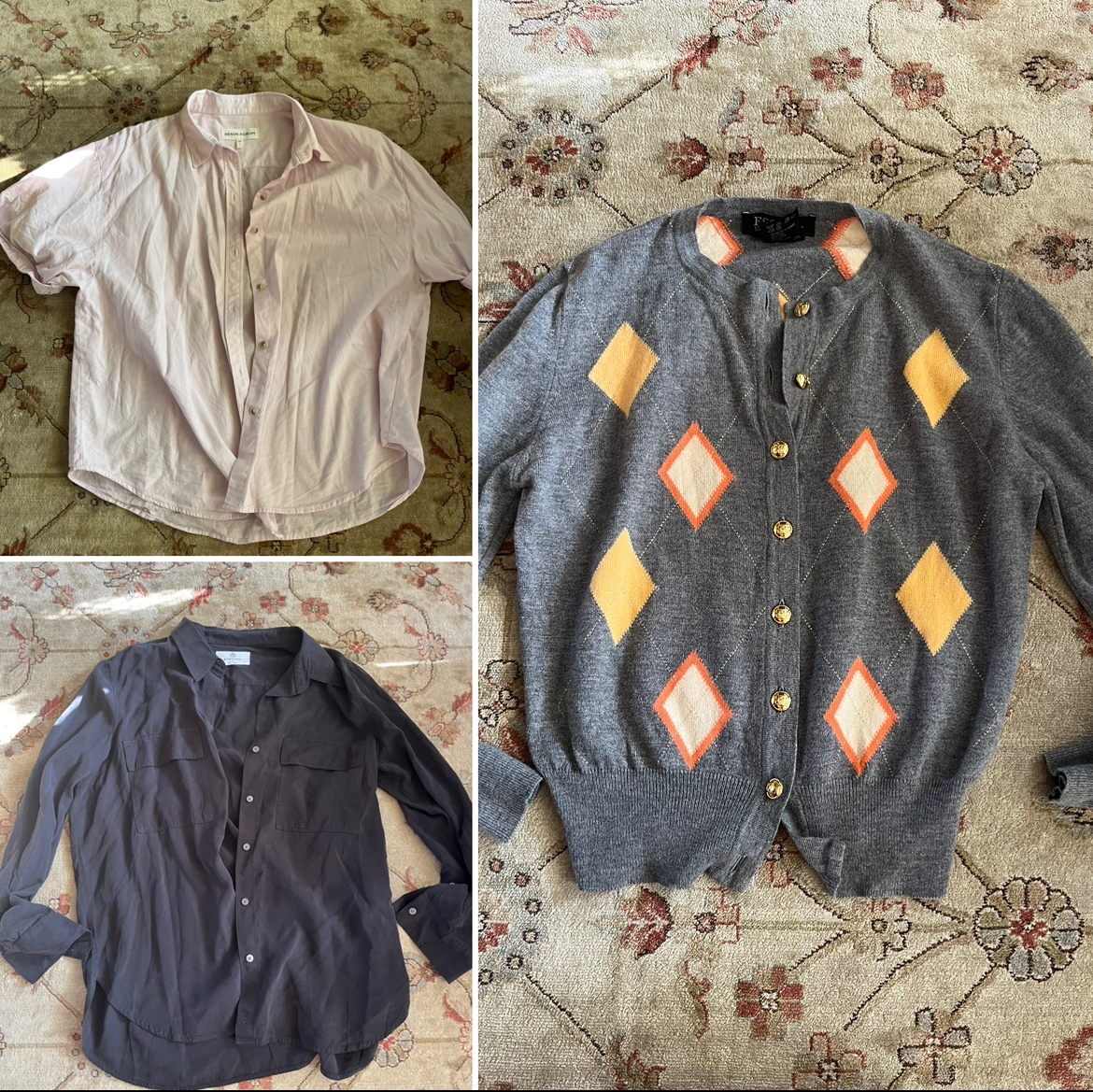
I got three tops, including 2 basics that will be good for summer, and a vintage Escada cardigan.

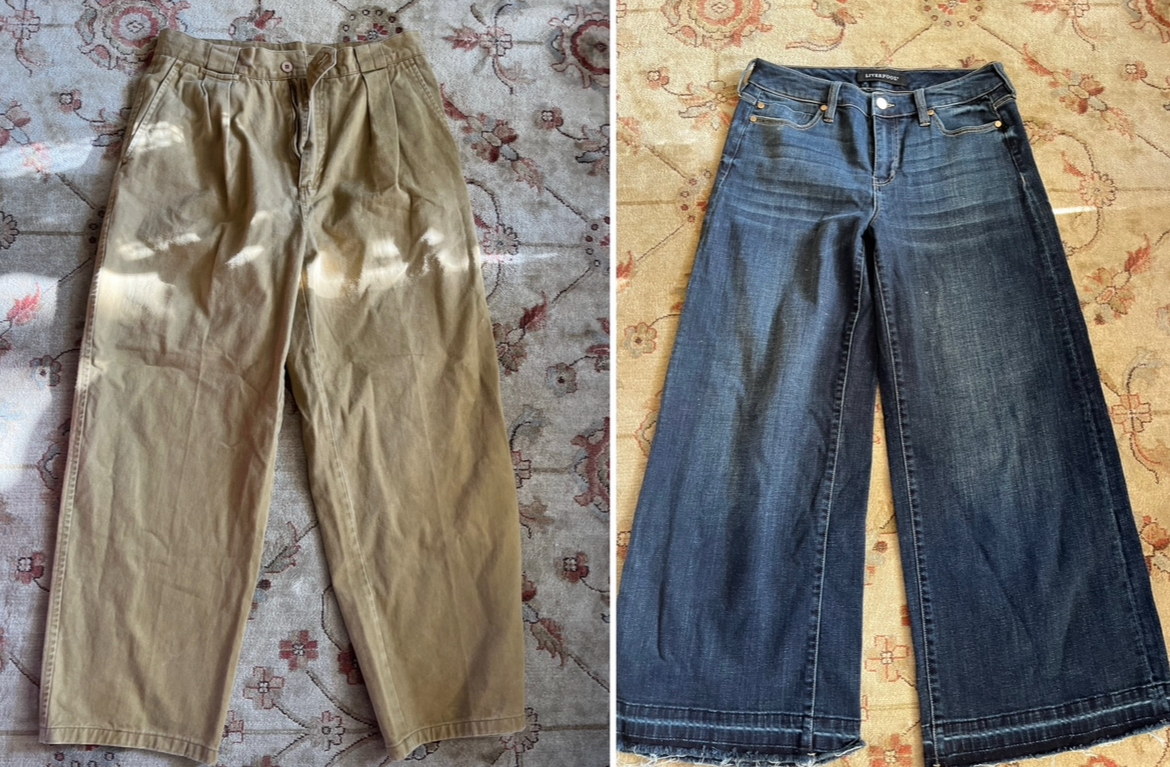
I got 2 pairs of pants, including the vintage Guess khakis. You know I can’t pass that up … much as I can’t pass up a pair of wide leg cropped jeans.

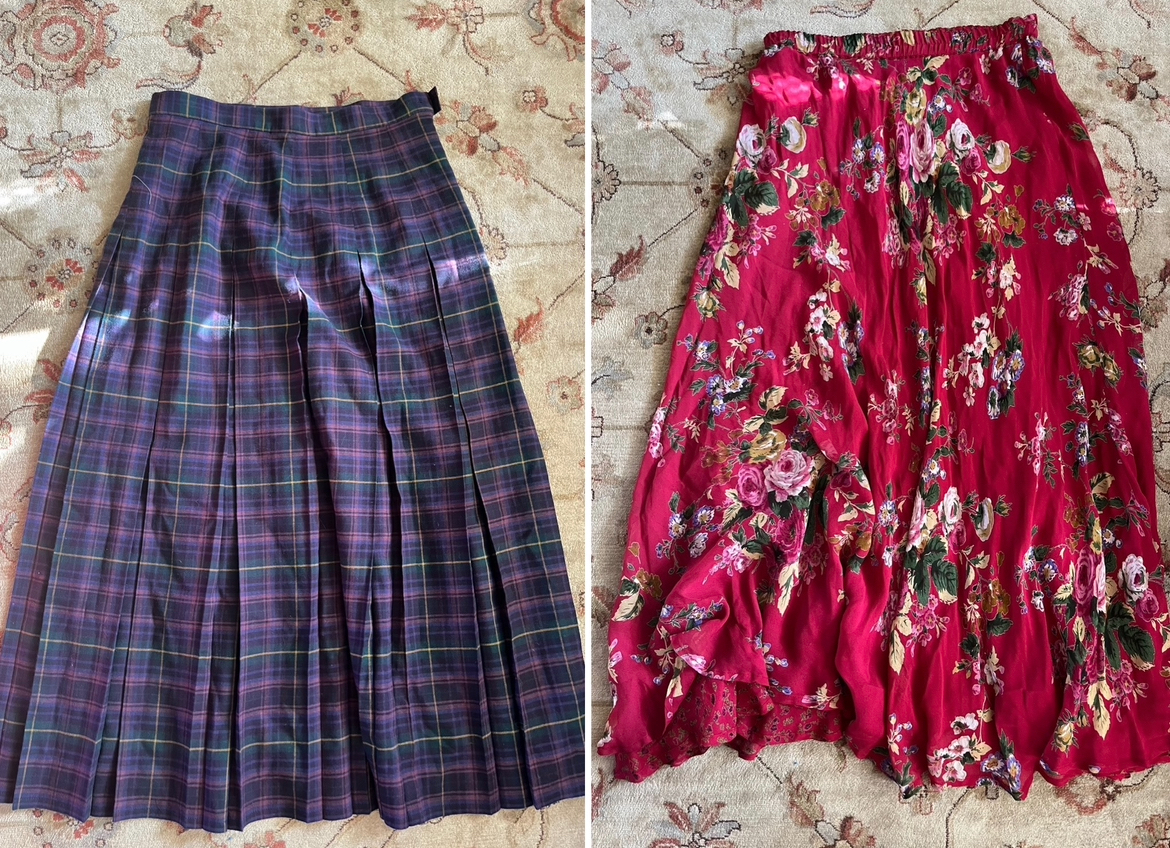
But my fave picks from the swap were these two skirts: vintage Laura Ashley plaid, and vintage Orvis floral. OBSESSED. I’ve worn the red skirt twice already. Can’t wait to do it again. Summer, here I come!

Alright, this has been an incredibly chaotic post … which is somehow appropriate because my clothing swaps are a bit chaotic, in the best way possible. We chat, we laugh, we try on clothes, we cheer each other on, we make a big ol’ mess – it’s like a girls’ slumber party in the middle of the afternoon, with snacks and ā€œfreeā€ shopping and zero judgment.

Can’t wait to do it all again next year!