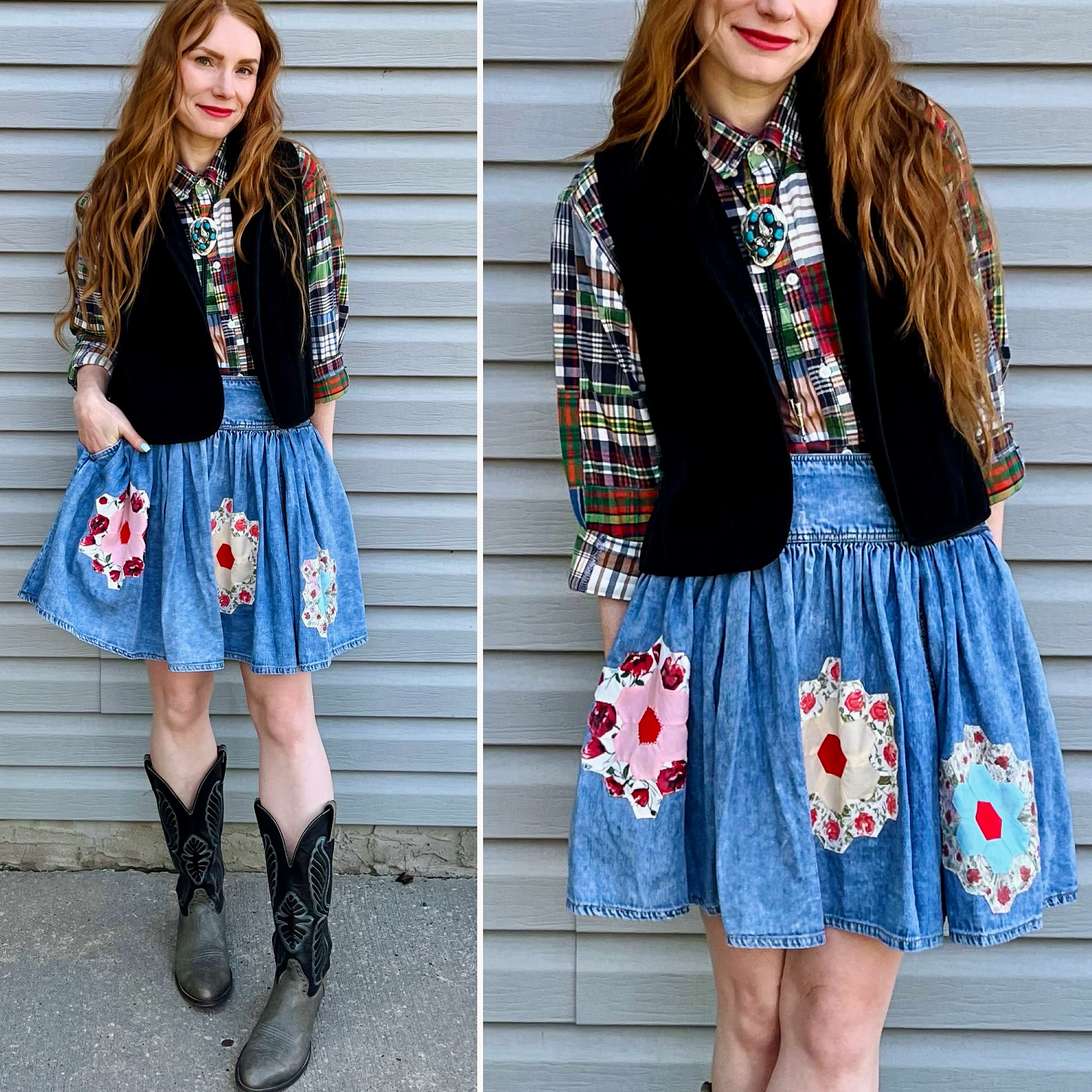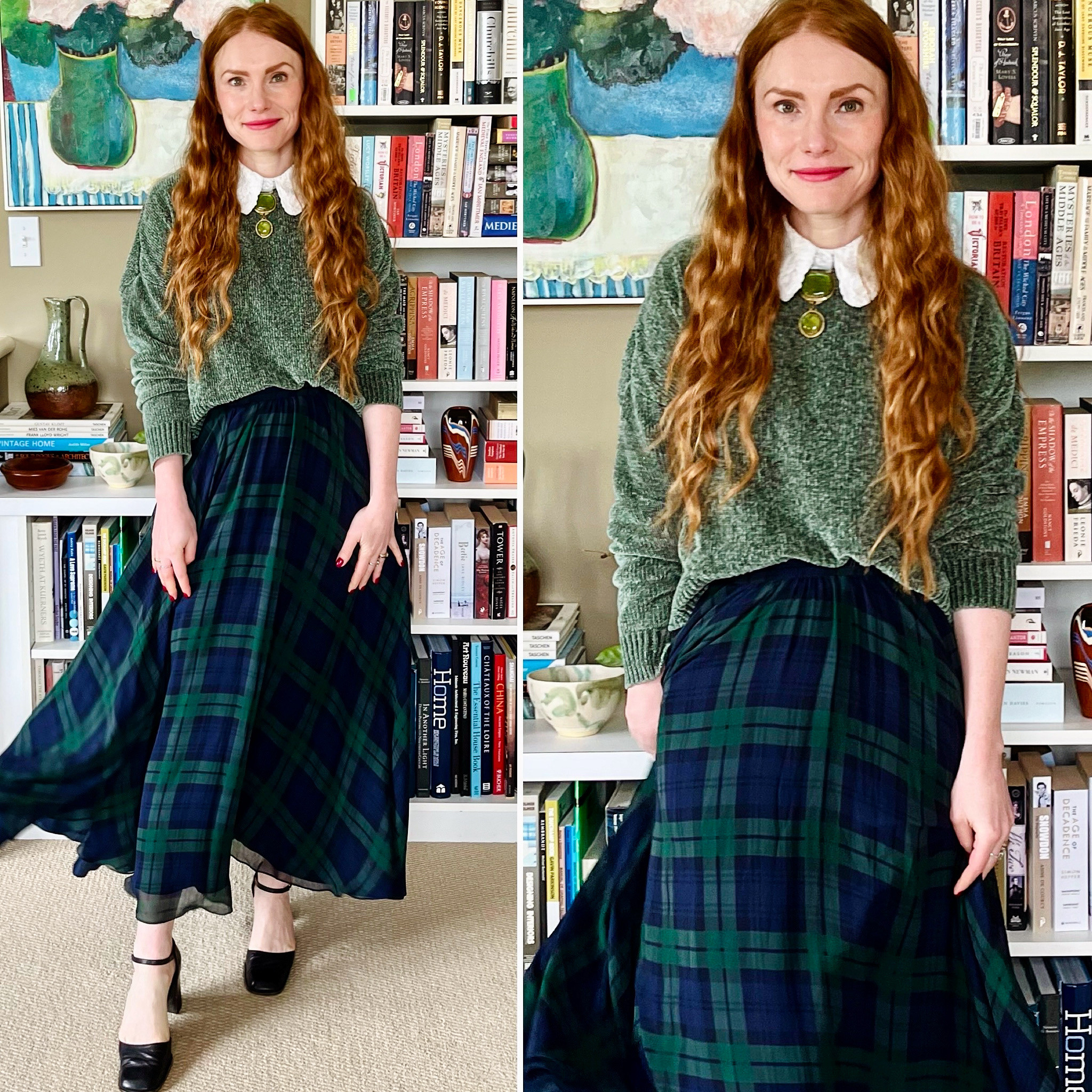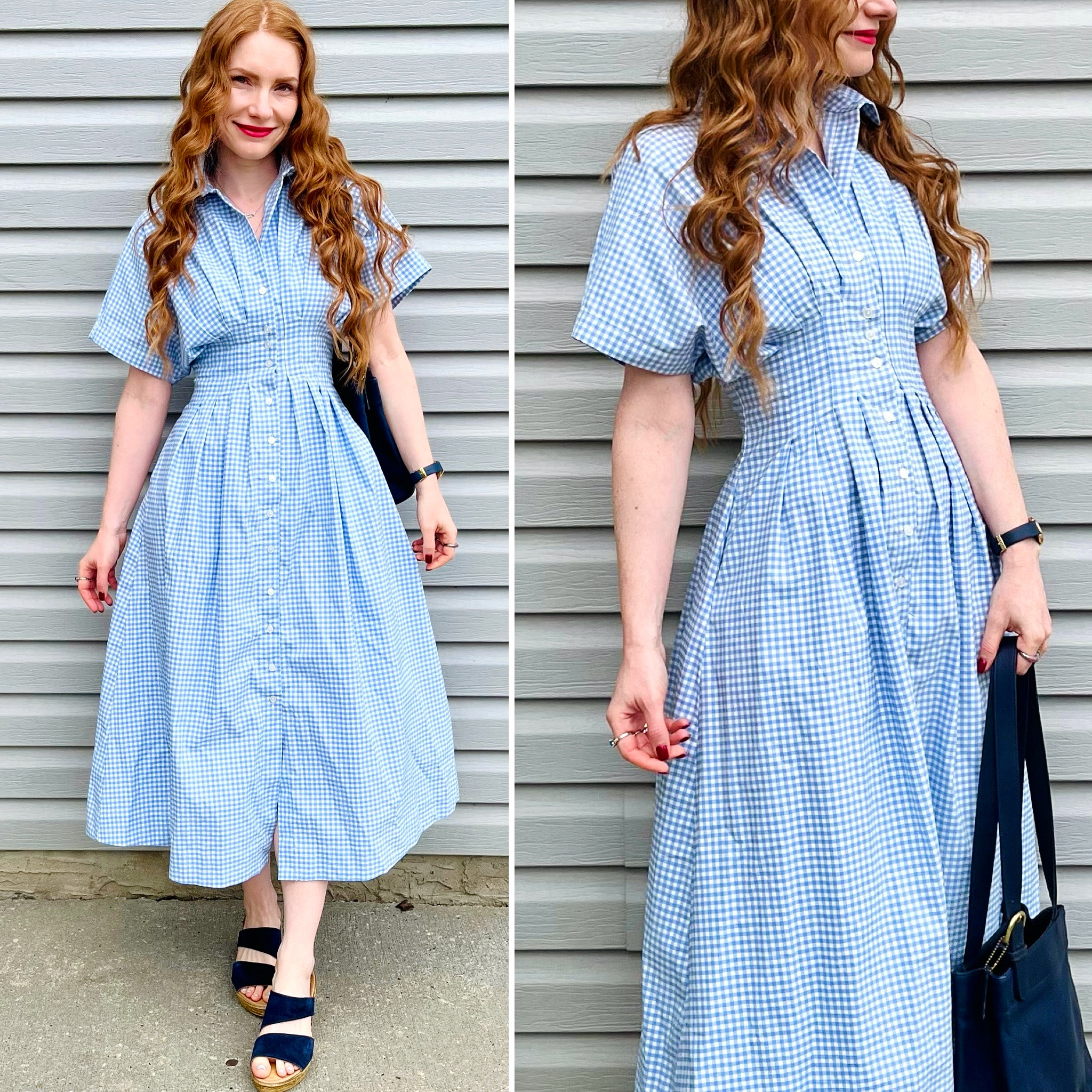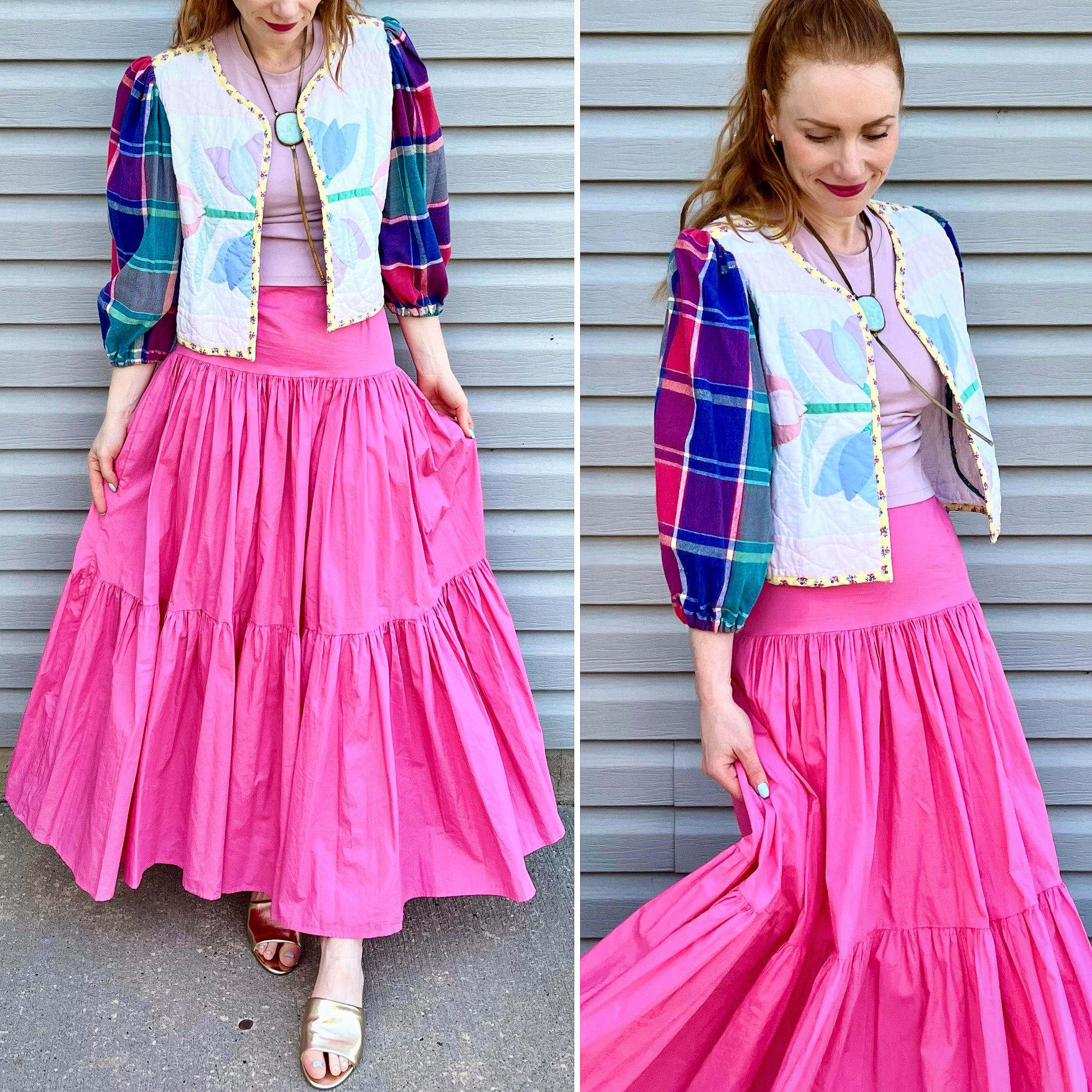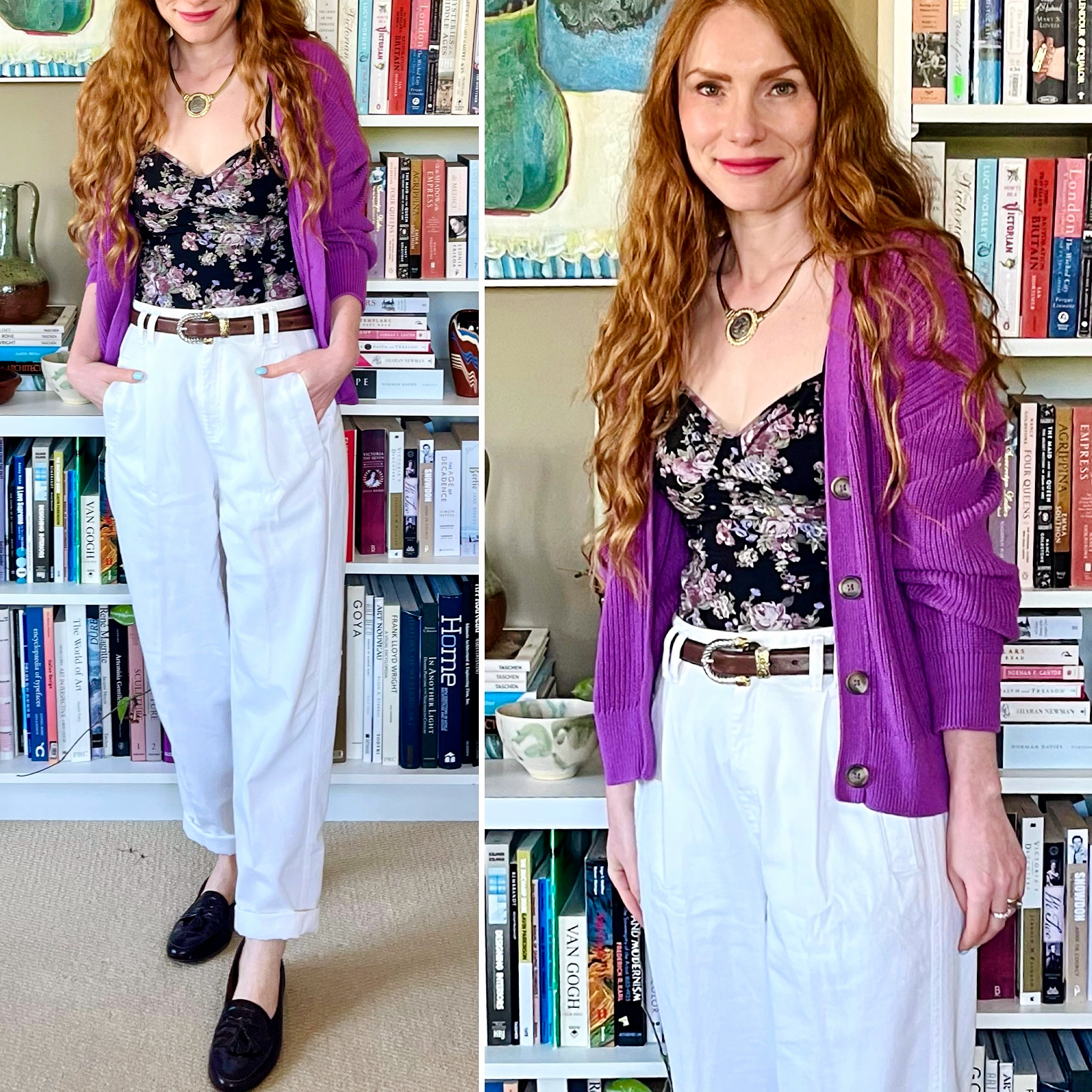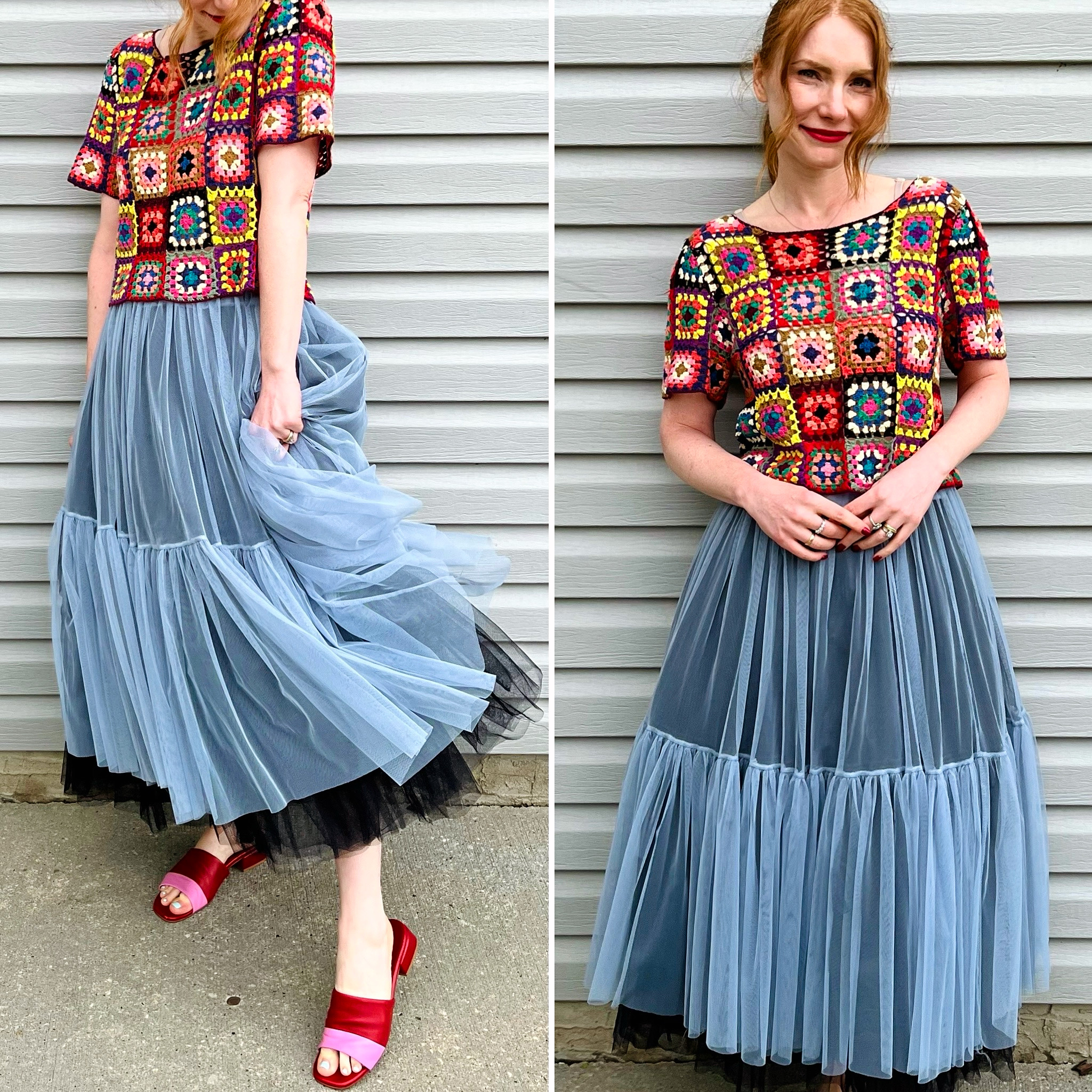
Editor’s note: hi, it’s me, I’m the editor. I’m adding this as a kind of introduction slash context for this new series, Tales of Thrift. The content of this series is adapted from the Memoir That Never Was, which I wrote last year. Its themes centered on identity-making and my relationship with secondhand stuff, but in writing it, I ended up synthesizing ideas that have been pivotal to my growth as a person since turning 40. Although I ultimately shelved my Memoir That Never Was indefinitely, I’ve decided that there are parts I would like to share here on the blog. It will get pretty personal/vulnerable at times, but I think the community we’ve created here is a wonderful (and safe) space, and I hope that these posts will inspire reflection and conversation. Cheers!
Before we can talk about the expression of self through personal style, we have to tackle a far more complicated question first.
Who am I, this entity who seeks to express itself?
In Status and Culture: How Our Desire for Social Rank Creates Taste, Identity, Art, Fashion, and Constant Change, W. David Marx argues there are three aspects to the “I”: self, identity, and persona.[1] I think there is a lot of merit in this particular breakdown, and since I expect nobody wants this post to turn into a treatise on Western philosophical thought, let’s just go with it, yeah? According to Marx, the self is something that exists within our minds. It’s our experience of our own existence, knowledge, and values. Identity is our experience of our existence, knowledge, and values in relation to other people – or, put differently, the perception of our distinctiveness. Marx notes that “[a]t a cosmic level, we all enjoy an absolute identity – a grand totality of distinguishing differences, including unique DNA sequences and an unrepeatable series of life experiences.”[2] Persona is the outward expression of our inner experiences – self and identity – or at least those parts we wish to make our public “face”. It’s the way other people get to experience our “I”.
To talk about personal style as a means of self-expression is a form of shorthand. It might be more accurate to call it a means of persona-expression or, perhaps more accurately still, persona-creation. Between identity and persona lies a series of choices: what we reveal, what we conceal, what we invent. In an ideal world, the situation might be less complicated – identity and persona collapsed into a single, unified, authentic whole. Maslow wrote that self-actualizing personalities are “marked by simplicity and naturalness, and by lack of artificiality or straining for effect”[3] – in other words, by authenticity. Be yourself is the imperative of our modern age, driven by the social belief that everyone should maximize individual difference.[4] But the world is less than ideal, in practice if not in theory, and as Marx notes:
“[a]dvising everyone to “be yourself” is therefore unfair as a broad mandate in a world still marked by bias: not everyone is born into a set of privileged attributes and behaviors … [so] until there is dignity for every immutable characteristic, persona crafting remains an important tool for status equalization. To stigmatize persona crafting is, then, to support the status ladder as it exists today.”[5]
He goes on to write:
“[m]oreover, the emphasis on being yourself overlooks the fact that self-definition is a continual process. We are writing a novel of identity for others, and the persona is simply the latest draft. Whoever we are, there is always an unstated opportunity for future revisions. And in a world of permanently shifting symbolic meanings, we’ll surely have to make changes, regardless of whether we want to or not.”[6]
So, authenticity is a virtue with an asterisk beside it. Society loves to exalt the idea of authenticity while making its practice extremely difficult. If “[i]nauthenticity is not just an act of cunning deception but implies a lack of self-confidence to resist external forces,”[7] then I think external forces have something to answer for, don’t you? Why are they sticking their nose in our business? If society wants us to be ourselves, it shouldn’t also be telling us who those selves ought to be. And, yet, that’s precisely what society is doing All. The. Goddamn. Time. Who is perpetrating an act of cunning deception here, and who is being deceived?
I guess what I’m trying to say is: who am I is a very complicated question which ultimately has no final, definitive answer. If you’re experiencing a strong urge to take a stiff drink right about now, I don’t blame you. Defining identity – who we are to ourselves and who we are to the world – is a kind of intricate dance whose steps we’re never properly taught, whose rhythm constantly changes, which involves countless of partners, and which never ends. And some of us (ahem, me) are born with two left feet, so to speak. Figuring out how to even begin answering the question took me years. Then years more to arrive at what felt like an authentic answer. Then a few years more to realize there is no answer, only a work in progress. This is where I’m at now, and I can tell you that it’s strangely very liberating and un-stressful … until someone asks me to tell them about myself, at which point I freeze like a proverbial deer in the headlights. It doesn’t seem to be socially acceptable to blurt out “I contain multitudes, ever evolving and never amenable to a process of simple categorization” for some reason. I don’t know why, don’t ask me. All the same, I have never felt more comfortable in my own skin in my whole life … which is probably why, after years spent trying to figure out the enigma we call personal style, it suddenly revealed itself to me. And instead of being some abstruse puzzle box, it turned out to be a child’s toy. A really fun toy, too, and not some sad beige wooden blocks. I said what I said.
Clothes can be frustratingly complicated considering they’re just a bunch of fabric … but then again, they are such intimate objects too, not just for our bodies but for our selves. (And we have already established how complicated selves are.] Through all the years I grappled with the question of identity, clothes were never far from my mind. They felt important, connected — somehow — to my search. There were times when I thought they could help me find what I was looking for, and times when I thought they were what I was looking for. I was obsessed with clothes and confused by clothes – often both at the same time – and this was simply a mirror image of my obsessive, confused search for the who am I.
When I was a child, clothes were costumes I could put on and take off as befitted whatever role I wanted to play – or, as was more often the case, the role I was forced to play. I wore my boy’s clothes hand-me-downs and became a tomboy. Swathed in my grandmother’s delicate pink tulle dress, I dreamed about becoming the belle of the ball. I was neither, and both, and perhaps something else altogether as well. I was becoming and I looked all around me to understand what. And, for years, I never got very far.
Catapulted across continents and ideologies, I was Self, Interrupted. I was a kid from an alien culture, grokking my way to assimilation. Being my alien self was off the table; I had to be whatever version of acceptable was within reach. Possibilities were served up in an endless menu on TV, in magazines, and in movies – in Technicolour and apparent good faith – but most of them felt inaccessible to me. The raw material at my disposal – dorky, timid, bespectacled, pimply – gave me very little to work with. I was a pumpkin, and not the magical kind that can turn into something sparkly at the appointed hour. I needed help, a lucky talisman or two (fairy godmothers being in perpetual short supply). And, lo, there they were: clothes. Totems of identity I could wrap around myself to cloak the raw, tender bits not fit for public consumption.
All teenagers, to some extent, engage in a bit of deception, trying different skins on for size. Some of us forget to grow out of the habit, or maybe we decide it’s safer not to. And when I say “us”, I mean me. My deception grew less innocent with time; by my early 20s, it became deliberate. By then, I knew that the “who of me” wasn’t the “who I wanted people to see”. I didn’t want people to look at me and see an oddball from the island of misfit toys. I wanted to look normal. I consumed as identity and I consumed for identity. I bought and wore whatever clothes fashion magazines and websites told me were must-have items to look like a Cool Girl – or at least whichever version of those clothes I could afford. Did it matter that some of those clothes didn’t look all that nice to me or feel good on my body? No. My body was a problem that needed to be fixed, and the only solution was to wear the clothes that the fashion industry offered because the fashion industry knew best – how to fix problems, how to make bodies acceptable.
Now, throw motherhood into the mix. It will be fun, they said. It will be fulfilling, they said.
Nobody said anything about implosions.
Emotionally, I was a mess in my early 30s. Not the Instagrammable kind – ever-so-lightly tousled, endearingly frazzled, chaotic-but-not-really. No, I was a mess that was 30 seconds away from taking a Thelma-and-Louise style leap off a high cliff. It was not because I lacked support; in fact, I had all those supports that are supposed to stop us from coming undone: financial security, reliable childcare, family help, a partner who pulled his weight. I had good benefits, free healthcare, a stable career. I had options. And I still fell apart. Sometimes life is just fucking hard, and sometimes we make it harder for ourselves by falling in love with the idea of having it all. It’s a scam, that idea, only you’re not just being phished for your money, but also for your time and mental energy. The upside of hitting rock bottom was that, once I had nothing left to give, I was forced to press pause on the script I’d been living, take a breath, and stand still for a moment.
There is a lot of clarity to be found in a pause. I am not saying it can change your life overnight – it’s not a magic wand. There is no magic wand. But clarity can bring with it a shift in perspective, and that can be transformative, in time. Starting in my mid-30s, I began to look at the outside world with a much more critical eye, and the inside self with a lot more compassion. I started to ask questions. Every time an I should floated into view, I hit back with why. Toddlers are smart, you guys. Why is the ultimate bullshit detector. Why cuts through illusions and obfuscations like a sharp knife through butter, revealing anything rotten that might be hidden beneath: prejudice, bad faith, hypocrisy. And, boy, there was a lot of that in the foundations of my life! If my identity was an onion, the first 20 layers were pure garbage I’d internalized over the years in my attempts to make myself digestible to the world. You know what? I really like this metaphor, mostly because I like the idea that the highest vocation of my authentic self is making society cry. I think society needs more women who make it uncomfortable. Anyway, I think you get the idea. Sweeping aside the notions of the person I thought I ought to be made room for me to have a better look at the person I was. I did not find Cinderella, perfection in a sooty dress. This was not a fairy tale. I found an imperfect human with a lot of untapped potential, and a lot of clothes she had no idea how to wear.
As luck would have it – which I supposed is a kind of real-life magic – by this point, I had been thrifting for a few years, and I felt its influence in various ways. The way I engaged with consumer culture was shifting. The way I looked at the objects in my life, clothes included, was changing. I was discovering new modes of creative expression – and suddenly plenty of things that I wanted to say. No more parroting of other people’s ideas, thank you. But I had to work up the confidence and the vocabulary to communicate them, which meant I had some learning to do. And a lot of unlearning too – starting with my own body. I had to unlearn seeing it from the lens of patriarchy as an object whose value was externally derived; in fact, as any kind of value proposition at all. I had to learn to see it as a conglomeration of facts, neither good nor bad, that must be considered when my body needs to be clothed: broad shoulders, short arms, long torso, wide hips, short legs. Generic labels like “hourglass” and “size small” don’t mean shit when it comes to figuring out the ways clothes fit and feel on my body. You know what does? Knowing that my inseam requires petite-sized trousers, despite the fact that I’m taller than average, and that the length and shape of my torso mean that low-rise jeans will never be a comfortable proposition no matter my weight. It’s all fine and good to have aesthetic ideals, but at the end of the day, we have to clothe our bodies, not our minds, so comfort and function have to be part and parcel of the creative process. I had to learn my body all over again – with a fresh slate and a lot of kindness – before I could figure out how I wanted to dress it … which was a whole other process.
[1] W. David Marx, Status and Culture: How Our Desire for Social Rank Creates Taste, Identity, Art, Fashion, and Constant Change, p. 82.
[2] Ibid p. 82
[3] Maslow, Motivation and Personality
[4] Marx, p. 84
[5] Marx p. 85
[6] Ibid p. 85-86
[7] W. David Marx, Status and Culture: How Our Desire For Social Rank Creates Taste, Identity, Art, Fashion, and Constant Change, 2022, p. 78