Category: Life

What I Read: Two Articles of Note

Through my years of blogging, I have tried to get various recurring post series going, with minimal success. And by that, I mean that I have had little success in staying organized enough to keep such series going. I’m not going to attempt to start another one, but if I did, I’d be tempted to try an “articles of note” round-up; I love reading them on other blogs. However, I am going to do a one-off (for now! Not committing but also not not-committing!) because I recently read a couple of fantastic articles and, despite making a mental note to share them (organically, as it were) in a style post at the earliest opportunity, I just haven’t managed to do it yet.

Fair warning to you all: neither is precisely about personal style, but both are great reads well worth the time investment in my opinion. I also think that both could be the springboard for some interesting discussion … and you guys know how much I love a good discussion.

First up, The Fashion Law (which is quickly becoming one of my daily reads) recently ran a series on “The 24 Anti-Laws of Marketing” (part 1 / part 2). It focused on the marketing strategies employed by luxury brands to maintain their cachet, most of which run entirely counter to typical fashion industry strategy. The book Bargain Fever touched briefly on some of these different techniques in one of its chapters, but the TFL articles are much more in-depth and specific.

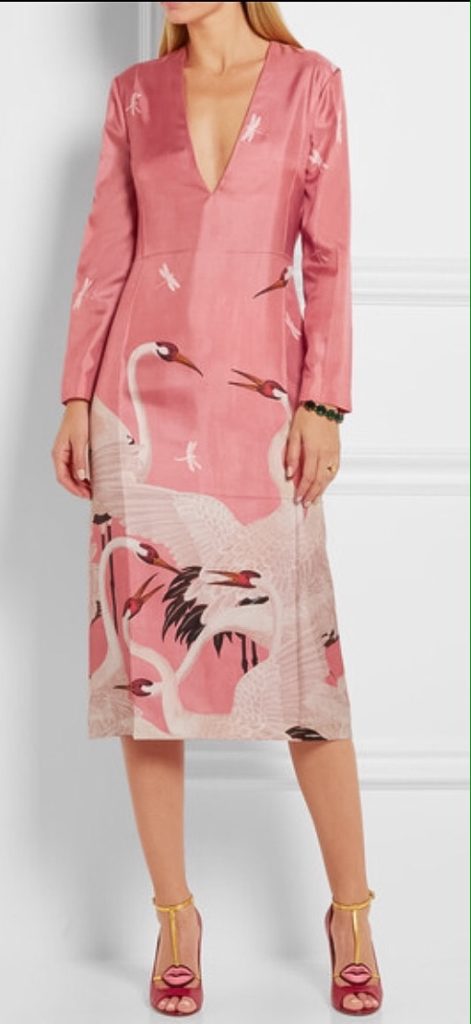
I found them fascinating because I am endlessly fascinated by the luxury industry, and the reaction of different people (myself included) to their products. Growing up poor, I always saw myself as an outsider to the fashion industry, especially the luxury market, and that self-perception has persisted despite the changing circumstances of my life. I love beautiful things, so I am very vulnerable to the lure of luxury, whose products are often (though definitely not always) very beautiful even when not practical. Case in point – and I could point to many:
Gucci via Lyst
Gucci via Lyst
This dress is like a work of art, quite apart from its label. But I am also cognizant that the label is not without an impact on my appreciation of the dress, even though I like to think of myself as a fairly savvy consumer. Recognizing my own vulnerability, I find it intriguing to read about how luxury labels craft their image and manipulate the impact on consumers. Coincidentally, having recently read Propaganda by Edward Bernays, I am more interested than ever in examining the masses of messaging we consume daily, from all sources. If anyone has recommendations for other books on this general topic, I am all ears.

Second, I randomly came across a 2011 advice column from The Rumpus, wherein the blogger was replying to a reader who asked how he could decide if he should or should not have kids. The resulting post is a must-read for anyone contemplating the same question (and deeply resonates with me now, 6 years after I answered that question for myself), but I think it has broader relevance. You guys should definitely read the whole post, but here is the excerpt that encapsulates its message beautifully, and which goes straight to my heart:

 “I’ll never know and neither will you of the life you don’t choose. We’ll only know that whatever that sister life was, it was important and beautiful and not ours. It was the ghost ship that didn’t carry us. There’s nothing to do but salute it from the shore.”

Chance are, if you’re like me, that just hit you like a metaphorical train. I have spent a good chunk of my life thinking about my ghost ship(s), without ever being able to put their existence and meaning into words quite as perfectly. I love my life, and would not change a single moment of my past (even the really, truly shitty ones) because each one was a link in the chain that guided me through the labyrinth of choices to this present moment … but I have still wrestled, too many times, with my “what ifs” – never quite knowing what to call the feeling they evoked, what it meant, and what to do about it.

Take the decision to have children, for example; I knew, without question (though, in fact, I never asked myself the question point blank, and sort of just stumbled towards the answer like a person left blindfolded in a dark room), that I would regret not having children. But I also often wondered, sometimes regretfully, about what my life without children would have been like. As I have sailed on through my life as a parent, those thoughts are growing ever more distant. The same is not necessarily true of other life choices; there, the wondering still visits me – like a ghost ship – every so often. Somehow, the thought that all I need to do is wave and watch it pass on, is deeply reassuring.

If you’re feeling in a confiding mood, here’s my question for you: how you deal with your ghosts ships or, more generally, with making difficult choices in the first place?
Blogging, Budgets, and Perceptions

One of my fave bloggers, Xin at Invicible Summer, who shares my interest in both clothes and personal finance (an Odd Couple pairing if there ever was one), recently wrote a thought-provoking post about clothing budgets, and specifically the balancing of shopping desires and fiscal responsibilities. Go and read her post (and the recommended reading), and then come back, and let’s chat.

I’ll wait.

OK, I obviously have many thoughts about this topic. I kinda touched on them before (like here), but reading Xin’s post made me wonder if they might be worth revisiting — not because the substance of my opinions has changed (it hasn’t), but because the readership of the blog has increased dramatically in the last year or so, and some of you may not have come across my old posts. At any rate, I think it’s a discussion worth having again.

As a blogger and as a blog reader, I am very much alive to the proposition that blogging sends messages, both explicit and implicit. Although I do not believe the focus of my blog is consumption per se, it is fundamentally a showcase for consumable goods so the distinction may be one without meaning. As far as that goes, I’ve said it before, and I will say it again: I do buy a lot of clothes. Obviously. Which is not to say that I think you should also buy as many clothes as I do; different strokes and all that. I do my best to side-step the connection between blog reading and shopping – it’s one of the reasons why I don’t use product links in my posts – but I realize that it’s probably impossible to avoid it altogether. Many of you have commented about buying an item because you saw it on my blog and liked it. The more clothes I feature on the blog, the more opportunities for you to find things you are inspired to buy – and, perhaps, to find tacit approval for buying them (should such thing matter to you). I get it, and it’s why I am about to talk about some things that are either outside the usual scope of the blog, or too “meta” for a typical post.

Shopping Responsibly

I don’t talk about my personal finances on the blog, but I want to make this clear: I shop within my means. My family does not have any debt (apart from a modest mortgage), and we have healthy emergency, retirement and education savings. We live in a country with (largely) free healthcare, and have coverage for things like dentist trips and pharmacy prescriptions through our jobs.  We are comparatively thrifty in some life categories, but we don’t scrimp on categories that are important to us (whether things or experiences). I’m fortunate to have enough discretionary income to indulge my passion for (collecting) clothes — responsibly, which means without negatively impacting my family’s financial situation. Most importantly, I have never spent money I did not have in order to buy clothes, and I would never encourage anyone to do that (with clothes or any other non-essential items). That means that there are things I lust over, but cannot and will not buy — unless I get lucky at the thrift store. It also means that, as I have come to put more and more value on having a large and varied wardrobe, I have made other adjustments to my shopping behaviour (i.e. buying a greater proportion of my clothes secondhand).

I realize that my discretionary income, while certainly not limitless, is higher than that of many people, and that some of those people will find it distasteful to see my spending “documented” on the blog. There isn’t much I can do about that, and I accept that it’s a legitimate reason for some to avoid my blog. But I do hope that the blog also shows that it’s possible to enjoy fashion no matter what your budget, and do so in a responsible fashion. (Psst, I’ve written before about ways to make the most of what you’ve got to work with, budget-wise.)

Shopping as Therapy

I know, I’ve joked about this many times, but listen: shopping is NOT actual therapy, OK? It’s not therapy in the same way that buying clothes is not an investment. Shopping — and more specifically, thrifting — is something I do to relax and take an occasional mental break … while I work on actively addressing whatever real problems or stressors I’m facing. [Which is the part I don’t talk about here, because it has nothing to do with this blog.] Shopping doesn’t fix my problems, nor do I expect it to do so. Some people watch TV to relax. Some people knit. Some people work out. I go thrifting. It clears my mind, by allowing me to focus on something very specific: finding a treasure in a haystack of other people’s trash. It’s the process I enjoy; the end result (if I find the proverbial needle) is just a nice bonus. Let me put it this way: I find it equally relaxing to thrift whether or not I buy something at the end.

In that sense, I find thrift shopping to be completely different than retail shopping. At a mall, it’s almost impossible NOT to find some thing (or many things) that appeal, without much effort — the retail business is predicated on it — so the experience for me is often less about the process and more about the end result. With that said, not much turns on this, ultimately. No matter what you get out of shopping, in any of its incarnations, the bottom line is the same: it won’t fix your or my problems (unless said problems are of the what-am-I-wearing-to-the-office-Christmas-party variety, and don’t get me started on that). That doesn’t mean that using shopping to get a “quick fix” (or relaxation, distraction, mood boost, whatever you want to call it) is a terrible thing. It’s not, as long as it’s recognized for what it is, and as long as it doesn’t amount to irresponsible behaviour (see above) — much like, say, having a glass of wine after work.

(Sidenote: we can certainly talk about the ethics of clothes consumption as it impacts the value of shopping as a form of relaxation, but that is a whole other topic which deserves its own post. I will just say that I do believe that it is important for everyone, as consumers, to be aware of the impact of our actions on the environment and others; it’s another one of the reasons I have embraced thrifting.)

Shopping and Blogs

I read only a handful of style blogs these days, and I read them mostly because I love their respective writers’ voices. Which is another way of saying that most of them are focused equally (if not more so) on writing as pretty photos. Even so, I occasionally find myself clicking a link to a retailer’s website … which, these days, is pretty much the only time I check those out. Inevitably, I end up with 2 or 3 items in my cart, and it takes a very conscious effort on my part to close my browser without going any further.

So, I get it. If you’re constantly looking at pictures of pretty things, it’s hard not to want to possess at least some of them. I avoid certain types of style blogs for that very reason, and I would encourage anyone struggling with blog-inspired FOMO to do the same with whatever is the source of their angst. If that means all style blogs are a no-go zone, then so be it.

One issue I do struggle with, however, is the amount of responsibility that bloggers owe to their readers, particularly with regard to implicit messaging. For example, I would probably feel bad if I knew that someone went into debt to buy something they saw on my blog; but is there, in fact, a degree of culpability on my part for that person’s actions? And further, if I am aware that my posts may be perceived as conveying an unintentional message, is it incumbent upon me to change them? Should blogs come with content warnings?

As you can imagine, this is a topic on which I would love to hear your thoughts. Do you have a clothes budget? And if so, how does blog reading (or media consumption generally) affect your budget or your shopping? If you read style blogs regularly, why do you do it and what do you wish you could change about them (or your engagement with or reaction to them)?


Colourful Business

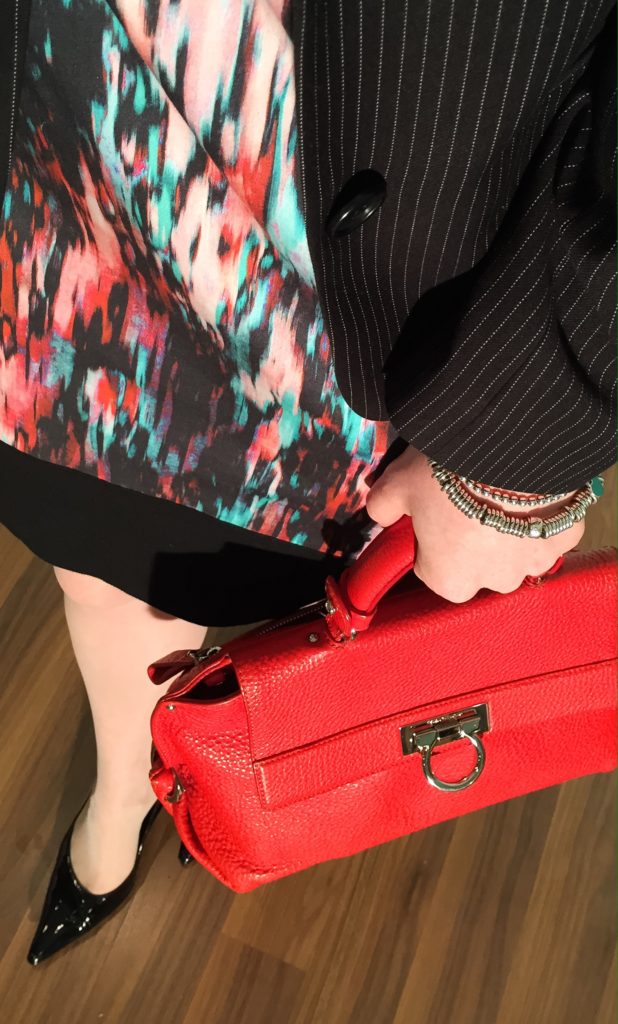
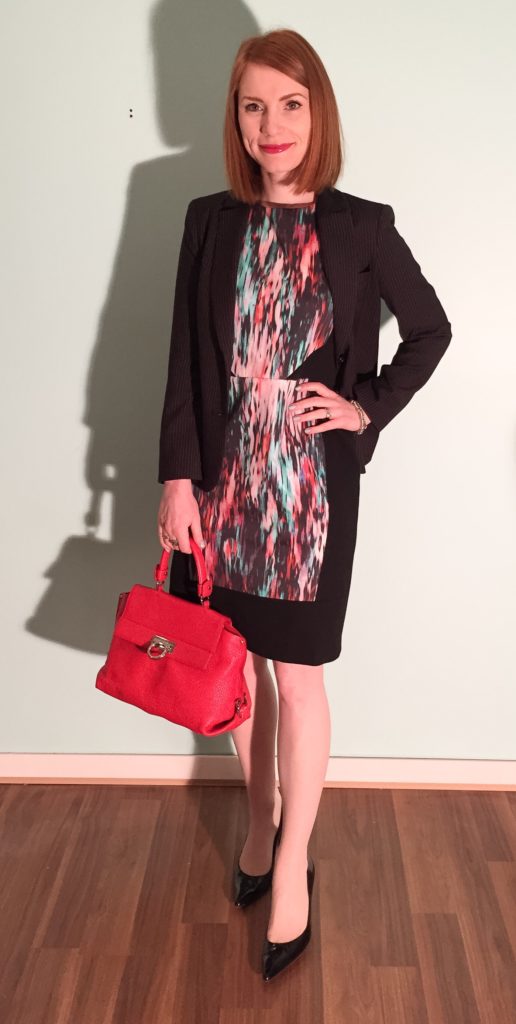
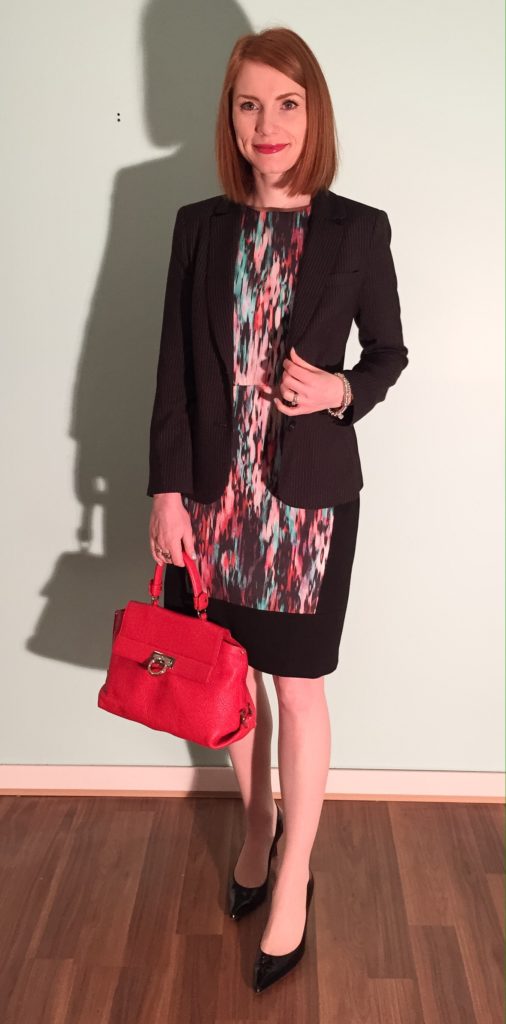
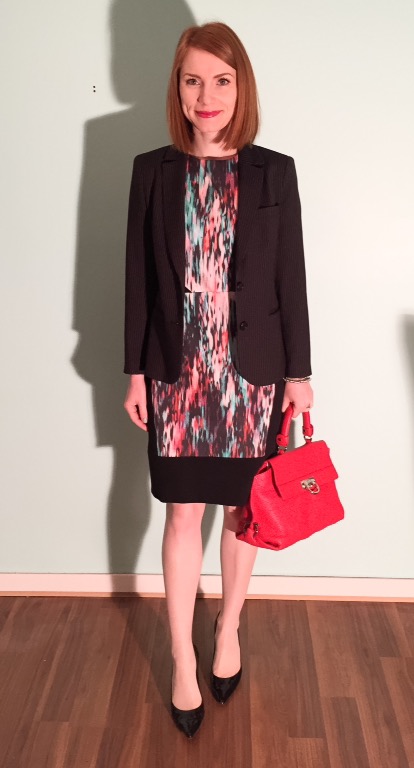
Blazer, DKNY (thrifted); dress, Judith & Charles (thrifted); bag, Ferragamo; shoes, Stuart Weitzman

This Judith & Charles dress is one of my favourite pieces to wear when I need to look “business-y”. It looks polished without being too staid, and bright without being cartoonish. In my line of work, I have to walk a fine line — having sufficient gravitas to be taken seriously, without appearing unapproachable or intimidating to the kind of clients with whom I usually work. I think (or hope) this dress helps me to do that. Although I have paired it with bright accessories for the office in the past, on this occasion I stuck with more conservative options. [I wore the red bag to work, but brought my large black tote to the off-site client meeting.] The pinstripe in the jacket added some subtle visual interest, but overall the effect was low key.

simple outfit formula
close-up
close-up

Outfits like this one are not necessarily my favourite, but needs must and all that, and I think it’s worthwhile putting them on the blog from time to time for a dose of (unglamorous?) reality. I feel pretty fortunate to be able to wear things that are more “my style” most of the time; I would have way less fun with clothes if my work dress code did not align at all with my personal preferences.

On that note, I’m curious: does your work code allow you to wear things you like every day, or do you have to “sacrifice” your personal style to pratical considerations? If so, how does that impact your attitude to clothes generally? Also speaking of professional dress, I would love to hear your thoughts on this article.

black with a side of colour