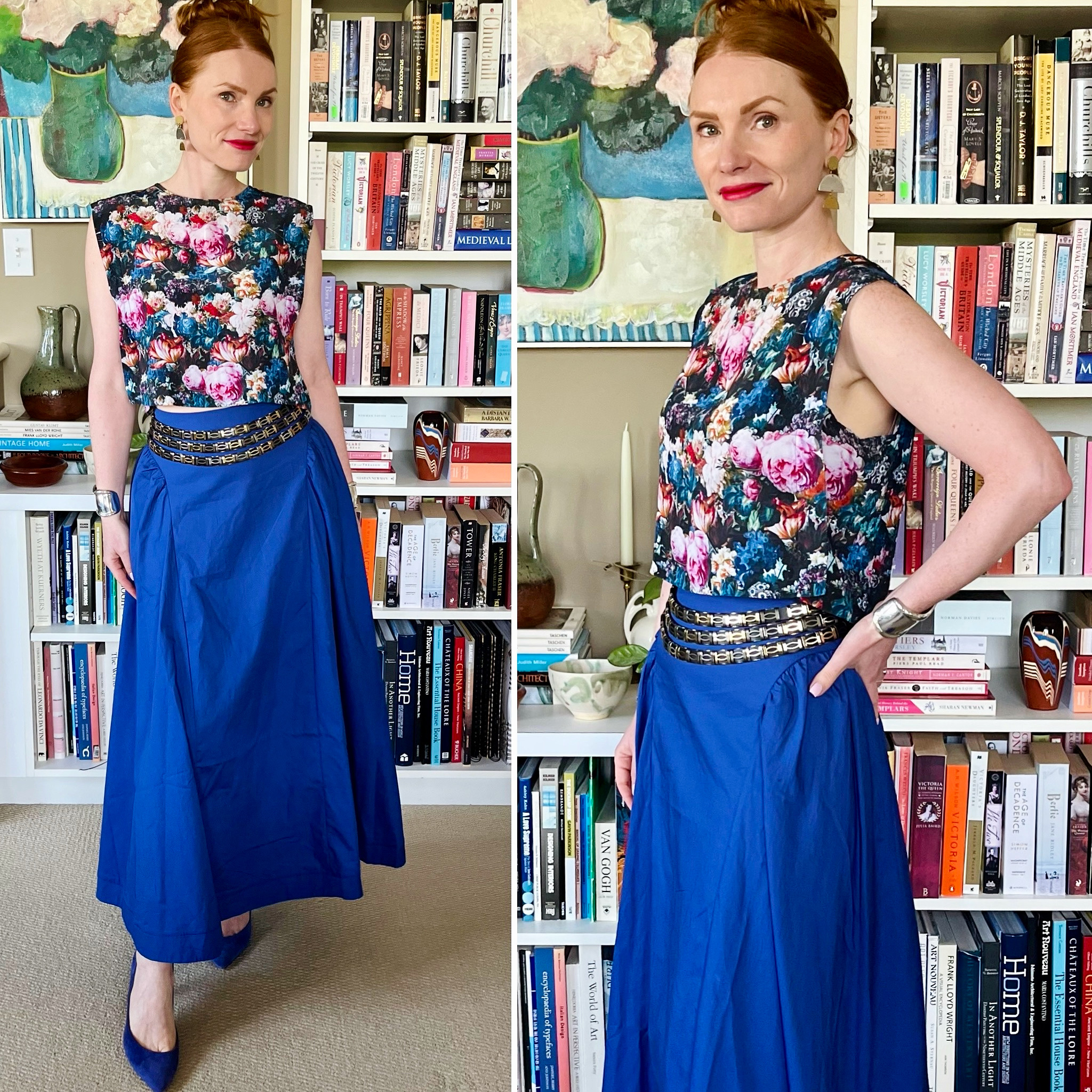
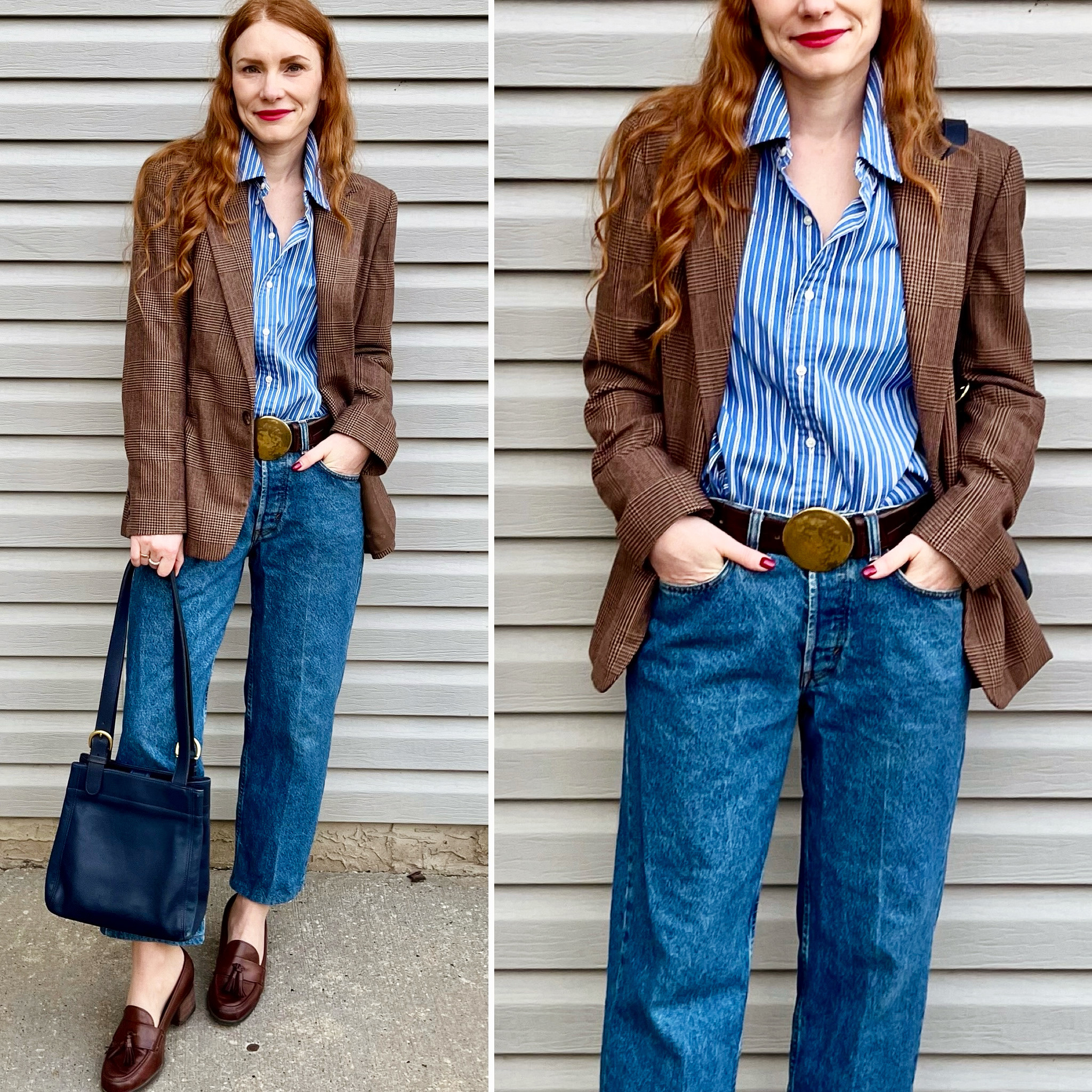
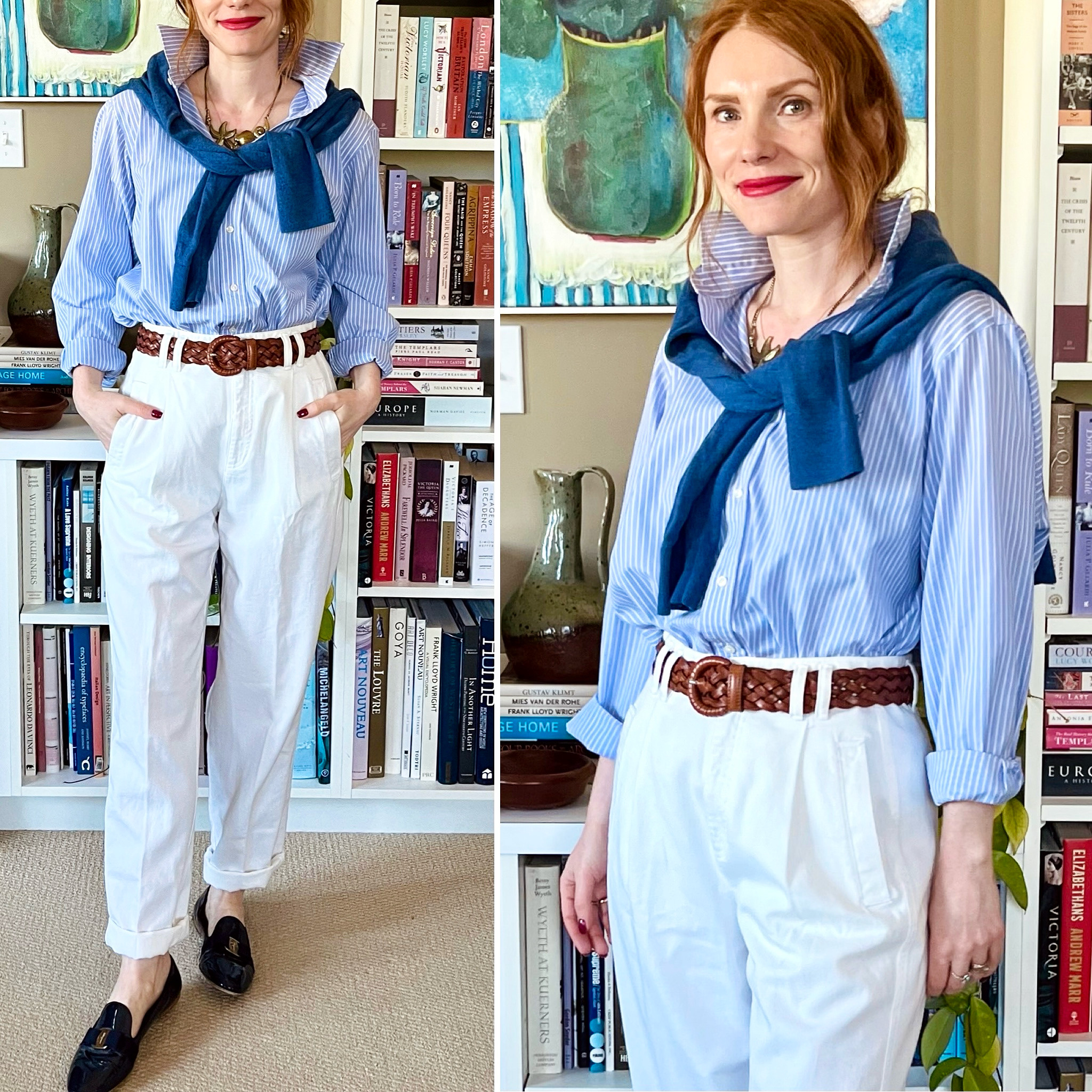
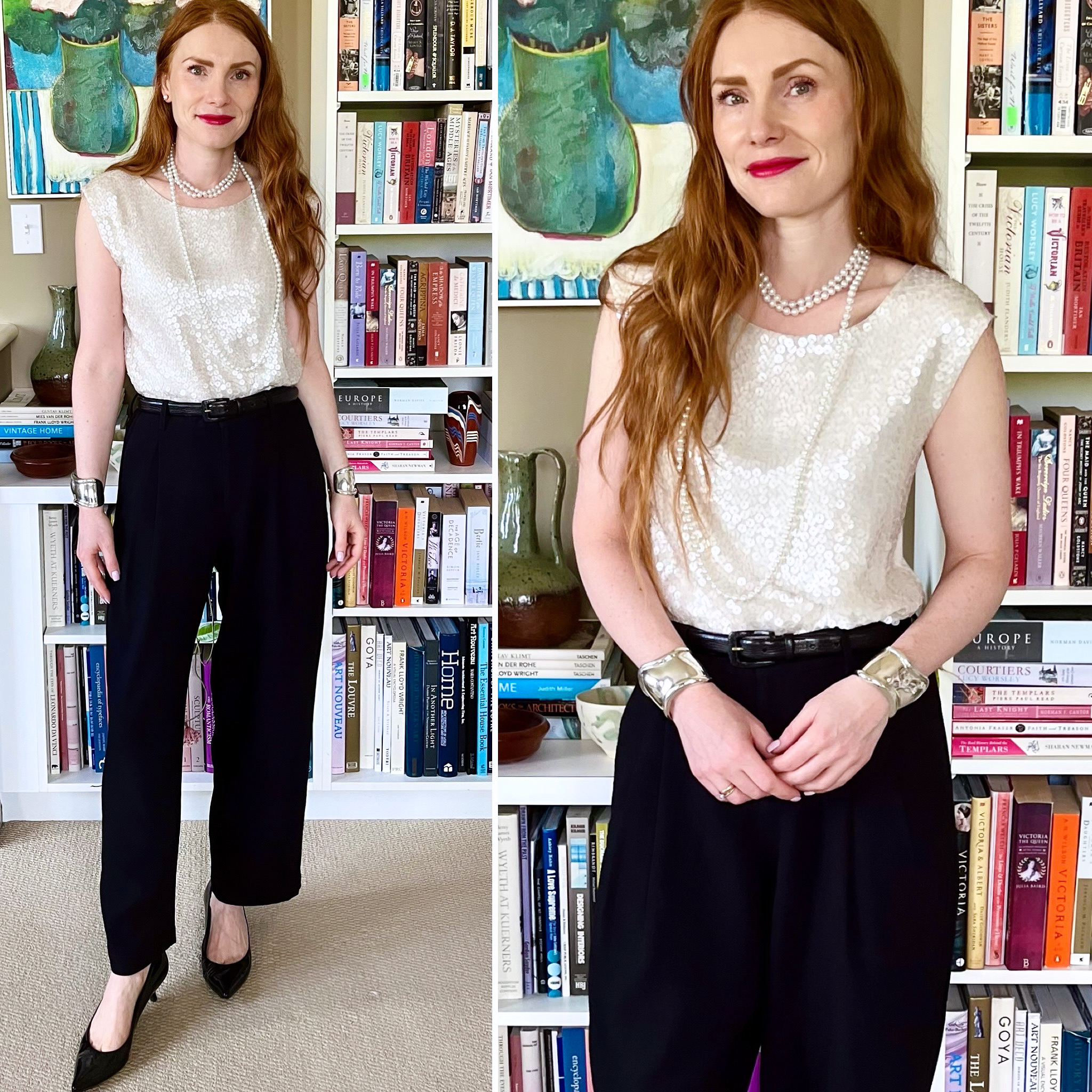
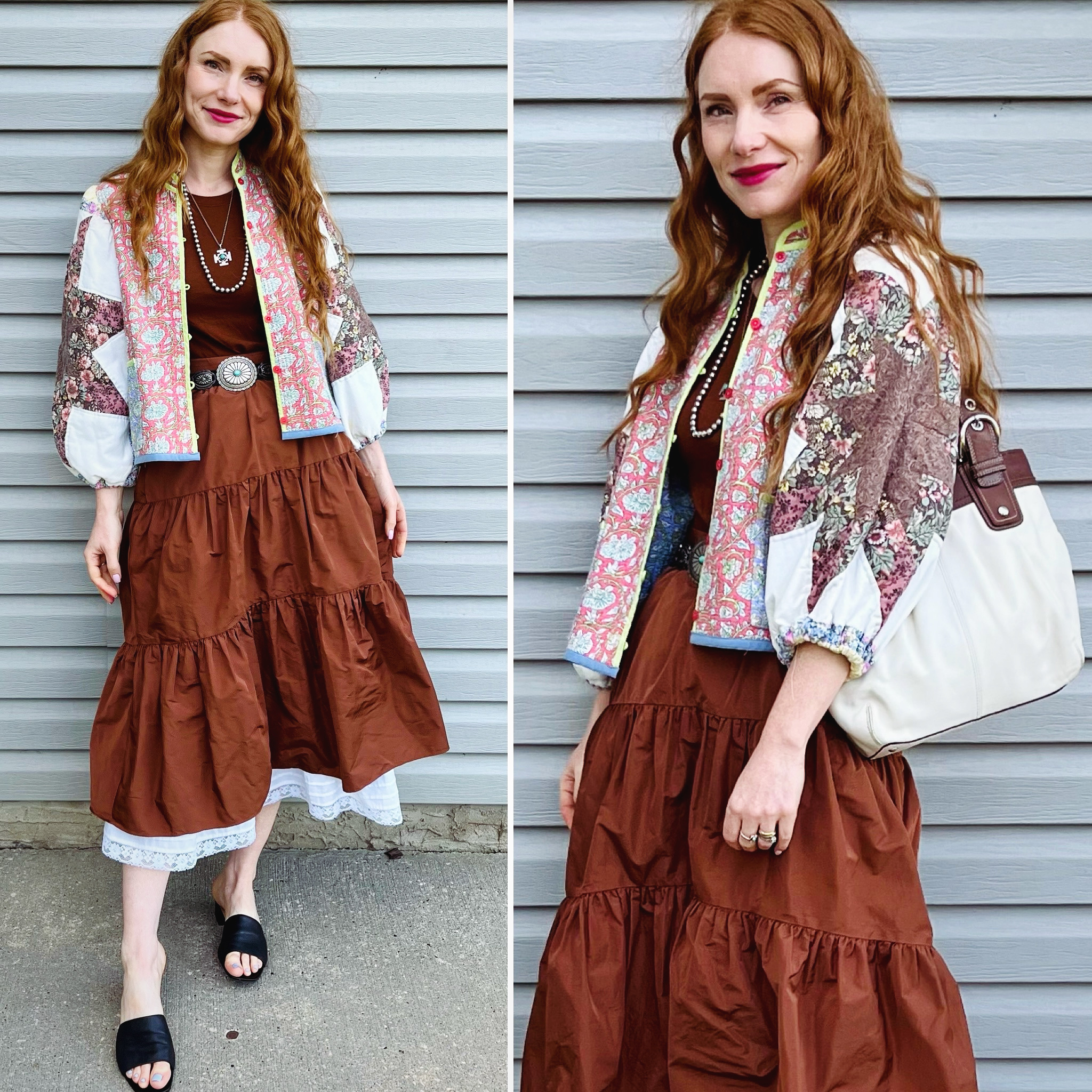
Editor’s note: hi, it’s me, I’m the editor. The content of this series is adapted from the Memoir That Never Was, which I wrote last year. The themes centered on identity-making and my relationship with secondhand stuff), but in writing it, I ended up synthesizing ideas that have been pivotal to my growth as a person since turning 40. Although I decided to shelve my Memoir That Never Was indefinitely, I decided that there are parts of it I would like to share here on the blog. It will get pretty personal/vulnerable at times, but I think the community we’ve created here is a wonderful (and safe) space, and I hope that these posts will inspire reflection and conversation. Cheers!
I like to think of thrift stores as giant libraries – stay with me here. Libraries are famously full of books, and books are famously full of words. If fashion is a language, the clothes are words, and, well, you see where I am going with this. Go into any thrift store, and you are sure to find clothes from the last three or four decades – every trend, every colour, every style, sometimes in several iterations. Take puffy sleeves: people have been making them since practically the dawn of time, or at least the Middle Ages. There are all kinds of puffy sleeves out there, and you’re likely to find a generous sampling of them at the thrift store. Go and look. Even if you’ve never been to fashion school and don’t know the technical terminology to articulate how this puffy sleeve is different from that one, you will still be able to see the difference. Try them out and you’ll also see how they fit on your body – and if you like the way they fit on your body. Most important of all, how they make you feel. Do they make you feel like you? Make a note of that. You’ve found a tool – a word or a sentence, if you like – you can use to tell the world something about yourself.
That’s basically what I did, one thrift store visit at a time. Before I even realized what was happening, I found myself in possession of a whole vocabulary. To me, personal style is nothing more than the way in which I put those words and sentences together. I want to be very clear here: personal style is the process of creating an outfit; it is not the outfit. I’m not just splitting hairs. Writing is not the same thing as the book. These days, with AI, you can have a book without any writing. Personal style is also not an aesthetic. If we stick with the writing analogy, aesthetic is the genre. Think of it like this: Daphne du Maurier and Shirley Jackson both wrote gothic fiction, but their books would never be confused. Similarly, there are plenty of people who like the goth aesthetic, but they don’t all have the same personal style. Personal style is an individual perspective brought to life through clothes.
Thrift stores are like libraries in another way as well. For a relatively modest fee, you can “check out” an item – say, a puffy-sleeved top – to figure out if it has a place in your closet or not. If it does, you can keep it; if not, you can return it. You can keep it for a while and then return it. Either way, your “experiment” has cost the planet nothing. A new puffy-sleeved top did not have to be created for your use; the existing top can remain in circulation (and out of landfills) long after you part ways with it, assuming you take care of it while it’s yours. I think this is really important. As a Creative Clothes Wearer, I crave novelty and diversity – I want to be able to write with a complete dictionary at my disposal, so to speak – but those things come at a cost. Clothes require vast amounts of resources to produce; the more variety, the greater the volume. Creating a chartreuse puffy-sleeved top for every person on the planet is not sustainable and or even worthwhile because not every person on the planet will be interested in wearing a chartreuse puffy-sleeved top. Ideally, there would only be as many chartreuse puffy-sleeved tops in the world as there are people who love wearing them. The reality is that the fashion industry isn’t designed for that kind of math; if capitalism can sell 10 billion chartreuse puffy-sleeved tops to 8 billion people, it will gladly do so. What someone like me can do, in this situation, is to minimize the impact of my hobby by shopping secondhand for my hobby-related needs as much as possible. I make thrift stores my libraries, try to be a good steward of the clothing I take into my closet, and do everything I can to keep the circular economy going.
Which is a good thing because, like I said, it took me a few years of regular thrifting (and an embarrassing amount of clothes) before I got the hang of my personal style and how to use it. At the beginning, as many people do, I tried to use brands as a shortcut to personal style, thrifting every attractive designer item I could get my hands on. But, friends, there is no shortcut to personal style. If you wear head-to-toe designer – pick any designer of your choice here, go on, aim for the sky – you won’t be any closer to having personal style than if you bought an outfit at Zara. Your outfit will probably look better and feel nicer (assuming that designer isn’t skimping on fabrics and construction), but you’ll be wearing someone else’s point of view, not your own.
Getting your own point of view across sounds nice, but the how of it isn’t necessarily obvious. It wasn’t obvious to me, even after I spent a few years circling around the topic in my mind, trying different approaches. Because here’s the thing: there isn’t a single, universal way of approaching personal style. That is a deeply personal process. Every artist thinks about their creative process in their own way. I mean, you’ve got Method actors and actors who think Method acting is stupid; neither is right, neither is wrong. The key is finding what works for you, what feels most natural and instinctive and easy. Personal style isn’t effortless – because nothing intentional is created without effort – but it shouldn’t feel difficult.
I am going to tell you what works for me, but only as a point of reference among others. There are lots of them out there; hang out with other Creative Clothes Wearers for a hot minute, and you will be sure to come across dozens. Allison Bornstein’s “three-word method” is one example; it helps people figure out how they want to express themselves through their clothing by asking them to identify three adjectives which best signify their unique look. To illustrate the process, Bornstein often uses real-life models; for example, she identifies style icon Jane Birkin’s three words as “simple, casual, sexy” and Kim Kardashian’s as “exaggerated, fitted, and sculptural.” The “three-word method” is extremely popular, so I assume a lot of people find it helpful, but here’s the thing: I’ve tried this approach, and it didn’t work for me. And I’ll tell you why – not because I want to criticize Bornstein’s methods, but because I think it helps to illustrate why it may or may not work for you.
Remember how I said that I hate when people ask me to tell them about myself? How that makes me want to dig a hole in the space-time continuum so I can disappear from existence? If I can’t string together a simple elevator pitch, do you think I’m going to be able to pick just three words – THREE! – to capture everything I want to say about myself through my clothing? Hell, no. I don’t think about myself in terms of simple labels, and I don’t approach my creative process in a diagrammatical sort of way.
I had to go all the way back to the beginning to find my process. Books were my first love, writing my first creative experience. I am, first and foremost and above all, someone who loves stories. I mean, look, I’ve been using a language analogy for fashion this entire time; you shouldn’t be surprised when I tell you that that personal style, to me, is like writing a character – with clothes, instead of words. Well, several characters, to be precise. I call them avatars, because why not add one more “me” into the confusing mix. Don’t hate me yet, I will explain.
So, we have the self … which becomes identity when perceived in relationship with the world around it … which in turn is presented as persona to others. I find it helpful to visualize this as 3 concentric circles, with the self at the core and the persona in the outer ring. How do avatars fit into this picture? Add another circle. Avatars are an anthropomorphized embodiment of those facets of my persona that I want to express through the clothes I wear and how I wear them. Conceptualizing these facets as characters – rather than words or descriptors – makes it easier for me to visualize them, and thereby translate abstract ideas into concrete outfits.
If I ask you to think about your favourite literary heroine, chances are that you can summon a clear picture in your head. Maybe it’s based on a movie adaptation you saw; maybe it’s based solely on your imagination, conjured up as you were reading the story. In fact, you can probably imagine how that heroine might dress under different circumstances – say, going to the grocery store or going to the opera – even if you’ve never thought about it before. In mentally dressing this character, you are exercising your creativity. Now, layer on the fact that the character is someone you relate to; someone with whom you identify, whether a little bit or a lot, and there you have it: that character is an avatar through which you can express yourself, creatively, in clothing. Characters are multi-dimensional. Even if they are amenable to a one-word label, they do not collapse into one-dimensionality because we know that behind that label is a much richer text. We can call Jane Eyre a “governess”, but what she signifies is so much more – and the what is unique to each reader. If the what I associate with Jane Eyre represents a facet of myself, asking myself ‘what would a modern-day Jane Eyre wear on a cold Saturday afternoon in February to visit her best friend’ helps me to visualize how to express that what in my outfit choices.
Choosing avatars is a deeply personal and subjective process that, like everything else to do with personal style, is more art than science. Avatars don’t have to be literary characters or historical figures, but the more well-developed they are in your mind, the better they can serve you when you shop for clothing and create outfits. I can look at a piece of clothing and immediately know whether one (or more) of my avatars would wear it, much in the same way I know these things about my closest friends. An avatar should be more than simply a collection of descriptors, otherwise it’s just a more verbose version of the “three-word method”. I came up with my avatars by thinking about the different aspects of myself that I wanted to bring out in different parts of my life – at work, at play, in different social groups and settings – and then turning them into characters, each with its own a backstory and atmosphere. The first time I did this exercise, back in 2018, I came up with 4 avatars. I say the first time, because I have repeated the process several times since then. As we’ve already discussed, our personas are works in progress, continually evolving as we evolve and our circumstances – where, how and with whom they live – change. As reflections of parts of our persona, avatars will evolve too. I like to sit down and reflect on my avatars at least once a year; sometimes I do it every season, around the time when new runway collections come out, as part of an exercise in updating my inspiration reference points. It’s a way to check in with myself: are these characters still telling the story I want to tell, and if so, what new elements (trends, colour stories, proportions) can I add to my toolbox to tell that story? My avatars haven’t changed very drastically over the last 6 years, but there has been a slow, steady, organic evolution.
Identity is a funny business. So much has been written about it throughout history, but at the end of the day, each of us is left to figure it out on our own. Kierkegaard was probably right in thinking that “[t]o be entirely present to oneself is the highest thing and the highest task for the personal life” but that doesn’t make it an easy one. We can look in many directions for help in finding our answer to ‘who I am‘ – philosophy, religion, art, friends and family – but the answer can only be found looking inward. And that’s hard, because society wants us to do the opposite and is constantly working to make sure we conform to its desires. Introspection takes our attention away from where society likes it to be: on the ideas and objects it wants to sell us. Telling us that identity can be created through consumption kills two birds with one stone. It’s a shiny distraction, phony as a three-dollar bill. Consumption should be a function of identity, not its source, if we are to have a hope in capitalist hell of being happy. My clothes make me happy, but they couldn’t make me happy until I stopped looking for them to tell me who I ought to be, and started looking at them as a way I could tell other people who I am. You may not look at clothes the same way, and that’s okay. We all tell our stories in different ways. The story, and the telling of it, is ours alone. As for personal style, the taste which informs it:
“is not an arbitrary collection of likes and dislikes, but rather a rare form of intelligence: an intelligence that transcends knowledge of styles past and present. Gaining this intelligence is a perpetual process, which is part and parcel of the gaining of self-knowledge. But to have gained it, cela justifie une vie.”[10]
[8] Marx, p. 106-107
[9] Marx p. 107
[10] Phillip Mann, p. 336