Category: Wardrobe Analytics

Wardrobe Statistics

How do you guys feel about another wardrobe statistics – are you with me? Good. Be forewarned, this one is going to be heavy on numbers. I was inspired to write it after reading about Emma Watson’s Met Gala outfit, which led me to discover the #30Wears movement; it’s been around for a while, but this would not be the first time I’m behind the times, so please bear with me. The premise is solid – making purposeful clothes purchases guided by ethical and sustainability principles – but what really intrigued me was the question that it poses and from which the hashtag is derived: would you wear a particular piece at least 30 times before disposing of it? That sort of thing is practically catnip for this numbers nerd. I was really curious to see what answers the question, applied to my existing wardrobe, might yield.

The short answer is: no, for the most part. The slightly longer answer is: no, with the exception of bags, coats, shoes, and black cardigans/blazers. For the really long answer, read on.

Let’s start with a quick inventory of the things currently in my closet. These numbers are ever-shifting targets, because I acquire new (to me) things all the time. Bad Adina! But also: good job, Fun Closet Adina. (I’m sure Emma W. would disapprove of Fun Closet Adina. I guess I’m Team Slytherin, or something. Moving on.) Here’s what I’ve got, along with the most worn item in each category:

Category      Total items     No. of items worn at least 30 times     Item most worn
Tops                      34                0                                striped top (26 times)
Jackets                   21                0                                 black blazer (28 times)
Outerwear              14                4                                 camel coat (223 times)
Pants                     23                2                                 skinny jeans (81 times)
Skirts                    33            1                                 black skirt (44 times)
Sweaters               26                3                                 black cardi (71 times)
Dresses                 52                0                                 black dress (27 times)
Bags                      25                8                                 black (commuting) tote
Shoes                    56                10                                black pumps (87 times)

This looks pretty pathetic, doesn’t it? I always knew that my closet sees a lot of turnover, but these numbers are quite stark. Let’s delve a bit deeper, though. How long, exactly, do clothes hang around (har har!) in my closet?

Vintage                    No. of Items
2010 or older             10
2012-2014                   64
2015                          57
2016                          74

Put another way, about a third of my clothes are more than 2 years old, and about a third are less than 1 year old, with the remaining third falling in the middle. I’ve been, um, busy this year. As far as trends go, it looks like coats and sweaters tend to keep the longest, with the remaining categories turning over almost completely about once every two years. It could be argued that the last 3-4 years may not represent the best data set, because of life changes and fluctuating weight (two pregnancies, two mat leaves, etc.), but I have a suspicion that the results would be the same regardless.

I think it all comes down to this: I like variety and I like bright, colourful things. I also get bored, periodically, of those bright colourful things, and want to exchange them for new ones. The basics tend to stick around much longer, usually until they fall apart. But “basics” in this context mean all the black things: black sweater, black cardigan, black pants, black blazer, black skirt, etc. And skinny jeans. The exception is coats/outerwear. Because I hate to buy coats, and because I also actually need to wear coats for a large part of the year, coats tend to get a lot of wear and stick around for a long time, regardless of style, colour, etc.

(Please note that the stats above do not include shoes and bags, which would probably skew the numbers a bit towards the older side. Also, “vintage” means years spent in my closet, rather than since production. I buy a lot of things secondhand, as will become apparent in a moment.)

I also decided to look at the composition of my closet, because there has got to be some good news in there, somewhere. Right?! So, I decided to look at the provenance of my clothes; due to time constraints, I looked at this only at a very high level. Ideally, I would like to tally the actual country of manufacture for each piece in my closet, but because I don’t currently track this in my closet worksheet, it would take a long time to tabulate at the moment. It’s definitely something I’m considering tracking on a going forward basis. For now, here goes:

Provenance                         No. of Items
New/Retail                                  59
Thrift                                            64
Consignment                               72
Swap/Gift                                     8

This, I feel good about. Over 70% of my clothes are pre-loved, which means that, although my environmental footprint is by no means small, it’s not quite as large as it would appear at first blush. I’d like to be able to say that the majority of my clothes have, in fact, been worn 30 or more times – if not by me, then by their previous owners – but I actually don’t think that’s true. Most of the clothes I thrift or buy from consignment (or eBay) come to me either brand new (some with tags) or very nearly new. A lot of clothes leave my closet (their second home, at the very least) only barely worn. It is entirely possible – and I hope it’s true – that they get their third lease on life in another closet. In my experience, however, the biggest driver of the rapid cycle of clothes production is not poor quality. Most clothes that end up in thrift stores are perfectly fine (fit excluded, which is a separate issue perhaps). Other factors are in play here, including the thrill (and relatively low personal cost) of novelty. I know that’s my weakness, for sure. And it’s a big reason why I’ve become an increasingly dedicated thrifter.

I want to hear your thoughts! Tell me if you’ve ever considered the #30Wears challenge (and question), and whether you think your closet would pass it.

The One Where I Go to a Conference

Yes, you guys: I finally did something mildly interesting. I went to a conference. In Ottawa. It was my first time in our nation’s capital, and it was great. I have the Instagram pictures to prove it, and the bathroom selfies to … prove I wore clothes while doing it, I suppose. And now you’ll get to hear aaaaall about it.

First of all, may I just say: getting away for three kid-free days is blissful. In theory. But between adjusting to a new routine (like, say, waking up without my usual “alarm clocks”), and worrying about how everyone was coping without me at home (short answer: just fine), it wasn’t nearly as blissful as I anticipated. With that said, don’t cry for me Argentina; I got a good chunk of personal reading time, a lovely hotel bed all to myself, yummy food eaten sitting down, some sightseeing, and even a bit of shopping done. Oh yeah … and I learned a bunch of (work related) things. Work is boring, so let’s talk about clothes instead.

First, the packing.

I wanted to enjoy the full benefits of traveling solo, and that included packing light and eliminating the need to check luggage. This went against my instinct to pack All The Things (just in case). But I persevered; I knew that my hotel was immediately adjacent to the biggest mall in town, so I figured I had the worst case scenario covered. In total, I packed 13 items, including shoes and my plane outfit.

packing for work conference
everything but the shoes and coat

Can we take a moment and marvel at the fact that I only took 2 pairs of shoes with me? If that doesn’t win the award for Unlikeliest Thing You’ll Ever Read On This Blog, then we need to run a re-count. I packed my trusty black wedge pumps (comfortable for potentially endless networking events, stylish enough for day- and nighttime wear) plus my equally trusty Ecco boots (comfortable for traveling and sightseeing). That was it. No fancy shoes. Nothing sparkly, nothing colourful. ‘Twas a miracle, I tell you.

But something went terribly wrong: after taking the photo above, I somehow forgot to pack my Yoana Baraschi jacket. This I didn’t realize until I checked into my Ottawa hotel and unpacked. Since the jacket was the centerpiece of my second conference day outfit, I had a bit of a problem on my hands. And I had no handy solution, since I had deliberately under-packed, and had no alternate outfits on hand. As it was, my options were (a) wearing my “plane outfit” sweater, or (b) trying to find something at the mall. More on that in a moment.

My husband’s cousin lives in Ottawa, and he kindly offered to act as my guide. I spent my last afternoon in town sightseeing (and visiting family) and it was super fun.

Ottawa Byward market
Le Moulin de Provence in Byward Market – I can highly recommend the cherry strudel
Notre Dame church Ottawa
Notre Dame church
Ottawa National Gallery
National Gallery
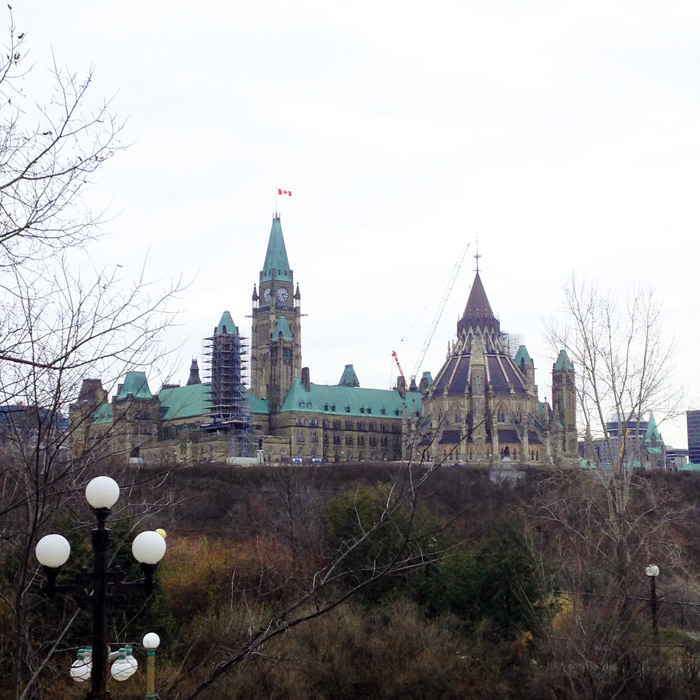
Ottawa Parliament Hill
Parliament Hill – Centre Block
Parliament Hill Ottawa East Block
Parliament Hill – East Block (my favourite)
Ottawa Parliament Hill Centre Block
Parliament Hill Centre Block entrance
Ottawa Supreme Court of Canada
Supreme Court of Canada – impressive, but not nearly as pretty as East Block
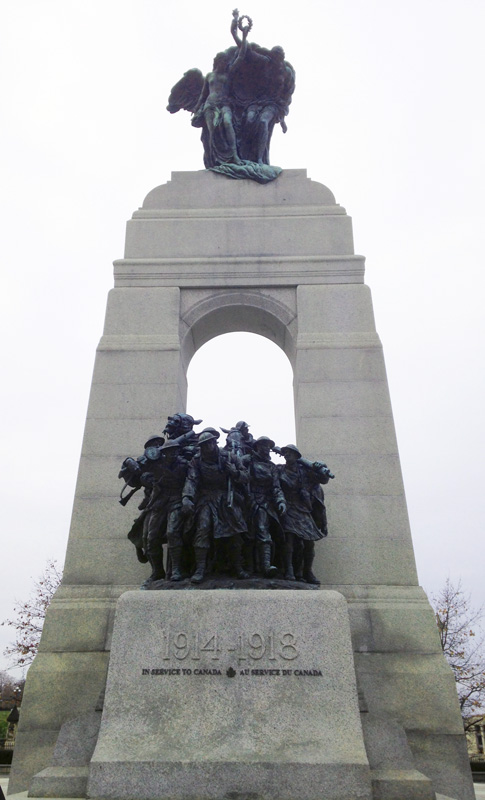
Ottawa National War Memorial
National War Memorial

Ok, enough about me. Let’s talk about my clothes. {har, har}

My excursion into Rideau Centre was a disaster. Compared to West Ed Mall, or even Chinook Mall in Calgary, Rideau Centre is small-ish. Nonetheless, on Black Friday (the day I happened to need to shop for a replacement outfit), it was packed to the gills. The sales were mediocre, but that didn’t even matter. At J. Crew, I couldn’t find anything in my size; everything was size 0 or 2. At Banana Republic, the line for the changing rooms was about an hour long. After that, I gave up. I went and walked around the Byward Market instead to get away from the madness, and decided to just make the best of it with the clothes I already had. Thankfully, the second day of the conference had a short, morning-only programme, and I didn’t have to parade around in my makeshift outfit for very long. Speaking of which – ready for those bathroom selfies?

plane outfit; J. Crew butterfly sweater
Plane outfit – there & back
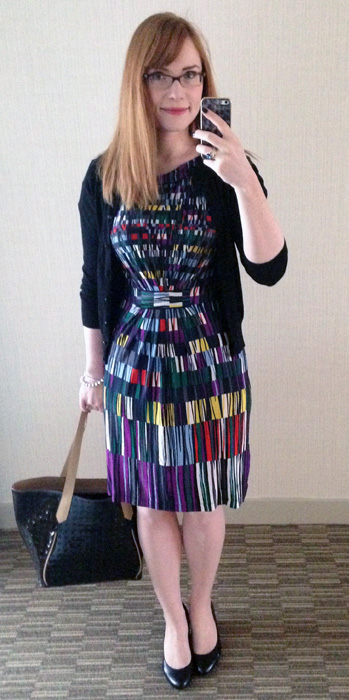
conference outfit; travel capsule; work conference outfit
conference, day #1
conference outfit; travel capsule; work conference outfit
fancy dinner outfit (conference related) – I ended up wearing this dress with black opaque tights & boots instead
conference outfit; travel capsule; work conference outfit
conference, day #2
conference outfit; travel capsule; work conference outfit
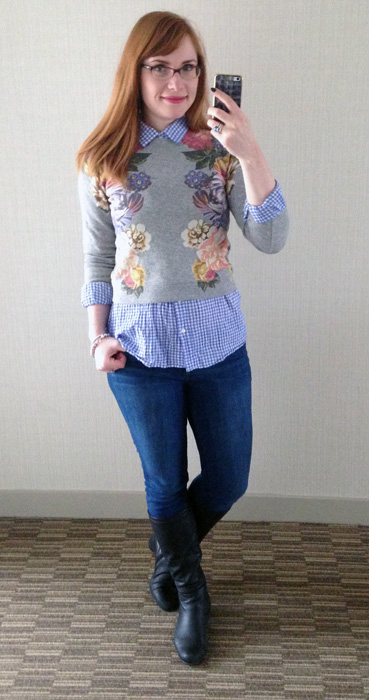
sightseeing/casual outfit

And there you have it: the ups and downs of a work travel capsule. Au revoir, Ottawa!

Wardrobe Analytics: How Much $ Are You Wearing Right Now?

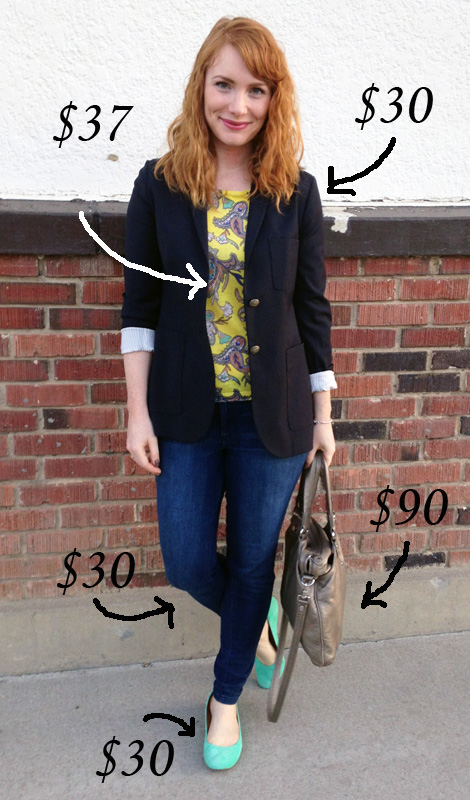
You know the saying: “I feel like a million bucks”? Well, have you ever wondered just exactly how much money you’re wearing right now? I have, because I love knowing weird little factoids like that. I also love compulsively tracking (and crunching) irrelevant data. Yep, time for another wardrobe analytics post.

There are several ways to approach the question of how much money your outfit cost. You can look at absolute numbers (i.e. tally up the purchase price of everything you’re wearing), or you can look at your collective Cost-per-Wear. I think the latter is a better indicator of how much you’re maximizing your wardrobe, but number-crunching fun can be had with both values. Speaking of which …

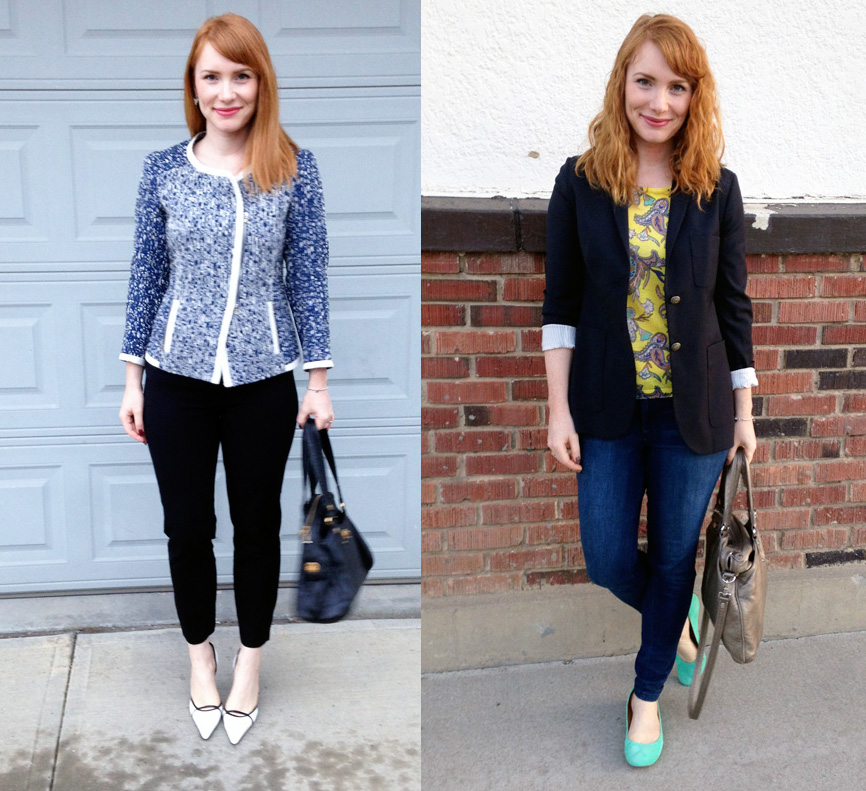
For this exercise, I picked two of my favourite outfits from last month. I felt pretty good – at least six figures’ worth – in both. To keep things fair, I chose two pants outfits (though one is casual, and the other dressy), each consisting of a roughly equal number of pieces (5 and 4, respectively), all of which were purchased in the last year. (That last bit matters when calculating Cost-per-Wear.)

Here are the two outfits:

wardrobe analytics; cost per wear calculations
Your choices

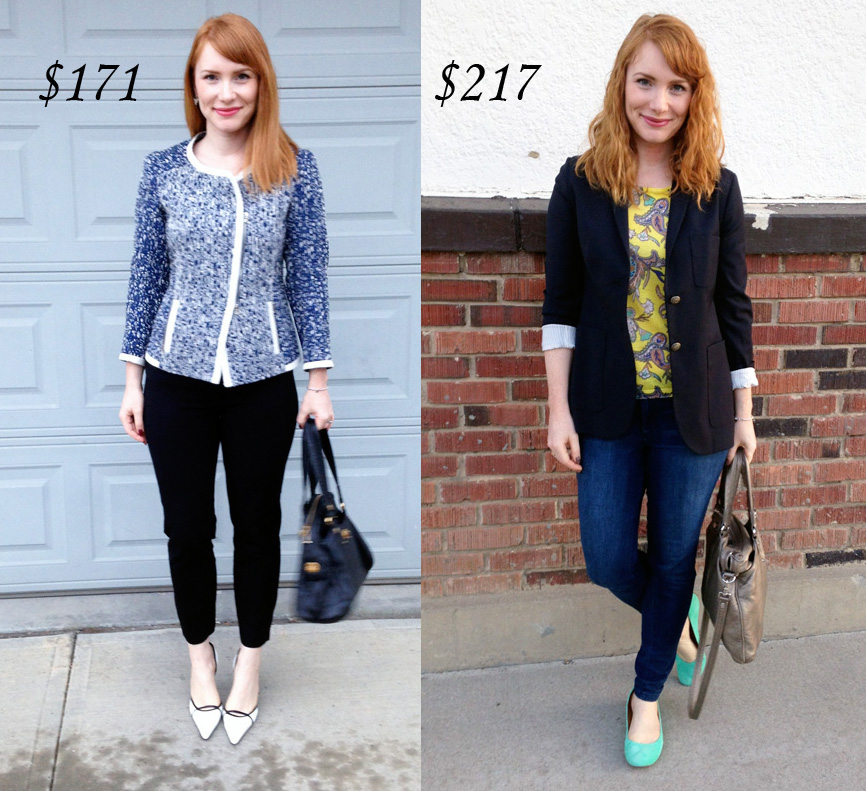
Now, do you think you can answer these questions: Which was the more expensive outfit? Which was the most expensive item in each outfit? Which outfit was the better deal? (Here’s a hint: one of these outfits cost approximately $1,540 in retail prices.)

Most Expensive Outfit: Absolute $ versus Cost-Per-Wear

wardrobe analytics; cost per wear calculations
Did you guess correctly?

First of all, I think these numbers are pretty reasonable given the (a) function (work outfits); and (b) overall quality. If you remove the cost of the bags from the equation, the amounts go down to $66 and $127 respectively; we all know that I love expensive bags, so this is no surprise. I’m fairly cheap thrifty when it comes to most other clothing categories, and I think this analysis bears that out.

In absolute terms, the outfits are actually pretty equal if you factor in the item difference. On a per-item basis, the outfit on the left cost $42.75, versus $43.40 for the outfit on the right. (Or $16.50 and $25.40, if you factor out the bags.) It’s a similar story if you look at it on a Cost-per-Wear basis.

wardrobe analytics; cost per wear calculations
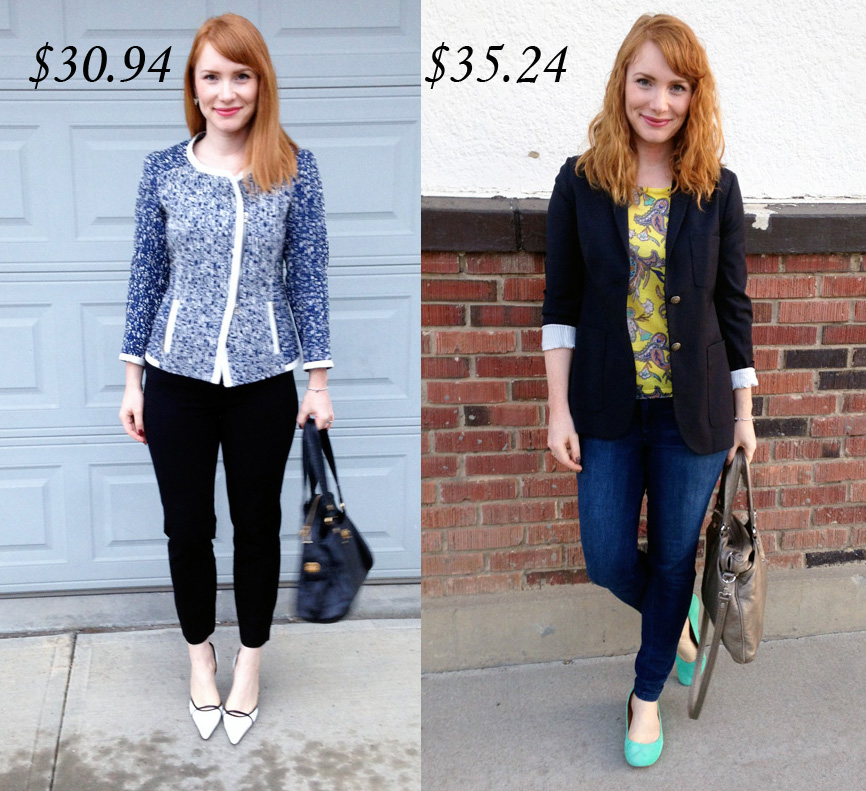
Cost-per-Wear

In the outfit on the left, the average Cost-per-Wear per item was $7.73; for the outfit on the right, the average Cost-per-wear per item was $7.05. Interestingly, removing the cost of the bags doesn’t make much difference: $7.31 and $6.10, respectively. That’s because I wear most of my bags on a regular basis (and these are two of my most worn), so their actual Cost-per-Wear is very low.

Overall, the Cost-per-Wear is still pretty high, but keep in mind that most of these items are fairly new.

Most Expensive Item: Absolute $ versus Cost-Per-Wear

wardrobe analytics; cost per wear calculations
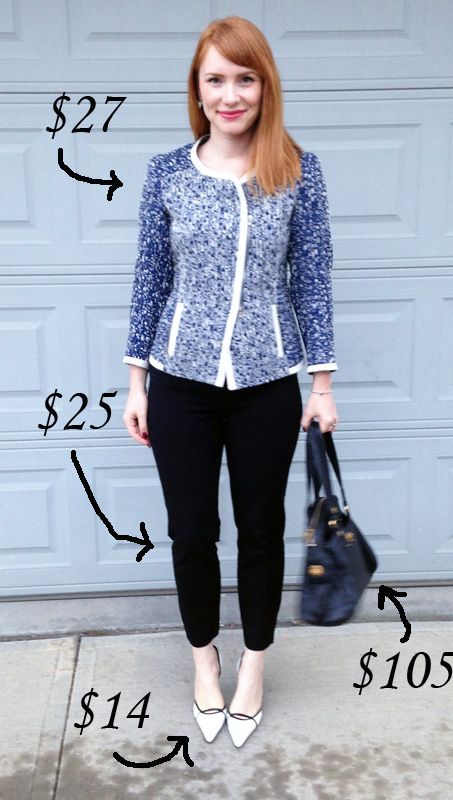
Jacket, Yoana Baraschi; pants, Banana Republic (via consignment); shoes, Manolo Blahnik (thrifted); bag, MbMJ (via eBay)

Here is where things get funny. In outfit #1, the cheapest item (my thrifted Manolos) actually have the highest Cost-per-Wear of the lot; I’ve worn them once – so far! – so it’s a whopping $14. The most expensive item (my MbMJ bag) actually has the lowest Cost-per-Wear ($1.69), because I’ve used it a lot. So, which is the most expensive item? You could argue it’s the shoes … for now.

wardrobe analytics; cost per wear calculations
Jacket, Talula (via Kijiji); top, LOFT (via eBay); jeans, RACHEL Rachel Roy; shoes, J. Crew Factory; bag, MbMJ (via eBay)

Outfit #2 speaks to a different contest: staple piece versus statement item. Not surprisingly, the staple piece (skinny jeans) has the lowest Cost-per-Wear ($0.67). I wear them at least once a week, every week. Usually, more like two (or three or four, if I’m in SAHM mode). My LOFT top, which I adore, currently has a Cost-per-Wear of $12.33, because it’s a work top I’ve only just started wearing, and can only wear every so often. It will take 55 wears before the Cost-per-Wear is the same as that of my jeans; needless to say, it will take me a lot longer to wear that top 55 times (if it even lasts that long) than the jeans. Lesson learned? It doesn’t make sense to spend more money on statement pieces than on staples, because the Cost-per-Wear just doesn’t justify it. Still, the heart wants what it wants, math be damned.

Best Deal

So, which outfit was the better deal? How about one last metric: retail cost versus actual purchase price. I think this is the least meaningful number, because retail values are more or less arbitrary numbers plucked from thin air (and marketing hype) by retailers … but let’s go with it anyway. I’m a bargain shopper, and this sort of calculation always makes me giddy. I mentioned earlier that one of these outfits would have cost approximately $1,540 at retail. The other one, approximately $750. You can probably guess which is which by now, so I’ll knock off the drum roll; the outfit on the left was the more “expensive”, and the better deal – I paid only 11% of the retail cost (compared to 29% in the second case). Both outfits comprised items bought at retail and secondhand, so the difference doesn’t necessarily come down to source – just luck.