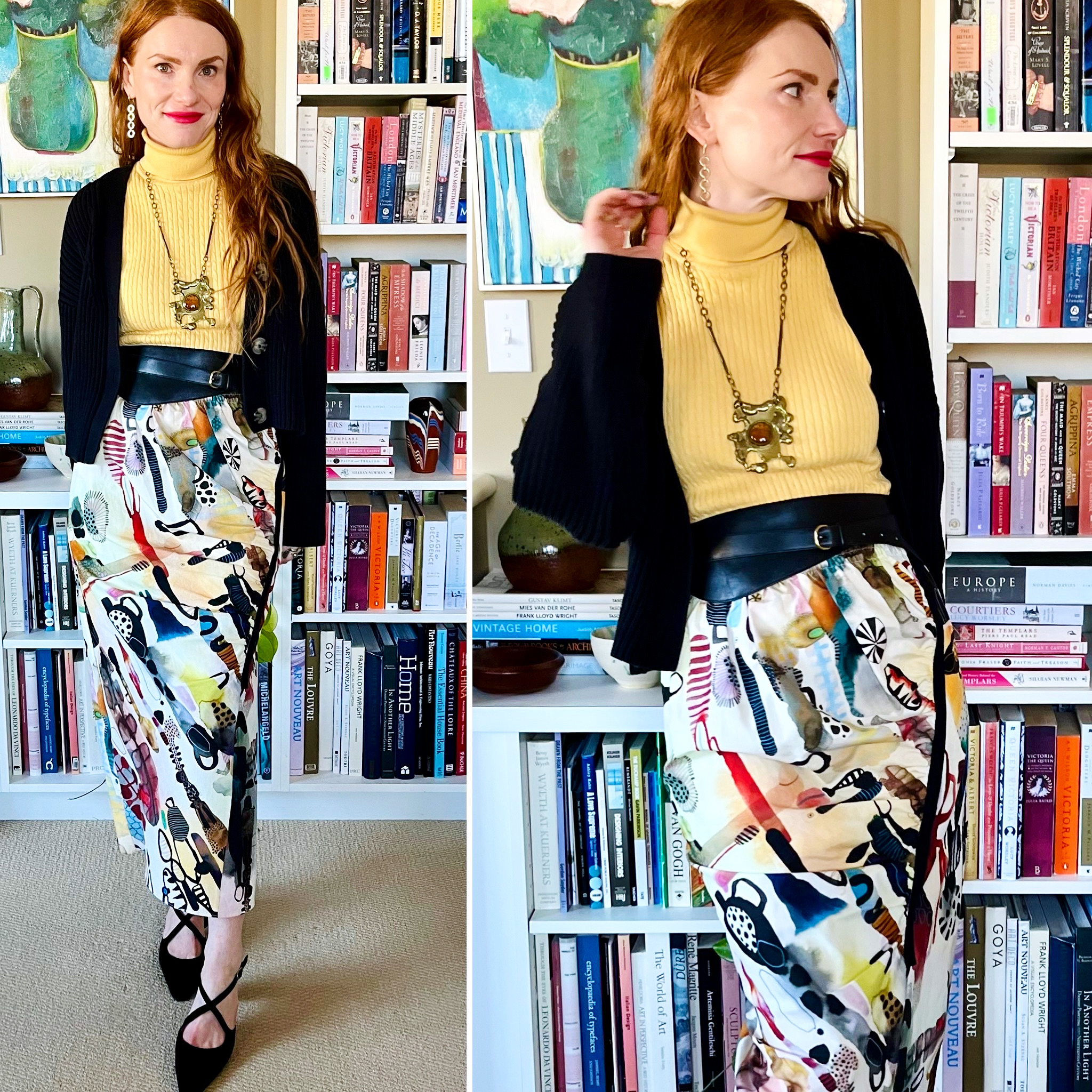
One of my favourite clothing purchases this year was an H&M cardigan. Yes, you read that correctly. It was secondhand, and I paid very nearly full retail price for it. Yes, you read that correctly too.
“But, Adina,” I can hear some of you go, “why?! And how, when your closet is full of amazing designer pieces?”
I’m going to hold your hand as I say this: not every piece in your closet needs to be amazing. It’s OK if some things are just good enough. Provided – and this is important – that they do one of two things (and preferably both): (1) they fill a functional need, and/or (2) they spark joy. That H&M cardigan? It’s good enough to do both, and I love that for me.
I am as guilty as the next gal of falling prey to the mindset that one’s closet is a work of constant progress, in which even basics need to be ‘elevated’ to their peak iteration. I’ve done a lot of ‘elevating’ in my years of clothes-buying, using thrifting to source the highest quality pieces I could reasonably get my hands on. And many of the items currently in my closet are pretty high quality indeed. Lately, though, I’ve been revisiting the whole idea and pondering how, in many ways, it boils down to a striving for perfection. To wanting to make the best and most optimal choices. This is not necessarily a bad thing (though some people have suggested that, on the whole, ‘maximizers’ tend to be less content than ‘satisficers’, but that’s another blog post). I am all about maximizing the value of my money; after all, finding the best quality stuff for the (relatively) lowest price possible is my raison d’etre as a thrifter. Just kidding. [But not really.]
On the other hand, value doesn’t only (or always) come from quality. Utility and joy also represent and give value, and they do so independently of quality. Let’s dig into that a bit further. In many cases, it’s probably fair to say that, for example, utility + quality = great value. Sometimes, though, the contribution made by quality to that equation is less significant than might appear at first. Sometimes, the bulk of an item’s value (to the individual person) derives from its utility, and the quality is just a cherry on top. And the same goes for joy + quality, too. In those cases, paying extra for quality – whether in terms of a cost premium or in time spent looking for the “perfect” item – isn’t really worth the sauce.
Let’s take the example of my H&M cardigan.
When I thrifted my first version, in black, at the beginning of the year, I didn’t think it was an especially exciting purchase. I bought it not because the quality was amazing – it’s OK, but more on that in a moment – but because it fit specific criteria that I had for the kind of cardigan that was missing from my closet at that time. It’s chunky and a little boxy but not too bulky. It’s cropped at the perfect length for me, which is important because I’m particular about proportions in my outfits; I had been struggling to find a cardigan that was the length I needed for my preferred aesthetic. It’s very plain and unfussy, which makes it a good “unobtrusive” piece to add to a variety of different outfits – aka a basic staple. And guess what? Over the course of the year, I found myself reaching for this cardigan constantly. Like, nearly every week … which, for someone with as big a closet as I have, is saying a lot.
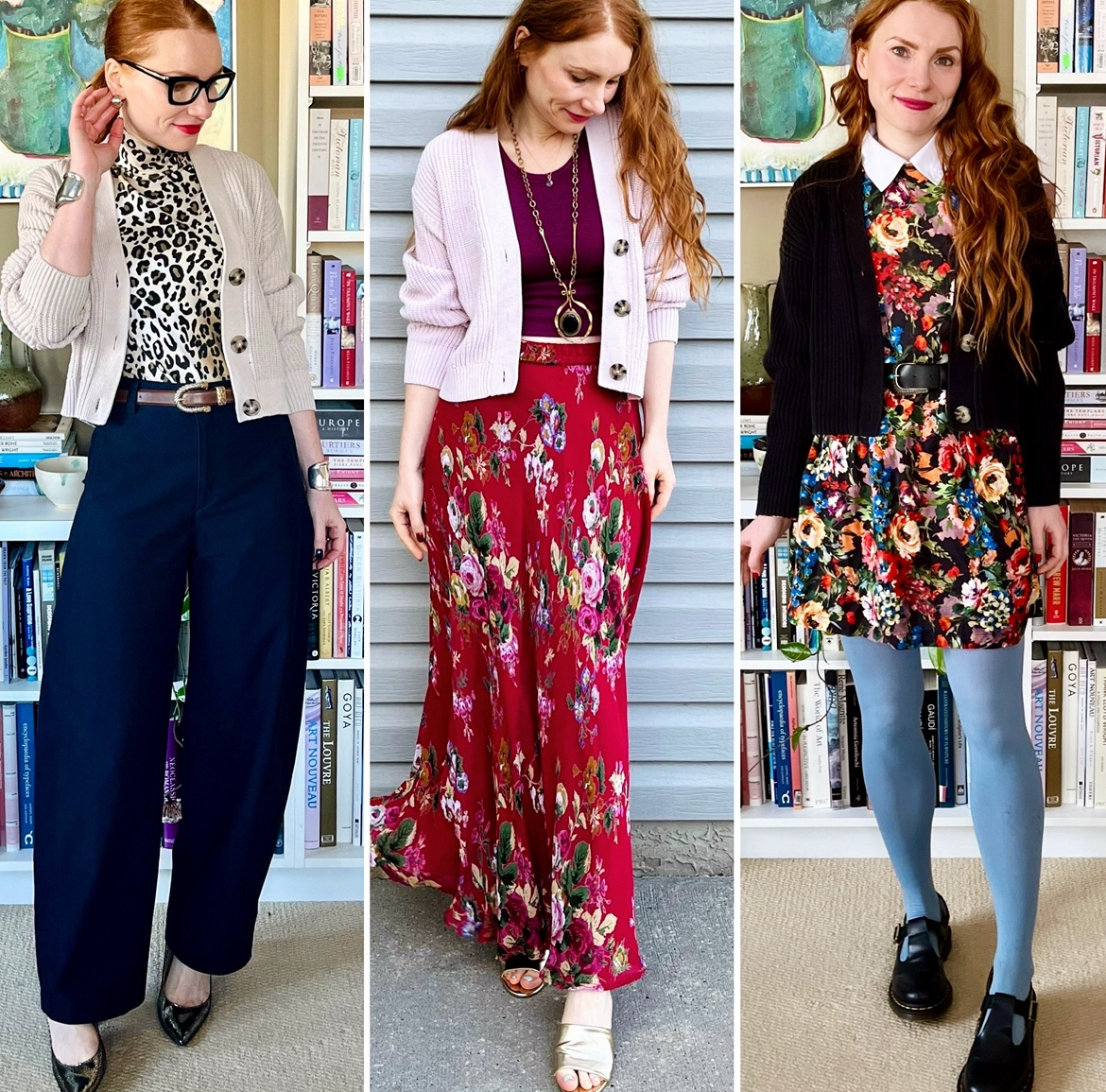
And you know what else started happening? I found myself thinking, ‘gosh, it would be so handy to have this in cream or beige.’ Because sometimes I’d want the exact same style/functionality but in a different, lighter neutral to go with a particular outfit. I ended up finding a near-identical version (also H&M) in blush pink at the thrifts, which helped fill the whole to some extent. Still, though, I continued to “miss” a cream version in my closet.
Well, you know what happened next.
And as much as it pained me to pay $30 for a secondhand H&M cardigan, I did it and I have no regrets. I’ve already worn it a handful of times and I’m sure that will continue.
So, what about the quality?
We’ve talked about this before, but quality in fast fashion (which now describes the vast majority of the fashion industry, not just Shein, Zara, and H&M) is very hit and miss. Now and then, there are pieces that are better quality than the usual norm. Not amazing, but good enough. What do I mean by that? I mean good enough to do the job they need to do, for a good enough amount of time. My H&M cardigan is a cotton blend (mixed with acrylic) but has a handfeel that I like – it feels like decent cotton, isn’t scratchy, isn’t too thin, etc. I enjoy how it feels on my body when I wear it. It can be machine washed, which is great. I don’t throw mine in the dryer, which should extend its longevity. I see no reason why this cardigan won’t last me for years and years. It’s good enough.
Now, I could have spent more time (and probably more money) trying to find a “nicer” version of this cardigan – maybe one that’s 100% cotton and a better brand. But the value I would get from the increase in material quality would be relatively minimal in this situation. Construction-wise, given the nature of the garment, I’m not sure there is a ton of room for meaningful improvement in quality there either; certainly not enough to materially improve its wearability to me.
A last word on joy: while this cardigan doesn’t exactly spark joy in and of itself, the outfits I am able to make with it do. So, indirectly, I guess it does bring me joy to have it in my closet 🙂
Perfect.